Winter/spring terms
New Student Arrival Schedule for Winter Term
PRE-ARRIVAL TO CAMPUS
New students must participate and complete several required onboarding programs and documents prior to their arrival to campus as part of the check-in process.
Information and access to orientation programs will be emailed to your Eckerd College email address. Many other orientation programs will take place during your Winter Term class. Please view the full orientation schedule here.
Important Dates
November 24 – Housing Application and Housing Agreement due for students living on campus
December 2 – Student Billing Mailed
December 8 – Immunization Form Due
mid-December – Housing assignments emailed to your Eckerd email account
December 12 – Student ID Photo Due
December 12 – Emergency & Missing Contact Info. Form Due
December 12 – Family & Legacy Form Due
December 12 – Health Insurance Waiver Form Due
December 12 – Completion of Online Courses (see Portal for specific online courses and trainings)
January 1 – Payment for Winter/Spring Semester Due
January 2 – Winter Term Check In & Orientation
January 2-4 – New Student Orientation
January 5 – First Day of Winter Term Class
January 19 – Martin Luther King, Jr. Day, no classes
January 23 – End of Winter Term
January 28 – First Day of Spring Semester
February 3 – End of drop/add period for Spring Semester
February 13-15 – Family Weekend
What to Pack
Small Items
● Reusable face covering (bandanas, gaiters, buffs, face coverings with exhalation valves or vents or similar face coverings are not permitted for use on campus)
● Small shelf unit, milk crates or shelves
● Mattress pad
● Comforter or blanket
● Twin extra long bedsheets
● Desk lamp and floor lamp
● Pillows
● Under bed storage boxes (3 or 4)
● Towels (2 to 4)
● Posters or other wall art
● Washcloths (2 to 4)
● Day Planner or calendar
● Message board to put next to your door
● Beach towels
● Plates, utensils, cups, mugs and bowls
● Toothbrush holder
● Small trash can
● Coffee or tea maker without hot plate (Keurig style)
● Hangers
● Shower caddy (for shampoo, soap, toothbrush, razor, etc.)
● Surge protector* (one per person and must be UL approved “power strip” extension cord with 14 gauge wiring and built-in circuit breaker)
● Headphones or a small speaker
● Command strips/hooks for hanging decorations
● Portable laundry basket* and laundry detergent
● Broom/small vacuum and Swiffer
As part of Eckerd’s commitment to environmentally conscious living, we also recommend the following products:
● Dryer balls
● Reusable containers and Stasher bags
● Reusable cutlery (ex. To Go-Ware)
● Reusable cups
● Composting bucket/collection container
● Recycling bin
● Bamboo toothbrush
● Shampoo bar
● Conditioner bar
● Reusable bags for grocery shopping
● Reusable K cups for coffee maker
● Loose-leaf tea + strainer
Large Items
- Television
Each room has cable available with approximately 100 channels. There are televisions in the lounges, but if it’s possible, it’s nice to have one in your room. - Computer
If you have a computer or are thinking about getting one, it’s a great idea and there is plenty of space. All of our rooms are equipped with wireless internet. You’ll find minimum requirements and other information on the Information Technology Services site. - Refrigerator*
Only Energy Star rated refrigerators of no more than five cubic feet are permitted. If you buy a small fridge (roughly between $50.00 and $90.00) and use it for your four years at Eckerd, you can donate it to our Trash 2 Treasure sale before you graduate. Renting is much more expensive, costing over $200.00 per year. - Bikes on Campus
Eckerd College has yellow “community bicycles” available for use only on campus as part of the Yellow Bike Program. They are wonderful for getting around campus. Eckerd also has six white bicycles that are available for students to take off campus. However, you will still want to consider bringing your own bike as these are all very popular. There’s plenty to do within a few miles of campus and many bike trails for the more serious rider. Florida’s flat terrain makes biking easy. If you don’t want to bring your bike from home or don’t own one, you can purchase a bicycle at one at any of the bike shops in the Tampa Bay area, including the Nu Bicycle Shop on campus. - Skateboards
Skateboards are also a popular item on campus. The roads on campus are paved and in pretty good shape. If you have a skateboard, bring it along! - Cars on Campus
First year students are allowed to keep cars on campus. All cars must be registered with campus safety during Autumn Term.
Transportation Off Campus
For those who do not have a car, or those who are not a fan of biking – you are in luck. There is a public bus stop on campus. Fares are reasonable and you can buy an all day pass or monthly unlimited passes. You can ride the bus to the beaches, downtown St. Petersburg, Tyrone Mall and Clearwater. Check out the Pinellas Suncoast Transit Authority website for more information.
Mailing Items Ahead
If you would like to ship a few boxes to campus in advance, you are permitted to mail a maximum of 5 boxes to your Eckerd mailbox number. Make sure they arrive before December 19th. Students will receive their mailbox number and mailing instructions in mid July.
Summer Storage
The only time that students generally move out of their rooms is during summer break. From time to time, first-year students are asked to move their belongings for the winter term if they don’t plan to be on campus and their room is needed for winter term visiting students. Basically, once you move in, it’s your room and your space. During the summer, there are some great storage places within 1 to 4 miles of campus. Many students will share storage space with friends. Costs can range from $30.00 to $60.00 for the summer, depending on how many people are storing together. Within the group, a few will have cars available and will help get everyone’s items to the storage area.
For those interested in maintaining a small storage space throughout the school year (for those with lots of luggage or other large items that might be inconvenient in a dorm room), you may contact one of the following local storage facilities:
Hideaway Storage
3950 34th Street South
727-565-0363
PODS $55/month, $69 delivery charge
PODS can be delivered on campus for mobile storage.
Spare Room Mini-Storage
4311 34th Street South
727-866-9357
No PODS, $47.08/month storage unit
Stormax Self Storage
4250 34th Street
727-866-7373
No PODS, $39-84/month storage unit
College Renters Insurance
Eckerd College has partnered with GradGuard to provide students with their own personal property insurance while living in their home away from home. GradGuard provides students with insurance designed for them.
As noted in your housing agreement, Eckerd College assumes no responsibility and provides no insurance or financial protection for your personal property. You are required to provide proof of renters insurance coverage, whether through GradGuard or your own.
Microfridges, Lofting and Insurance
Microfridge and Bed Lofting Rentals
We have partnered with Collegiate Concepts to provide students with a bed lofting and microfridge rental option.
- Renting a bed loft is an easy, affordable way to create additional living space in your room.
- Microfridge units are energy star rated and consist of a microwave oven, refrigerator, and a zero degree true freezer, all in one integrated unit.
As part of the program, your rented Bed Loft and/or Microfridge will be delivered to your room before your arrival to campus and picked up at the end of the academic year. You must have a confirmed residence hall and room assignment before orders can be placed.
Renters Insurance
Eckerd College has partnered with National Student Services, Inc. (NSSI) to provide students with their own personal property insurance while living in their home away from home. NSSI provides students with insurance designed for them.
You can receive a free quote online or call (800) 256-6774 to speak with a customer service representative.
Renters insurance is typically less than the cost of a homeowner’s deductible and typically offers better coverage at affordable rates. This property insurance covers many personal items such as laptops, cell phones, tablets, clothes, TVs and much more.
Mail Services
There are a few housekeeping items you need to be aware of that will ensure that your friends and loved ones will be able to effectively correspond with you while attending Eckerd. Before moving in, you will receive an introductory email from Mail Services which contains your Campus Box number. It is essential that this number be used on all mail and packages sent to you.
Many students elect to ship objects, such as books or other items, to the college in advance of their arrival. While this practice is permitted, please understand that Mail Services has limited storage space. Because of this, please schedule your deliveries as close to your arrival as possible. DO NOT ship anything to the campus before you have your Campus Box number. If you plan to purchase items online and have them shipped directly to the college, you MUST be sure to provide the campus box number as part of the ship-to address (use the address format below). The information that Mail Services uses to identify student names is based off the name the student provided during registration. Mail Services sorts all packages based on the student first and last name, not by box number, failure to include the actual student name, not a pet-name or alias, may result in the item being misplaced or lost. Finally, because of space limitations, we ask that you limit the number of advance shipments to no more than 5.
Please use the following address format for all items:
Student Name
Campus Box xxxx
Eckerd College
4200 54th Avenue South
St. Petersburg, FL 33711-4744
Every business day, Mail Services receives large volumes of mail and packages. Therefore, failure to indicate the actual name of the recipient will delay the item. Also, it is not unusual for some students to share the same name. In this circumstance, absence of the Campus Box number results in confusion and delay.
The Student Name and Campus Box number should always be located above Eckerd College in the address field. Use the specific words “Campus Box” followed by the number. DO NOT refer to the Student Box as “PO Box”, “Box No” or “Box” since the processing equipment used by the US Postal Service specifically looks for these. If that system reads one of these indicators, it may misdirect the piece of mail causing delay and, in some instances, loss of the item. Also, many shipping carriers and online vendors may not ship to PO Boxes because they require a signature as proof of delivery.
Once you get to campus, follow these easy steps to open your mailbox.
Travel & Transport
What is the closest airport?
There are two airports within 20-25 minutes of campus that serve the Tampa Bay area. TPA handles a large volume of flights and handles most airline carriers. PIE is a smaller terminal that serves fewer airline carriers.
Tampa International Airport (TPA)
St. Petersburg/Clearwater International Airport (PIE)
How should we get from the airport to Eckerd?
- Renting a Car
Both airports also offer rental car services. Tampa International has sixteen rental car companies located on the property: Avis, Budget, Payless, Zipcar; Enterprise, Alamo, National; Hertz, Dollar, Thrifty; Ace; Advantage; E-Z; Executive; Fox; Sixt. St. Petersburg/Clearwater airport offers service from the following rental car companies: Alamo, Avis, Budget, Enterprise, Hertz and National. - Driving Directions
Right off of Interstate 275, Eckerd’s campus is easy to find! For specific driving directions, utilize Google Maps here. - Uber/Lyft
Uber and Lyft are downloadable apps for users on Android, Apple iOS, and Windows Phones. Uber and Lyft connect riders with drivers using their phone’s GPS capabilities and provides users with a reliable, safe form of transportation. Use their website to get a fare estimate to see what it might cost you.
When should we arrive and depart and where should we stay?
Although you will not be able to move into your residence hall until check in, many families choose to arrive early and stay in the area. They enjoy the extra time to rest and recharge before check-in as well as to pick up any last-minute items not purchased at home.
There are quite a few hotel options in the local area. A list of recommended hotels can be found on our Parents page. If you’re considering a hotel that is not listed, please feel free to contact the Admissions Office at 727-864-8331 if you would like information regarding the hotel’s location, surrounding area and proximity to the College.
If you plan to be in the area longer than a couple of nights, we would recommend that you consider renting a condominium or house as the cost may be equal to or less than many nights in a hotel and it would provide a full kitchen and more space. Feel free to use Airbnb or Vrbo for rentals.
NOTE:
You may not move into the residence halls until your assigned check-in date and time. If you will be driving to St. Petersburg and anticipate that you will have items to store for a few days, please contact Spare Room Mini Storage, Inc. Their phone number is 727.866.9357.
Autumn/fall terms
Summer Reading

Deborah Taffa’s, Whiskey Tender, is a memoir of family and survival, coming-of-age on and off the reservation, and the frictions between mainstream American culture and Native inheritance, assimilation and reverence for tradition.
- Finalist for the National Book Award
- Longlisted for a Carnegie Medal for Excellence
- Winner of the Southwest Book Award
- A Best Book of the Year: Washington Post, Esquire, Time, The Atlantic, NPR, and Publishers Weekly
- A New York Times “New Book to Read”
New Student Arrival Schedule for Autumn Term
Tentative Schedule. Events are subject to change.
Friday, August 14
8 – 11 a.m.
Check-In and Move-In for New Students | Cobb Loop
You will receive a specific check-in time with your housing assignments.
8 a.m. – 8 p.m.
Bookstore Open
Mandatory to buy books for tomorrow’s class and for Human Experience: Then & Now.
8:30 a.m. -5 p.m.
ITS Help Desk | ITS Front Desk – Armacost Library Accessible Ramp Entrance
Technicians from Apogee (MyResnet Support) and the Information Technology Services (ITS) Department will be available to help you with network connectivity.
11:15 a.m. – 4 p.m.
Trash 2 Treasure- Sponsored by the Office of Sustainability | Cobb Gallery
Buy lightly used dorm essentials: mini-fridges, microwaves, bed risers, brooms, lamps, rugs, printers, and more. There also will be used bicycles for sale.
11 a.m. – 2 p.m.
Lunch on your own | Main Café
Students on a meal plan will be able to access their meal plan. Credit cards are also accepted.
1 – 2 p.m.
Meeting for all International Students and their Families | Admission Office, Franklin Templeton
The staff in the Office of International Student Services will review visa regulations for internships, social security number issuance, and driver’s license applications. They will answer questions related to topics specific to international students and families including health insurance and travel requirements.
2 – 3:30 p.m.
Unity Center Open House | Lindsey 103
All students and their families are invited to drop-in and meet students and staff members representing affinity groups such as the First-Gen Club, ECQSA (Queer Straight Alliance), Afro American Society, Latinos Unidos, Leadership Scholars, and Peer Mentors. Come make connections and discuss getting engaged!
4 – 5 p.m.
Mentor Meetings for all Students and their Families
(See handout in your registration packet for your meeting location.)
5 p.m.
Seating McArthur Gymnasium
Students will receive their class medallion and be seated for the Ceremony of Lights.
5:30 p.m.
Ceremony of Lights | McArthur Gymnasium
This ceremony symbolizes our new students becoming part of the Eckerd College academic community.
6:30 p.m.
Welcome Picnic | Fox Hall & Hough Quad
Bon Appétit will be setting up a lovely summer picnic and giving students, their families, faculty, and staff an opportunity to eat, mingle, and talk about the Eckerd experience.
9 p.m.
House Meetings for Students | Residence Halls
Mandatory for students living on campus; commuters exempt.
Meet your Resident Advisor (RA) and start discussing how to live together comfortably and considerately in college housing.
Saturday, August 15
7:15 – 8:45 a.m.
Breakfast for Students | Main Café
8 a.m. – 2 p.m.
Bookstore Open
Mandatory-Buy your Human Experience: Then and Now textbooks and Autumn Term materials, if you haven’t done so already.
8:15 – 9:30 a.m.
Welcome Breakfast for Families Hosted by the President | Fox Hall
During this continental breakfast, parents will have an opportunity to meet President Annarelli, the College’s Executive Staff, and Student Life Department Heads. Students should not attend this breakfast in Fox Hall. Breakfast for students is available in the Main Café.
9 a.m. – 12 p.m.
Class
Only students should attend this class.
This meeting of your Autumn Term course is absolutely, totally, and completely MANDATORY, like all Autumn Term classes! After all, who would want to miss their very first college course?
Academic Success with Peer Mentors |Autumn Term Classroom
During the last hour of class, Peer Mentors will lead a presentation that prepares incoming students for academic success. This session will focus on basic academic skills including proper email etiquette, using Moodle, and how to act as a college student.
9:30 a.m. – 12:30 p.m.
The following campus offices are open and available to answer questions:
Brown Hall
The Dean of Students Office
Housing & Residence Life
Campus Activities
Campus Safety
Center of Academic Excellence
Student Outreach & Support
Office of Accessibility
Edmundson Hall
Counseling Services
Mail Services
Franklin Templeton
Financial Aid
Bursar
Lindsey Hall
Career Center
Seibert
Global Education
Waterfront Complex
Waterfront
10 – 11:45 a.m.
Long Distance Parenting and Successful Power Shifting for Families | Fox Hall
Please join the Eckerd College Counseling Services staff for this interactive program focusing on the natural changes in parenting and the inevitable shift in power that takes place when a student leaves home. Students should not attend this event.
11 a.m. – 1 p.m.
Trash 2 Treasure- Sponsored by the Office of Sustainability | Cobb Gallery
Buy lightly used dorm essentials: mini-fridges, microwaves, bed risers, brooms, lamps, rugs, printers, and more. There also will be used bicycles for sale.
11 a.m – 5 p.m.
The following campus offices are open and available to answer questions:
Armacost Library
Library Services
Information Technology Services
12 – 4 p.m.
Computer and Connectivity Help | ITS Front Desk – Armacost Library Accessible Ramp Entrance
Technicians from Apogee (MyResnet Support) and the Information Technology Services (ITS) Department will be available to help you with network connectivity. Call (727) 864-8318 for more information.
12:30 – 2:30 p.m.
Unity Center Open Office Hours | Lindsey 103
The Unity Center will be open to meet families & students, as well as answer any questions.
1 – 2 p.m.
Meet and Greet with Athletics | Wrenn Hall (James Center)
New student-athletes and their families are invited to join the Athletics department for a meet and greet hosted by Director of Athletics Tom Ryan and his staff. The meeting will go over expectations of Eckerd student-athletes and the resources available to them. Light refreshments will be provided.
1:15 – 4 p.m.
Waterfront Open House | Waterfront
Check out all of the exciting things the Waterfront has to offer! Go on a boat ride, check out a kayak or paddleboard, or just hang out and enjoy Eckerd’s awesome location on Boca Ciega Bay.
9 p.m. – 12 a.m.
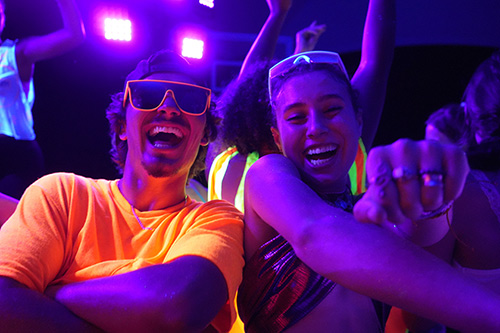
Glow Dance Party | GO Pavilion
EC’s annual Glow in the Dark Dance Party! Be ready to dance the night away and enjoy glow-in-the-dark paint, food, giveaways, and a great time. Hosted by Palmetto Productions.
Glow Paint Night | Fox Hall
Looking for something a little more chill? Join us in Fox Hall for a night of glow painting and music! We will provide canvases, painting supplies, and good vibes! Bring your own headphones (BYOH) for a mini silent disco with your friends.
Sunday, August 16
9 a.m. – 2 p.m.
Continental Breakfast for Students | Main Café
9 – 11 a.m.
Study Time
Remember – You should devote at least 4 hours per day to preparing for your Autumn Term class.
11 a.m. – 1:15 p.m.
EC Wellness | Miller Auditorium
College is an amazing and often life-changing experience; however, we recognize that this period of transition is not without its academic and personal stressors. Join your Wellness Services staff to learn about the support available for all students through the offices of Student Outreach and Support (SOS), Counseling Services, Health Services, and Advocacy and Prevention. Each of us has a role to play in creating a safe, respectful, and nonviolent community. During this interactive program you will learn about how you can best care for yourself, someone in need, and what to do if you or a friend needs help on campus and how to intervene to help you successfully navigate Autumn Term, Fall Semester, and beyond! You will also learn about the New Triton Wellness Challenge, designed specifically for first-year students to develop sustainable wellness habits!
Content warning: Topics of mental health, self-harm behavior, suicidal ideation, and sexual assault may be discussed broadly.
11:45 a.m. – 1:30 p.m.
Center for Spiritual Life Ice Cream Social | Miller Auditorium
Enjoy ice cream (including vegan options), meet new students, and learn about Buddhist Meditation, Catholic Campus Ministry, Christian Campus Ministry, Eckerd Hillel, Arabic Club, and the variety of spiritual life programs at Eckerd.
1:30 – 3:30 p.m.
Kappa Field Day with ECOS and the Autumn Term Activators! | Kappa Field
Meet and make new friends during the year’s first Kappa Field Day with ECOS and the Autumn Term Activators. Enjoy inflatable water slides, games, and music. Also, learn about ways to get involved with Campus Activities and the Autumn Term Activators.
6:30 – 7:30 p.m.
Catholic Campus Ministries Mass | Roberts 104
6:00 – 7:00 p.m.
EC Hillel & Student Club: Scubi Jew Pizza Party | Triton Room
Join EC Hillel and Scubi Jew for a pizza party. Meet other Jewish students and learn about the opportunities that Hillel provides at Eckerd College—from free trips to Israel on Birthright to Scubi Jew (the only Hillel Scuba Club in the country).
9 – 11 p.m.
Study Time
You should devote at least 4 hours per day to preparing for your Autumn Term class.
Important Dates
As you prepare for your transition to college life at Eckerd, check out the timeline below to make sure that you are on track throughout the summer.
Be sure to add these important dates to your calendar, phone, right hand, or whatever you use to stay on schedule so that you don’t miss a deadline or due date.
June 1 – Housing Application and Housing Agreement Due
June 10 – Autumn Term Class Online Registration Opens
June 19 – Autumn Term Class Registration Closes
June 26 – Immunization Form Due
Mid-Late June – Housing assignments emailed to your Eckerd email account
Late June/Early July – Student Billing Emailed
July 15 – Official Final Transcript Due
August 3 – Emergency & Missing Contact Info. Form Due
August 3 – Family & Legacy Form Due
August 3 – Payment for 1st Semester Due
August 7 – Health Insurance Waiver Form Due
August 14 – Autumn Term check-in. You will receive a specific check-in date and time with your housing assignment.
August 15 – Autumn Term First Day of Class.
August 26 – First-year registration for fall semester begins.
September 3 – Autumn Term ends.
September 3 – Check-in and orientation for new transfer students who did not participate in Autumn Term. Orientation runs Thursday, August 28, through Saturday August 30.
September 4 – Autumn Term make up day, if needed.
September 7 – Fall semester begins.
October 19-20 – Fall Reading Days (if not needed to make up class days).
November 16 – Winter/Spring 2027 registration begins at 7 a.m.
November 25-27 – Thanksgiving holiday. No classes.
December 11 – Last day of classes.
December 14-17 – Examination period. Students must vacate residents halls within 24 hours after their last exam or by noon December 18 (whichever is first)
What to Pack
* Starred items may be found at Trash To Treasure, an annual sale of second-hand items that past students have donated for new students to purchase at discounted prices. Trash 2 Treasure is hosted by the Office of Sustainability and will be running on move-in day during Autumn Term. Items are subject to availability.
Small Items
● Small shelf unit*, milk crates or shelves*
● Mattress pad
● Comforter or blanket
● Twin extra long bedsheets
● Desk lamp and floor lamp*
● Pillows
● Under bed storage boxes (3 or 4)*
● Towels (2 to 4)
● Posters or other wall art*
● Washcloths (2 to 4)
● Day Planner or calendar
● Message board for your door*
● Beach towels
● Plates, utensils, cups, mugs and bowls
● Toothbrush holder
● Small trash can*
● Coffee or tea maker without hot plate (Keurig style)*
● Hangers*
● Shower caddy (for shampoo, soap, toothbrush, razor, etc.)
● Surge protector*
● Headphones or a small speaker
● Command strips/hooks for hanging decorations
● Portable laundry basket* and laundry detergent
● Broom/small vacuum and Swiffer*
● Cleaning Supplies (students living in Sigma/West Lodge have their own bathroom, which they get to clean)
As part of Eckerd’s commitment to environmentally conscious living, we also recommend the following products:
● Dryer balls
● Reusable containers and Stasher bags
● Reusable cutlery (ex. To Go-Ware)
● Reusable cups
● Composting bucket/collection container
● Recycling bin
● Bamboo toothbrush
● Shampoo bar
● Conditioner bar
● Reusable bags for grocery shopping
● Reusable K cups for coffee maker
● Loose-leaf tea + strainer
Large Items
- Television
There are televisions in the lounges, but if it’s possible, it’s nice to have one in your room. - Computer
If you have a computer or are thinking about getting one, it’s a great idea and there is plenty of space. All of our rooms are equipped with wireless internet. You’ll find minimum requirements and other information on the Information Technology Services site. - Refrigerator*
If you buy a small fridge (roughly between $50.00 and $90.00) and use it for your four years at Eckerd, you can donate it to our Trash 2 Treasure sale before you graduate. Renting is much more expensive, costing over $200.00 per year. - Bikes on Campus
Eckerd College has yellow “community bicycles” available for use only on campus as part of the Yellow Bike Program. They are wonderful for getting around campus. Eckerd also has six white bicycles that are available for students to take off campus. However, you will still want to consider bringing your own bike as these are all very popular. There’s plenty to do within a few miles of campus and many bike trails for the more serious rider. Florida’s flat terrain makes biking easy. If you don’t want to bring your bike from home or don’t own one, you can purchase a bicycle at one at any of the bike shops in the Tampa Bay area, including the Nu Bicycle Shop on campus. - Skateboards
Skateboards are also a popular item on campus. The roads on campus are paved and in pretty good shape. If you have a skateboard, bring it along! - Cars on Campus
First year students are allowed to keep cars on campus. All cars must be registered with campus safety during Autumn Term. The parking permit is $130 for the year.
Transportation Off Campus
For those who do not have a car, or those who are not a fan of biking – you are in luck. There is a public bus stop on campus. Fares are reasonable and you can buy an all day pass or monthly unlimited passes. You can ride the bus to the beaches, downtown St. Petersburg, Tyrone Mall and Clearwater. Check out the Pinellas Suncoast Transit Authority website for more information.
Mailing Items Ahead
If you would like to ship a few boxes to campus in advance, you are permitted to mail a maximum of 5 boxes to your Eckerd mailbox number. Make sure they arrive after July 31st. Students will receive their mailbox number and mailing instructions in mid July.
Summer Storage
The only time that students generally move out of their rooms is during summer break. From time to time, first-year students are asked to move their belongings for the winter term if they don’t plan to be on campus and their room is needed for winter term visiting students. Basically, once you move in, it’s your room and your space. During the summer, there are some great storage places within 1 to 4 miles of campus. Many students will share storage space with friends. Costs can range from $30.00 to $60.00 for the summer, depending on how many people are storing together. Within the group, a few will have cars available and will help get everyone’s items to the storage area.
For those interested in maintaining a small storage space throughout the school year (for those with lots of luggage or other large items that might be inconvenient in a dorm room), you may contact one of the following local storage facilities:
iStorage
3950 34th Street South
727-308-5565
Spare Room Mini-Storage
4311 34th Street South
727-866-9357
Stormax Self Storage
4250 34th Street
727-866-7373
College Renters Insurance
Eckerd College has partnered with GradGuard to provide students with their own personal property insurance while living in their home away from home. GradGuard provides students with insurance designed for them.
As noted in your housing agreement, Eckerd College assumes no responsibility and provides no insurance or financial protection for your personal property. You are required to provide proof of renters insurance coverage, whether through GradGuard or your own.
Microfridge and Lofting Rentals
Microfridge and Bed Lofting Rentals
We have partnered with Collegiate Concepts to provide students with a bed lofting and microfridge rental option.
- Renting a bed loft is an easy, affordable way to create additional living space in your room.
- Microfridge units are energy star rated and consist of a microwave oven, refrigerator, and a zero degree true freezer, all in one integrated unit.
As part of the program, your rented Bed Loft and/or Microfridge will be delivered to your room before your arrival to campus and picked up at the end of the academic year. You must have a confirmed residence hall and room assignment before orders can be placed.
Mail Services
There are a few housekeeping items you need to be aware of that will ensure that your friends and loved ones will be able to effectively correspond with you while attending Eckerd. In early July, you will receive an introductory email from Mail Services which contains your Campus Box number. It is essential that this number be used on all mail and packages sent to you.
Many students elect to ship objects, such as books or other items, to the college in advance of their arrival. While this practice is permitted, please understand that Mail Services has limited storage space. Because of this, please schedule your deliveries as close to your arrival as possible. DO NOT ship anything to the campus before you have your Campus Box number. If you plan to purchase items online and have them shipped directly to the college, you MUST be sure to provide the campus box number as part of the ship-to address (use the address format below). The information that Mail Services uses to identify student names is based off the name the student provided during registration. Mail Services sorts all packages based on the student first and last name, not by box number, failure to include the actual student name, not a pet-name or alias, may result in the item being misplaced or lost. Finally, because of space limitations, we ask that you limit the number of advance shipments to no more than 5.
Please use the following address format for all items:
Student Name
Campus Box xxxx
Eckerd College
4200 54th Avenue South
St. Petersburg, FL 33711-4744
Every business day, Mail Services receives large volumes of mail and packages. Therefore, failure to indicate the actual name of the recipient will delay the item. Also, it is not unusual for some students to share the same name. In this circumstance, absence of the Campus Box number results in confusion and delay.
The Student Name and Campus Box number should always be located above Eckerd College in the address field. Use the specific words “Campus Box” followed by the number. DO NOT refer to the Student Box as “PO Box”, “Box No” or “Box” since the processing equipment used by the US Postal Service specifically looks for these. If that system reads one of these indicators, it may misdirect the piece of mail causing delay and, in some instances, loss of the item. Also, many shipping carriers and online vendors may not ship to PO Boxes because they require a signature as proof of delivery.
Once you get to campus, follow these easy steps to open your mailbox.
Travel & Transport
What is the closest airport?
There are two airports within 20-25 minutes of campus that serve the Tampa Bay area. TPA handles a large volume of flights and handles most airline carriers. PIE is a smaller terminal that serves fewer airline carriers.
Tampa International Airport (TPA)
St. Petersburg/Clearwater International Airport (PIE)
Sarasota Bradenton International Airport (SRQ)
How should we get from the airport to Eckerd?
- Renting a Car
Both airports also offer rental car services. Tampa International has sixteen rental car companies located on the property: Avis, Budget, Payless, Zipcar; Enterprise, Alamo, National; Hertz, Dollar, Thrifty; Ace; Advantage; E-Z; Executive; Fox; Sixt. St. Petersburg/Clearwater airport offers service from the following rental car companies: Alamo, Avis, Budget, Enterprise, Hertz and National. - Driving Directions
Right off of Interstate 275, Eckerd’s campus is easy to find! For specific driving directions, utilize Google Maps here. - Uber/Lyft
Uber and Lyft are downloadable apps for users on Android, Apple iOS, and Windows Phones. Uber and Lyft connect riders with drivers using their phone’s GPS capabilities and provides users with a reliable, safe form of transportation. Use their website to get a fare estimate to see what it might cost you.
When should we arrive and depart and where should we stay?
Although you will not be able to move into your residence hall until check in, many families choose to arrive early and stay in the area. They enjoy the extra time to rest and recharge before check-in as well as to pick up any last-minute items not purchased at home.
There are quite a few hotel options in the local area. A list of recommended hotels can be found here. If you’re considering a hotel that is not listed, please feel free to contact the Admissions Office at 727-864-8331 if you would like information regarding the hotel’s location, surrounding area and proximity to the College.
If you plan to be in the area longer than a couple of nights, we would recommend that you consider renting a condominium or house as the cost may be equal to or less than many nights in a hotel and it would provide a full kitchen and more space. Feel free to use Airbnb or Vrbo for rentals.
NOTE:
You may not move into the residence halls until your assigned check-in date and time. If you will be driving to St. Petersburg and anticipate that you will have items to store for a few days, please contact Spare Room Mini Storage, Inc. Their phone number is 727.866.9357.
Mentoring
You’ll have mentorship from day one on campus!
As your first-year faculty mentor, your Autumn Term professor will help you navigate thoughts related to a potential major and register for classes.
Each Autumn and Winter Term class also has a peer mentor—a friendly face to support each new student!
New Student Course
All new students take one course for credit Autumn Term and Winter Term to prepare them for the semester ahead.
Winter Term course
Individual Winter Term Course assignments will be sent by email around mid-December.
Autumn Term courses
AT 1: Sculpting with Clay - Identity and Social Issues
Tony Baker
This course introduces students to college through creative exploration of identity and contemporary social issues using ceramic sculpture. Students will examine how artists use form to communicate ideas about personal experience, culture, and the world around them. Through discussion, short readings, writing, and hands-on sculptural work, students will identify a social issue that connects to their own identity or lived experience and develop a ceramic sculpture expressing that relationship. Students will also present their work and ideas to the class, building confidence in communication and critical thinking. No prior art experience is required. This course emphasizes experimentation, personal expression, and the development of academic and creative skills while helping students build confidence and community in their transition to college.
Tony Baker is a ceramic artist and Assistant Professor of Ceramics at Eckerd College in St. Petersburg, Florida. He received his MFA from Alfred University. Growing up in a poor urban neighborhood in Sacramento, California, Baker’s work is shaped by the ways environment, culture, and socio-economic conditions influence identity and lived experience. His practice focuses on large-scale ceramic sculpture and installation, exploring themes of class, survival, and resilience. Drawing from personal experience, his work reflects on the psychological and physical realities of navigating underprivileged environments, often blending realism and abstraction to create immersive, emotionally charged forms. In his teaching, Baker emphasizes material exploration, conceptual thinking, and the use of art as a way to understand both personal experience and broader social issues.

AT 2: Imagining Italy through Film
Kristy Cardellio
The Italian peninsula, historically made up of myriad civilizations with diverse cultures and languages, became unified as a nation in 1861. In this course we will view and critically analyze Italian films that address the question of national identity, particularly after the fall of Fascism. The films included in the course are by distinguished Italian directors who express their ideas of what it means to be Italian through their films. We will explore and reflect on their vision for the future of Italy. As a final project, students will have the opportunity to make their own short films.
Kristy Cardellio, Instructor of Italian, earned her Ph.D. in Applied Linguistics from the University of South Florida and her M.A. in Italian at New York University. Areas of interest and research include Italian film, applied linguistics and study abroad. In addition to teaching Italian, she works with the Office of Global Education and enjoys leading language immersion programs to Italy.

AT 4: Illusion and the World We See
Louise Daoust
Imagine you are looking at a bowl of strawberries. You have a visual experience of seeing red objects at a distance. But how does that experience relate to what is in fact in front of you? This course explores recent and interdisciplinary efforts to answer one of the oldest philosophical questions: What do we see? Are our ordinary visual experiences anything like what’s “really there”? Should we understand our perceptual experiences as illusory, or at least as heavily constructed? In attempting to answer these questions, we’ll also ask: What can we learn from thinking about non-human animal visual systems? And what about the kinds of visual experiences made possible by new technologies? For example, are the experiences we have in virtual reality best thought of as accurate experiences of a real, if virtual, world? Or does a world have to be physical for it to be real? What is synesthesia (e.g. when letters or numbers are perceived as inherently colored), and how does it relate to what we count as ordinary visual awareness? In striving to understand our perceptual relation with the world around us, we’ll work together to prepare you for a successful four years at Eckerd.
Louise Daoust earned her PhD in Philosophy at the University of Pennsylvania in 2017. She studies issues in philosophy of psychology and biology, with a focus on visual perception. She also has research interests in the history of philosophy and science, especially in women writers from the early modern period. She teaches a broad range of courses, including Introduction to Philosophy, Environmental Ethics, and Animals and Experience. And she always loves teaching in Autumn Term and Human Experience.

AT 6: Life: Score
Kelly Debure
Ever wonder why your Instagram feed feels like it was made just for you? Or why two people can search the same thing and get completely different results? Algorithms are quietly running the show — and their influence goes far beyond your phone screen. In this course, we’ll pull back the curtain on the hidden systems shaping what you see, what you believe, and even what opportunities come your way. From Netflix recommendations to courtroom sentencing, from medical diagnoses to college admissions, algorithms are making decisions that affect real lives — including yours. Drawing on real-world case studies, we’ll ask the big questions: Who builds these systems? Who benefits? And who gets left behind? No coding required — just curiosity and a willingness to think differently about the technology that scores, sorts, and shapes your world.
Before academia, Professor Kelly Debure worked at NASA Langley Research Center, where she consulted on image processing for NASA researchers and helped design cockpit displays and flight management software for real-time flight systems. She holds a Ph.D. in Computer Science from the University of South Carolina, with a focus on image processing and compression, and her research interests include computer vision and mobile app development. One of her coolest projects? She directs the DARWIN Research Group at Eckerd College, which uses image recognition technology to identify individual dolphins by their dorsal fins. When she’s not teaching or tracking dolphins, you’ll find her traveling, cooking, or gardening.

AT 7: Under our Eyes: Exploring the Natural World
David Durieux
This course will introduce students to the plants and animals found around Pinellas County, with a focus on species that people often overlook. Students will practice observing nature closely and reflect on how our senses shape what we notice. The course will look at marine and terrestrial invertebrates, fish, and plants, how humans affect the natural world. Learning will be split between in-class discussions and outdoor work, including daily hands-on activities on campus, a boat trip to Shell Key to catch sandbar fish, a visit to Boyd Hill Nature Preserve, and two nighttime sessions to see nocturnal wildlife. Students also contribute observations to iNaturalist. Work is graded through short written reflections, class discussions, and a practical exam identifying organisms. Readings come from scientific articles provided in class.
Dr. David Durieux is a Visiting Assistant Professor of Marine Science. They graduated from Eckerd College in 2011 with a B.S. in Marine Science (Marine Biology concentration) and minors in Chemistry and Religious Studies. After several years caring for animals in public aquariums, they returned to Florida for a Ph.D. in Integrative Biology from the University of South Florida, which they completed in 2021. Professor Durieux studies marine ecology and is currently working on a long-term project using the sounds that fish make as a way to learn how healthy the environment is. They are also an avid martial artist, and have trained in several styles, especially Aikido, over the last 25 years. They enjoy gardening, fishing, and camping.

AT 8: Animated Stories & the Psychology of You
Katherine Dyer
What helps someone stay motivated, pursue their goals, and grow through challenges, whether in real life or in fictional stories? In this course, we will explore the psychological science of resilience and human flourishing through the familiar and powerful storytelling of classic animated films, such as Hercules and The Princess and the Frog. Drawing on concepts from the field of psychology, we will examine how animated characters face obstacles, talk to themselves in moments of doubt, and stay motivated as they pursue meaningful goals. Through these iconic songs and stories, you’ll reflect on how your own values, motivations, and behaviors can support your long-term resilience and success, in college and beyond. This course will blend psychological science, personal reflection, and pop culture to highlight how the psychological lessons embedded in these animated journeys can help you pursue your dreams with resilience and purpose.
Katherine Dyer is an Assistant Professor of Psychology and Coordinator of the Behavioral Neuroscience minor. She earned her Ph.D. in Psychology with a concentration in Behavioral Neuroscience from Kent State University, and both her master’s and bachelor’s degrees in Psychology from the University of North Carolina Wilmington. Her research at Eckerd focuses on how the human brain supports learning and memory. Her current projects explore a range of topics, including psychoactive substance use, neurodivergence, and electroencephalography (EEG). Outside of the classroom and lab, she enjoys spending time at the beach (tanning, swimming, and collecting shells), relaxing at home with her two miniature schnauzers (Winnie and Wallie), and going to Disney on the weekends.

AT 9: What Makes Florida Weird?
Anna Guengerich
Question: what do real-life mermaids, immigrants, grapefruits, air conditioning, and the Underground Railroad have in common? Answer: they’re all important parts of Florida’s past and present! In this course, we will explore what makes Florida so different from the rest of America, and how things got to be this way. From the geological forces that laid down its limestone foundations millions of years ago, to the tourist boom made possible by the invention of air conditioning, we will consider how people and nature have intertwined throughout history to make this state unlike any other. Along the way, we will explore Florida’s close connections to Cuba and long history of racial diversity, the rise of industries like citrus and salted fish made possible by our subtropical climate, and the retired “snowbirds” who flood the state every winter. Along the way, we will also take several field trips to explore these topics on the ground. By the end of this class, you can expect to gain
an understanding of why this state has come to boast a reputation as one of the most unusual places in America.
Anna Guengerich is a professor in Anthropology and Latin American Studies. She has previously lived in Nashville, Tennessee, her hometown, and Chicago, Illinois, where she got her Ph.D. at the University of Chicago. Since moving to Florida in 2020 to start teaching at Eckerd, she has spent many weekends on road trips getting to know her new home state. She spends at least part of every summer in Peru, where she has been conducting archaeological fieldwork on human-environmental interactions for fifteen years. In her free time, she loves to spend time in her garden, her kitchen (cooking and pickling things from the garden), and paddleboarding with her dog, Kish Kish (who is from Peru). On campus, you can find her serving as a faculty advisor to the Indigenous Cultures Club and teaching classes such as Archaeology of the Environment, Andean Civilizations, and Archaeology of Food.

AT 10: Freud and the Modern Imagination
Barnet Hartston
Sigmund Freud was one of the most influential and most controversial figures of the twentieth century. In the eighty plus years since his death, many of his theories have been challenged and rejected by psychologists and neuroscientists. His complex model of the mind, however, has had a profound impact on American and European literary and artistic forms as well as on popular culture as a whole. Concepts such as id, ego, repression, fixations, the Oedipal Complex, defense mechanisms, and “Freudian slips” are all still part of our common vocabulary and our general sense of how human beings work. In this Autumn Term course, we will examine some of Freud’s most important ideas, engage in dream analysis and automatic writing, consider Freud’s impact on Salvador Dalí and the Surrealists, and discuss how a Freudian perspective might be used to interpret artworks, films, social media, and even the rituals surrounding modern sports. The goal of this class is not to “become Freudians,” but to put his ideas into historical context and examine how they challenge our understanding of the way the human psyche (and human societies) are constructed.
Barnet Hartston has a Ph.D. in European History from the University of California, San Diego. He teaches courses on animal history, environmental history, history of sport, WWII, and Nazi Germany. He is also author of two books: Sensationalizing the Jewish Question: Anti-Semitic Trials and the Press in the Early German Empire and The Trial of Gustav Graef: Art, Sex and Scandal in Late Nineteenth-Century Germany. He is currently writing a third book entitled The Great Berlin-Vienna Horse Race of 1892 and Other Masculine Misadventures.

AT 12: Resilience at Work: Promoting Creativity and Wellbeing
Jennifer Knippen
Preparing for work in this rapidly changing world can leave us feeling overwhelmed and underprepared. While some skill needs are unclear, others are coming more into focus. Companies are consistently looking for resilient and agile leaders with strong analytical and creative thinking skills. During this course we will explore the intersection of collaborative innovation, personal wellbeing, and team effectiveness in the workplace. We will develop your team building and leadership skills, which can benefit you academically and professionally in any field, whether you aspire to be a scientist, policy maker, or business leader. We will engage in self-reflection and peer feedback to enhance your self-awareness and identify opportunities for further development. You will delve into the management literature, conduct original research, and present your findings to the class. This is a highly interactive course, which involves experiential activities and excursions to local organizations to investigate various models of team creativity, effectiveness, and resilience.
Jennifer Knippen, Associate Professor of Management, earned her PhD in Strategic Management from the University of Florida. Before joining Eckerd, she taught at the University of Virginia and the University of Florida. She teaches various Management and Entrepreneurship Courses on campus and abroad at Eckerd (including Principles of Management and Leadership, Cultivating an Entrepreneurial Mindset, Venture Creation, Business Policy and Strategy, Global Changemakers, and Global Ecotourism).
Her published work focuses on team composition and diversity in the upper echelons of organizations (think top executives and board of directors) and social and political pressures on firms. Her current research interests also include exploring factors that enhance or limit creativity and wellbeing in new and existing organizations. When she is not in the classroom she enjoys traveling, camping and attending music festivals with her husband and three children.
.

AT 13: Coral Reef Time Machine
Chelsea Korpanty
Did you know that corals evolved over 350 million years ago? Did you know that those ancient corals are preserved in rocks and can offer clues about living reefs and their capacity to adapt and survive in the future? This class will turn back time on living coral reefs to explore how the fossil record of corals can inform our understanding of how today’s coral reefs have evolved, thrived, survived, and changed in response to various environmental and anthropogenic influences. We will also use this information to fast-forward to anticipate how today’s coral reefs might persist in the future with ongoing global climate change. This class will dive into topics such as coral biology, geology, and conservation by analyzing and discussing scientific texts, news articles, and documentaries. Experiential activities include a specimen-based fossil coral identification lab, a trip to the Coral Habitat at the Tampa Aquarium, and the opportunity to interact with coral reef restoration specialists. No snorkel, fins, or prior marine experience required to learn how understanding the past is key to the present and future of coral reefs.
Chelsea Korpanty, Assistant Professor of Marine Science and Geosciences, earned a B.A. in Geology and B.A. in Studio Art from Cornell College, her M.S. in Geology and Geography at the University of North Carolina Wilmington, and her Ph.D. in Biological Sciences at the University of Queensland in Brisbane, Australia. She teaches Geological Oceanography, one of two foundational introductory courses in Marine Sciences, and upper-level courses including Earth Systems History and Marine Invertebrate Paleontology. Her research interests focus on the ecological dynamics and drivers of marine invertebrate assemblages associated with seagrass meadows, tropical reefs, and deep-sea coral habitats. These projects span local sites in Tampa Bay and Boca Ciega Bay, to the Caribbean, Mediterranean, and Australia. Outside of work, she enjoys traveling, running, baking, art-ing, and going on adventures with her family.

AT 14: Oceans Across Media
Antonia S. Krueger
From seafarers to scientists, surfers to sirens, humankind’s close relationships to the sea span time and culture. This transdisciplinary course explores ways in which representations of this relationship, from “The Pearl Diver” of ancient Noh Theatre to Wes Anderson’s The Life Aquatic, have reflected (and sometimes transformed) various cultural contexts. Students will take a deep-dive into stories of human relationships to the ocean that have sparked replication, representation, and repetition across performance media. They will examine the cultural retellings inspired by these stories, and ways in which those tellings have in turn reflected and shaped their societal contexts. Students will also read key theoretical works, both ancient and contemporary, to gain an understanding of critical conceptual application to representations of human-ocean relationships. These theoretical concepts will serve as tools for students’ written analysis of the narratives and media we examine. Finally, students will apply their knowledge by creating their own representations of a human-ocean relationship through original creative digital media projects.
Antonia S. Krueger has a PhD in Theatre from The Ohio State University, where she was the first person in theatre ever to receive a Presidential Fellowship, the most prestigious graduate fellowship offered by OSU. She has two Masters degrees: an MA in Communication (Theatre) from Indiana State University, and an MA in English as a Second Language (graduate minor in Psychology) from the University of Minnesota. Her scholarship focuses on life narratives across multiple disciplines and incorporates elements of psychology, history, comparative literature, performance studies, critical theory, sociolinguistics, and inter-natural communication studies. She is the faculty coordinator for the Eckerd College Makerspace and the discipline coordinator for the Interdisciplinary Arts program. Tonia enjoys butterfly gardening with Florida native wildflowers.

AT 15: Digital Pirates
Tom Lombardi
What would the world look like if a person saw everything, truly everything, as an opportunity? Consider the case of Ross Ulbricht, otherwise known as Dread Pirate Roberts. After earning the rank of Eagle Scout, a bachelor’s degree in physics, and a master’s degree in materials science and engineering, Mr. Ulbricht founded the darknet market, Silk Road, in 2011. By 2015, at the age of 31, Mr. Ulbricht was sentenced to life in prison without parole and fined 183 million U.S. dollars. In this course, we will explore the complex lives of modern-day pirates like Mr. Ulbricht who push hustle and innovation to unsustainable and unethical extremes. The class will outline the technologies and business processes underpinning digital piracy including cryptocurrencies, the dark web, encryption, artificial intelligence, and e-commerce. In the process, we will analyze digital pirates’ approaches to innovation and technology to explore and understand the entrepreneurial spirit.
Tom Lombardi offers courses in management information systems, statistics, business analytics, and cybersecurity. Since earning his doctorate at Pace University, his research has touched on a variety of specialized information systems for analyzing art and processing data in the field of astronomy. When not looking at screens filled with numbers, he rides his e-bike around St. Petersburg in search of the perfect cup of coffee.

AT 16: Attention!
Katrin Pesch
Human attention is among the most valuable resources in the world. And each of us has it. However, it is being taken from us, in little increments, constantly. Have you felt that it’s difficult to pay attention, even when you want to? Have you ever lost yourself in an endless scroll of short-form videos—for half an hour, an hour, two hours—only to snap out of it, feeling not entirely human? If you yearn to focus, to conquer distraction, you are not alone. For hundreds and even thousands of years, humans have wrestled with problems of attention, distraction, and boredom, hoping to develop the discipline to pay attention to what is worthy of it and shut out the rest. It’s always been hard. But today it’s likely harder than ever, as most of us walk around with pinging push-notifications beckoning us to look at the dopamine-depositing slot machine never far from our grasp. How do you read a complicated book when your mind has been trained on the smartphone? You’ll need to figure that out—and soon. In this class we will study attention, understanding it as an immensely important site of collective political struggle.
Charles McCrary received his PhD in American religious history from Florida State University. He came to Eckerd in 2023 after postdoctoral fellowships at Arizona State University and Washington University in St. Louis. In his research, he focuses especially on topics related to religious freedom, secularism, politics, and race in the United States. His first book, Sincerely Held: American Secularism and Its Believers (2022), analyzes “sincerely held religious belief” and its role in the history of American religious freedom. He is currently researching religion, science, and eugenics. In his spare time, he reads scholarly books and watches professional basketball.

AT 17: The Art of Detective Fiction
Colby Nelson
The Art of Detective Fiction: What makes a good detective? In one of the earliest examples of a detective story, Edgar Allan Poe claims that detectives need to employ the “high powers of the reflective intellect.” What are these “powers”? How do they get used by the detective? And for nineteenth-century readers, how might the detective’s adventures make them feel better about all the scary crimes that are happening in their urban environment? We’ll attempt to answer these questions by reading stories by Poe, Arthur Conan Doyle, and Agatha Christie. We will also consider the evolution of the detective story as we move into the twentieth century and witness the rise of the “hard-boiled” detective, a genre filled with tough-talking wise guys and alluring and dangerous ladies who appeared in those old black and white movies your grandparents watched. As we move into the later twentieth century, we will look at how artists begin to use the detective story to consider questions of race and gender in the United States. The course’s conclusion will include a screening and discussion of Rian Johnson’s 2019 film Knives Out.
Colby Nelson arrives at Eckerd College after spending the last seventeen years teaching in St. Mary’s College of Maryland’s English department. He received his M.A. and Ph.D. from the University of Washington where he studied 19th and 20th century U.S. literature. He has frequently taught courses in 20th century African-American literature, modernism and postmodernism, and literary theory, but really he most loves teaching any class where he gets to read and discuss cool stuff with students. He also likes to run long distances (he recently completed his second marathon) and cooking for his family. He has a dog, Gracie, who is eternally hopeful that he will share some of that cooking with her and is puzzled why he never does. She is quite forgiving, though, and lets him take her for walks anyway.

AT 18: Disney and Latin America
Axel Presas
Do you enjoy Disney movies? Are you familiar with the representation of Latin American characters and cultures in what we know as the ‘Disney universe?’ Would you like to partake in the intellectual adventure in which you will watch Disney movies while examining them ‘under a critical lens?’ We will discuss how Latin American peoples (communities, cultural spaces, heritages, social histories, traditional stories, and distinctive legacies) have been represented in the ‘Disney universe.’ Also, we will endeavor to answer questions such as: 1) How is the Latin American identity expressed in Disney movies? How does collective communities and their traditional values emerge signified under the scope of Disney’s fictional narratives? Are Disney movies exemplary of Latin American communities? We will re-watch a number of movies such as Coco (2017), Encanto (2021), Río (2011), The Emperor’s New Groove (2000), and many others to answer these questions. Also, we will read, debate, and present our critical thoughts regarding subjects such as, “allegories of others” and “fairness in representation.” I welcome you to Eckerd College and to our Autumn Term course, with the goal to share the value of Latin American cultures with you.
Axel Presas is Assistant Professor of Spanish at Eckerd College. Originally from Cuba, he received his B.A. in Philosophy and his Masters in Spanish from the University of South Florida,Tampa. Later, he completed his Ph.D. in Spanish, with a concentration in AfroLatinx Cultures and Literatures from the Southern Cone with a minor in Afro Lusophone Literatures, from the University of Wisconsin-Madison. His research focuses on AfroLatinx cultures, literatures, and religions. His publications examine the decolonization of Afro Latinx aesthetics and Afro Latinx peoples cultural spaces in Latin America and the U.S.A. He has written many articles and book chapters on Afro Cuban, Afro Argentinean, Afro Uruguayan, and Afro Chilean aesthetics. Professor Presas is also a poet. He has published two books of poetry in Spain. One of his own poetry and in his second book he translates, into Spanish, the poetry of Herman Melville. In his free time, he likes to hang out with his two daughters and his wife at Fort De Soto and also spending time with them in downtown Saint Pete.

AT 19: What Is Welfare Beyond Humans?
Erin Rickman
How should humans responsibly manage and care for the other living beings whose lives intersect with our own? This introductory course explores the scientific approaches used to understand and improve animal welfare.
By the end of the course, students will understand the foundations of animal welfare science through key concepts including sentience, emotion, enrichment, and ethical decision-making in managed care. Throughout the course, we will apply these ideas to real-world welfare challenges across different species and contexts.
Students will examine how welfare has developed over time, from early frameworks such as the Five Freedoms to modern approaches that emphasize positive experiences and a “life worth living.” The course also explores how human perception, species bias, and assumptions about animal minds influence how different species are treated, with particular attention given to reptiles and other historically understudied animals.
Through readings, discussions, and small research activities, students will learn how scientists assess welfare using behavioral observations, preference testing, and indicators of emotional state. Designed for first-year students with no prior background in animal science, this course provides a foundation for understanding how scientific evidence informs the ethical treatment and management of animals.
Professor Erin Rickman is a welfare scientist whose work focuses on understanding how environmental conditions influence the behavior, cognition, and well-being of non-human species. Her research explores how housing design, enrichment, lighting, and human interaction affect animal welfare, with particular attention to reptiles who have historically received less attention in welfare science.
She directs the Herpetological Environments and Research in Practice (HERP) Laboratory at Eckerd College, where students participate in research examining how environmental factors shape the lives and welfare of reptiles.
Professor Rickman has now submitted her PhD in Animal Behavior and Welfare and serves on the board of the British Herpetological Society, where she is also Associate Editor of its scientific journal, The Herpetological Bulletin. Through both her research and teaching, she aims to help bridge the gap between scientific research and practical improvements in the care and management of non-human species.

AT 20: Constructions of Nature
Jason Sears
This course considers the varied ways that nature is socially constructed in the history of ideas and in contemporary film. By subverting the notion that the natural world is only represented in books and movies that seek to spread environmental awareness or activism, we consider how four prevalent models of nature are represented in various genres of literature and film. These four models include seeing nature as Frontier (wild and needs cultivating), Sublime (spiritual), Mechanistic (a machine to be manipulated), and Feminist (akin to aspects of the feminine and consequently oppressed). We explore how it is that these models deeply influence what we believe to be our role in nature and our responsibilities to it.
Jason Sears, Philosophy Instructor at Eckerd College, specializes in Ancient Greek philosophy, Ethical Theory, and Environmental Ethics. His research focuses on Plato and Aristotle’s competing conceptions of justice. He teaches in the Philosophy, Animal Studies, and Environmental Studies disciplines. Some of his courses include Animal Ethics, Environmental Ethics, Philosophy of Love and Death, Plato, and Aristotle. He misses Greece, where he spent a year doing research at the American School of Classical Studies, and enjoys martial arts, playing guitar, and training canines in his limited free time.

AT 21: Mission Impossible: Religion, Science and Spies
Dawn Shedden
We talk all the time about people “on a mission” to change the world but what does that really mean? Are missions supposed to be so hard that we can focus on nothing else? Are they possible or impossible? Do they alter who we are and how we behave? Why do most organizations feel the need to create mission statements? Do they really follow them? Join us on a journey as we explore these questions and seek to understand missions in our wider world while developing our own sense of what our individual missions might be. Our main sources will be the diaries of early German missionaries to Pennsylvania, Anna Botsford Comstock’s guide to the study of nature and Katy Payne’s work with whales and elephants, and the story of women in the CIA. We will also look at popular films like The Martian and Operation Mincemeat and visit local community organizations in search of that illusive sense of purpose and meaning within ourselves and others.
Dawn Shedden, Visiting Assistant Professor of Foundations/History, has lived in St. Petersburg for over 25 years and has worked at Eckerd College in various capacities for much of that time. She has a Ph.D. in European history from the University of Florida, a master’s degree from the University of North Carolina Chapel Hill, and a bachelor’s degree from Wellesley College. Professor Shedden’s dissertation research examines how individuals living in border regions organized their worlds in the turmoil of the French Revolution. More recently, she has been working on understanding identity within the diverse communities of the St. Petersburg area. In her spare time, she enjoys cooking, reading, singing, and taking nature walks with her husband and three boys.

AT 22: Playing History in China
Jing Shen
China has a long history filled with dramatic moments, many of which are recaptured in Chinese dramatic literature. This course explores representations of Chinese historical cataclysms from the late imperial to the modern periods through the lenses of theater and cinema. We will investigate how drama is used to portray and construct history and society, and discuss the purposes served by creative interpretations of the past. Students will study Chinese drama, literature, and films that incorporate theatrical performance. These works introduce rich and varied traditional and modern Chinese theatrical forms, as well as important dramatists and artists, while also offering insight into the acting profession in both traditional and modern China. As a final project, students will perform a Chinese play.
Jing Shen, Professor of Chinese Language and Literature, received her Ph.D. in Chinese and Comparative Literature from Washington University in St. Louis after completing her M.A. and B.A. degrees at Beijing Foreign Studies University in Beijing. She has published on Chinese literature, drama, and film. Groups of Eckerd College students have travelled to mainland China with her to conduct research on Chinese cinema, theater, television, and environmental issues. She recently led the Language and Culture in Taipei winter term program. At Eckerd College, Professor Shen directs the Chinese program and teaches courses on Chinese martial arts literature and film, Chinese pop culture, and other literature and theater topics. In addition to her teaching and research, she serves as Editor of CHINOPERL, an interdisciplinary and international journal devoted to Chinese oral and performing literature.

Honors Program courses
Students who were invited and accept a place in our Honors Program will be placed in one of the following Autumn Term courses.
AT 3: A Crude Awakening: Moving Beyond the Age of Oil- Honors
How addicted is the U.S. to oil? How much oil does the world have left? What are the costs and benefits to society of fracking? Is it possible to reduce our consumption of oil and other fossil fuels to avert the dangers of climate change? How much has oil driven our foreign policy? Should the U.S. strive to be “energy independent”? This course examines such questions and invites students to critically assess existing U.S. oil policy and make informed recommendations for the future. Issues to be explored are the supply and demand for this nonrenewable resource, its historical importance to the U.S. economy, and its national security and environmental consequences. We will analyze various policy options, including supply-based measures such as increased oil drilling and use of unconventional sources, as well as demand-based measures such as fuel economy standards, higher gasoline taxes, and incentives for alternatives like electric vehicles and biofuels. Throughout this course, we will work together to develop our research, writing, and presentation skills, and become familiar with class preparation and participation expectations at Eckerd.
Jill Collins received her Ph.D. in Economics from The University of Tennessee at Knoxville, having already completed an M.S. at Arizona State University and a B.A. at Wellesley College. Her research interests include how to value environmental amenities such as clean air and clean water, how to best manage natural resources such as oil and water over time, and the role of cost benefit analysis in public policy. She enjoys yoga, playing the piano, working crosswords, and going to the beach with her husband Bill and daughters Chloe and Summer.

AT 11: People, Plants, and Place- Honors
The story of human history in many ways is the story of the complex relationship between humans and plants. As the basis of human diets, plants feed us, but they do so much more. Plants cure us when we’re sick, provide us building materials, make us money, and get us high. They’ve contributed to the rise and downfall of civilizations, famines, wars, slavery, and driven scientific innovations that have saved millions. In this course, we will investigate how human-plant relationships have shaped societies and ecosystems around the world and cultivate our own relationships with the plant world on the Eckerd College Community Farm.
Dave Himmelfarb, Instructor and Internship Coordinator in Environmental Studies, began his exploration of the relationship between people and the environment as a child, traveling with his parents throughout the rainforests of Latin America. These early adventures inspired him to design his own major at Cornell University (B.A. 2004), where he sought to bring together courses in Anthropology, Conservation, and Ecology and did undergraduate research on social change and deforestation in Samoa. He went on to pursue his Ph.D. in Anthropology at the University of Georgia (2012), during which time he did years of field in Uganda and Vietnam, focusing on rural livelihoods and environmental conflict. In recent years, he has worked with faculty, students, and staff to develop the student garden into the Eckerd College Community Farm, of which he is the Faculty Director.

Questions?
Of course, we can’t cover everything, so if you didn’t find what you are looking for, please contact your admission counselor for more details.