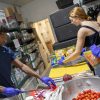

Eckerd College students Tyler Greene ’29 and Lily Niehaus ’28 work in the kitchen at Missio Dei Community Church as a part of their Faith, Service, Leadership Reflective Service-Learning course. Photos by Penh Alicandro ’22
Dinner wouldn’t start for at least a half hour, but at the EC Kitchen at the Missio Dei Community Church in St. Petersburg on a recent Thursday afternoon, several people had already gathered inside. One of them was 72-year-old Nate Sullivan.
“Been coming here for five or six years,” he said. “What we can get here helps a lot. And these are good people.”
The people he was referring to were members of an Eckerd College Reflective Service Learning (RSL) course led by Adam Guerin, Ph.D., professor of history and interim coordinator of the RSL program, and Rev. Doug McMahon, former director of religious life and chaplain at Eckerd. Guerin and McMahon, along with 15 Eckerd students, run the EC Kitchen, which prepares and serves free hot food, salad and dessert to about 100 people every Thursday. Guests can also learn where to find health care or shelter for the night, and free toothbrushes and toothpaste are available.
On this Thursday, students were busy preparing meals and setting up the serving area inside the tiny church. Many people get their food to go, and some ask for an extra meal to take to those unable to get to the church.
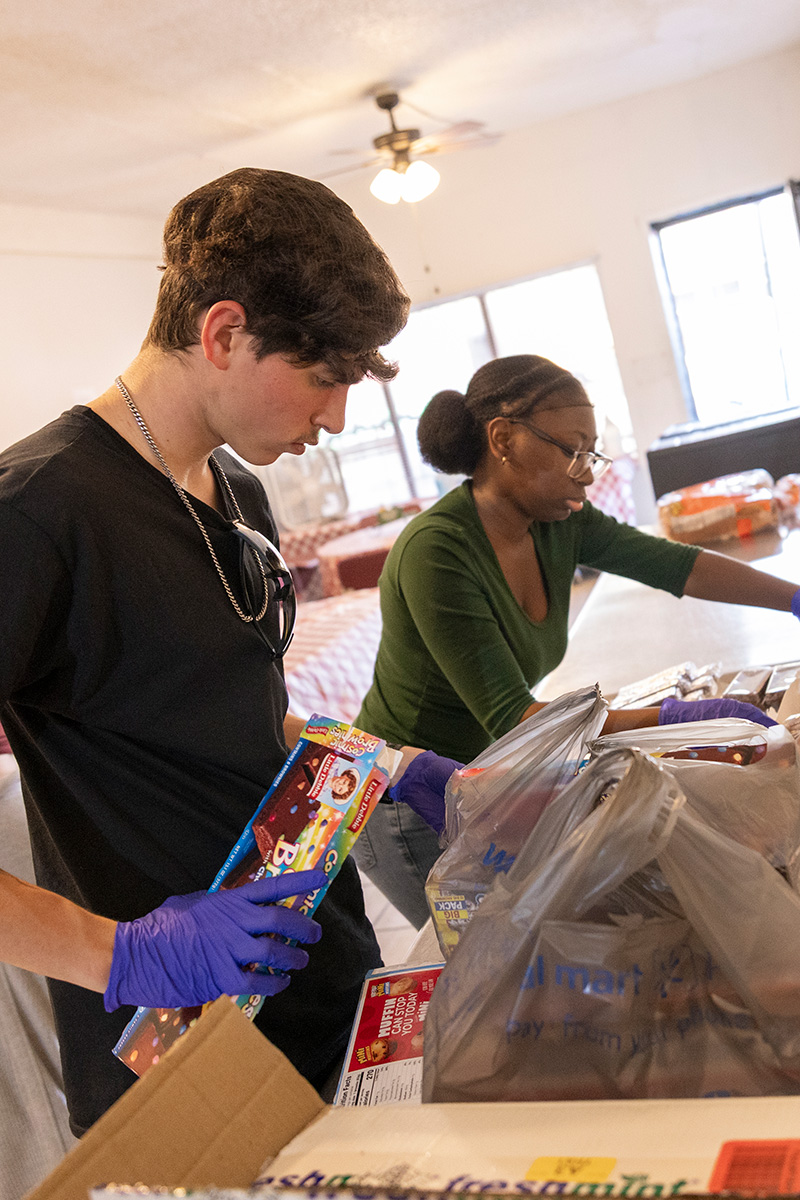
Renn Telles ’29 and Jiah King ’28 helped pack meals for the community.
Although it’s not listed, empathy is also on the menu.
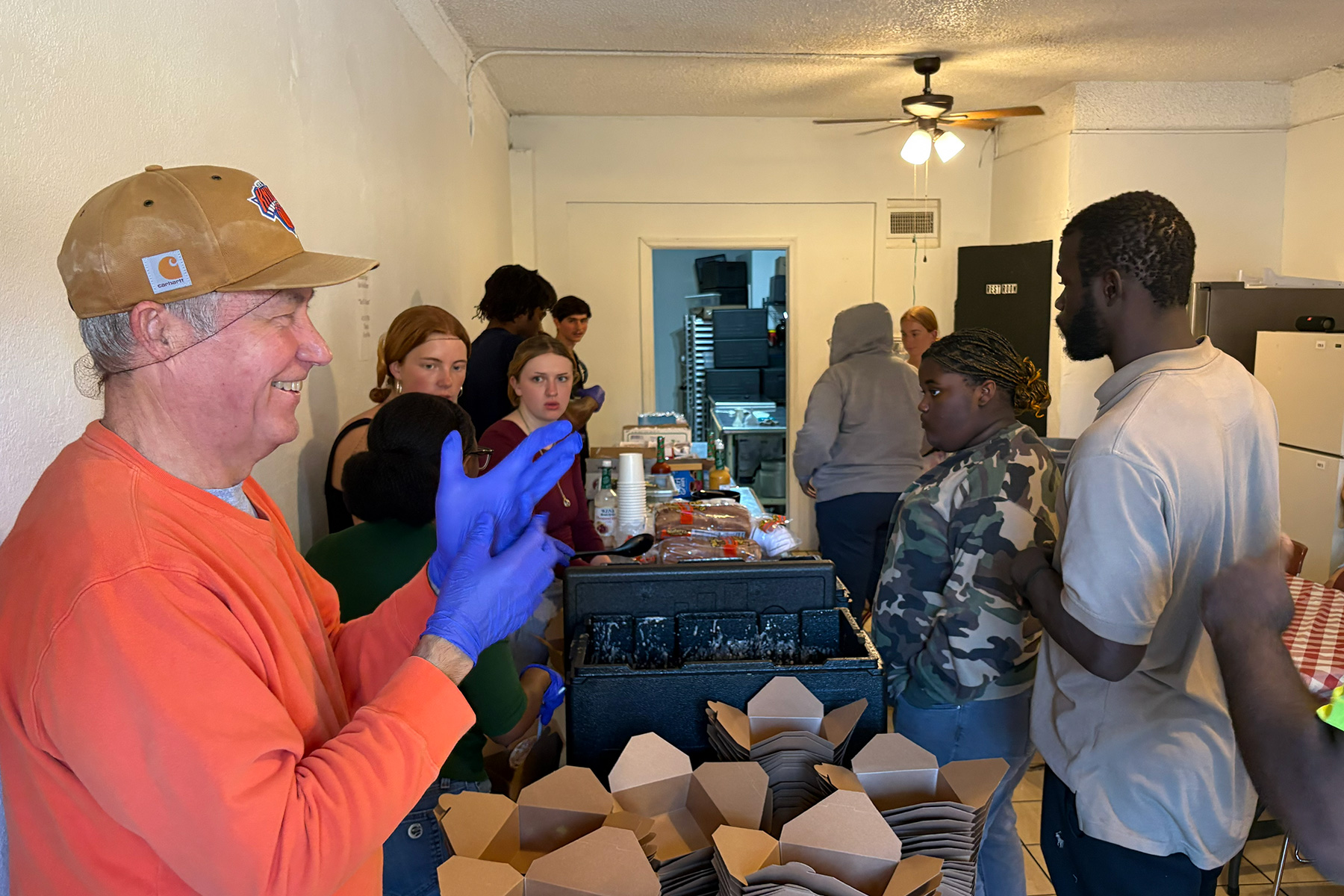
Rev. Doug McMahon, Eckerd College’s former chaplain, was accompanied in the food service lines by the students who were learning about serving their community through nonprofit organizations.
“The EC kitchen has exposed me to a community that often gets overlooked, which are the wonderful homeless and working class people of St. Pete,” says Ann Marie Knight, a senior environmental studies and humanities student from Chapel Hill, North Carolina.
“Everyone takes care of each other and this can be seen from the connections through food.
“There is also a great level of awareness from people. When they come in they often say, ‘God bless you for doing this.’ Acknowledging their situation that brought them to get a free meal, but still being thankful for life and those who support them through it. Whenever I participate at the EC Kitchen it remains the highlight of my week until the next time I go.”
Before graduation, all Eckerd students must complete at least one RSL course, have a total of 20 recorded service hours, and write a paper reflecting on the experience. With nearly two dozen RSL courses offered every semester, students can choose from a wide range of approaches to service. Faculty across all disciplines propose and offer RSL courses designed to place students in a variety of working environments and introduce them to various organizations in the local community.
Among the non-profit organizations that have worked with Eckerd’s RSL program are Daystar Life Center, Community Action Stops Abuse, and the Coalition of Immokalee Workers.
“Being exposed to a radically different group of people but seeing the commonalities is one of our ultimate goals,” Guerin explains. “And the feedback from students has been overwhelmingly supportive. RSL is not new. I did an RSL course when I was in college in the ‘’90s. It’s foundational to a liberal arts program.”
Rev. McMahon is one of the pastors who helped organize the Missio Dei church in 2008. “The focus of the RSL course is on service,” he says. “But reflection and learning are just as important. Adam and I talk to the students about there being no us and them. Just us. We hope to make a difference in other people’s lives, and in our own lives. The students bring empathy, and their open-heartedness about the project is inspiring.
“We live in a society where many people believe that the most important thing is me, me, me. What I have observed among Eckerd students is that “we” is more important than “me”, and community values are more important than individual goals.”
Like Ann Marie, Jiah King, a sophomore biology student from St. Petersburg, considers Thursdays at the EC Kitchen one of the highlights of her week. “It’s that time I get to just wind down and reflect on what I’m doing and the importance of giving back to my community,” she explains.
“We greet everyone, ask how their day is going .. It’s a good way to just look at marginalized groups in general. For me, I have experienced some of the same things. I can feel it on a more personal level.
“I believe in our current generation we’re so focused on ourselves that we don’t see how small things like a hot meal and a bottle of water can make a huge difference in someone’s day, week or even that month.
“Volunteering in a community that you aren’t familiar with is important because it exposes you to a wide range of people, cultures and customs you wouldn’t see anywhere else. And I believe that the experience will be different for every place someone volunteers, whether it’s in St. Petersburg, out in Tampa, or anywhere else in the world.”