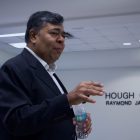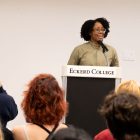

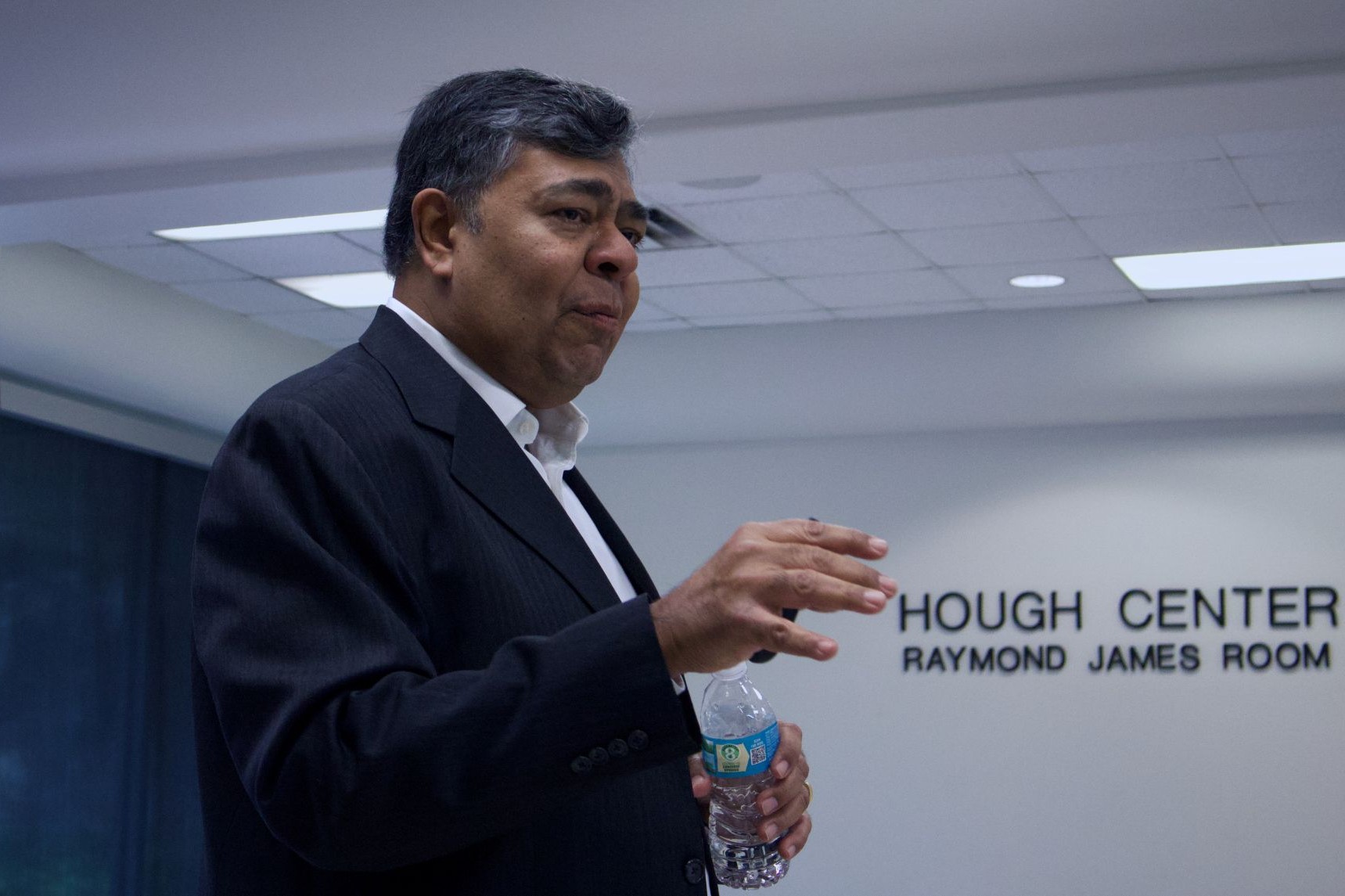
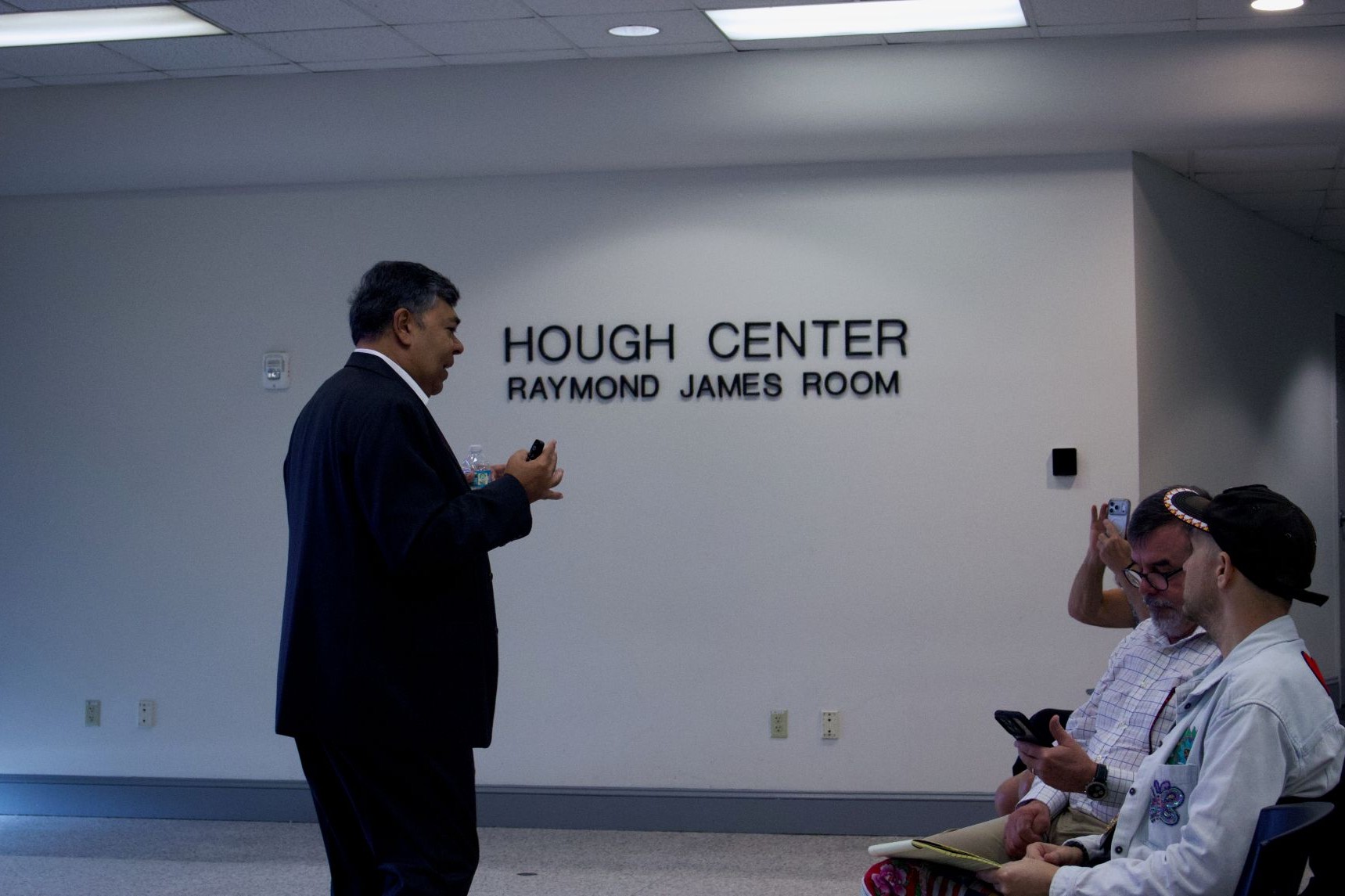
Henry Balani, DBA, delivered a lecture on Nov. 4 on the difficulties governments, law enforcement, and regulatory agencies face when addressing money laundering. Photos by Ana Lense ’28
“Money laundering is dirty, all right?” says Henry Balani, DBA, to a rapt gathering in Eckerd College’s Fox Hall. “It destroys our modern financial and economic systems, but the problem is it’s difficult to really address some of these issues.”
His Nov. 4 lecture, “How to Launder a Billion Dollars (And Why It’s Getting Easier),” was hosted as a partnership between the Career Center and St. Petersburg World Affairs Council. The goal was to gather Eckerd students and the public to bridge global and local issues.
Although the lecture was not a tutorial on how to launder a billion dollars, Balani, an instructor of international business, finance and banking, used the time to define the process of money laundering: “to take money, hide the origin of the money, obfuscate and obscure the ownership.”
He taught the audience by evidence and interactive surveys about common debunked money laundering methods and explained the intricacies, addressed misconceptions, and explained how money laundering is happening presently.
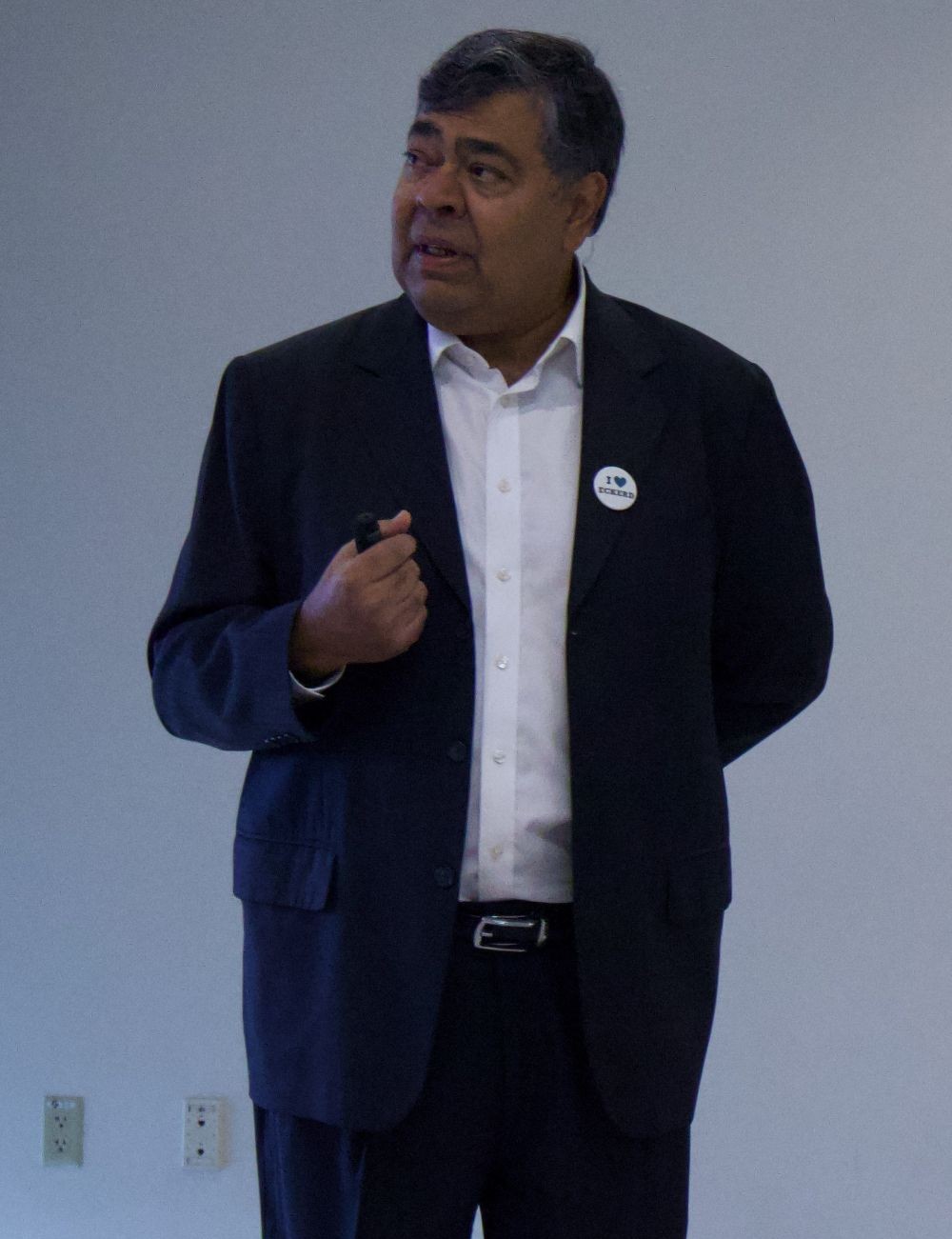
Balani joined Eckerd this year as an instructor of international business, finance and banking.
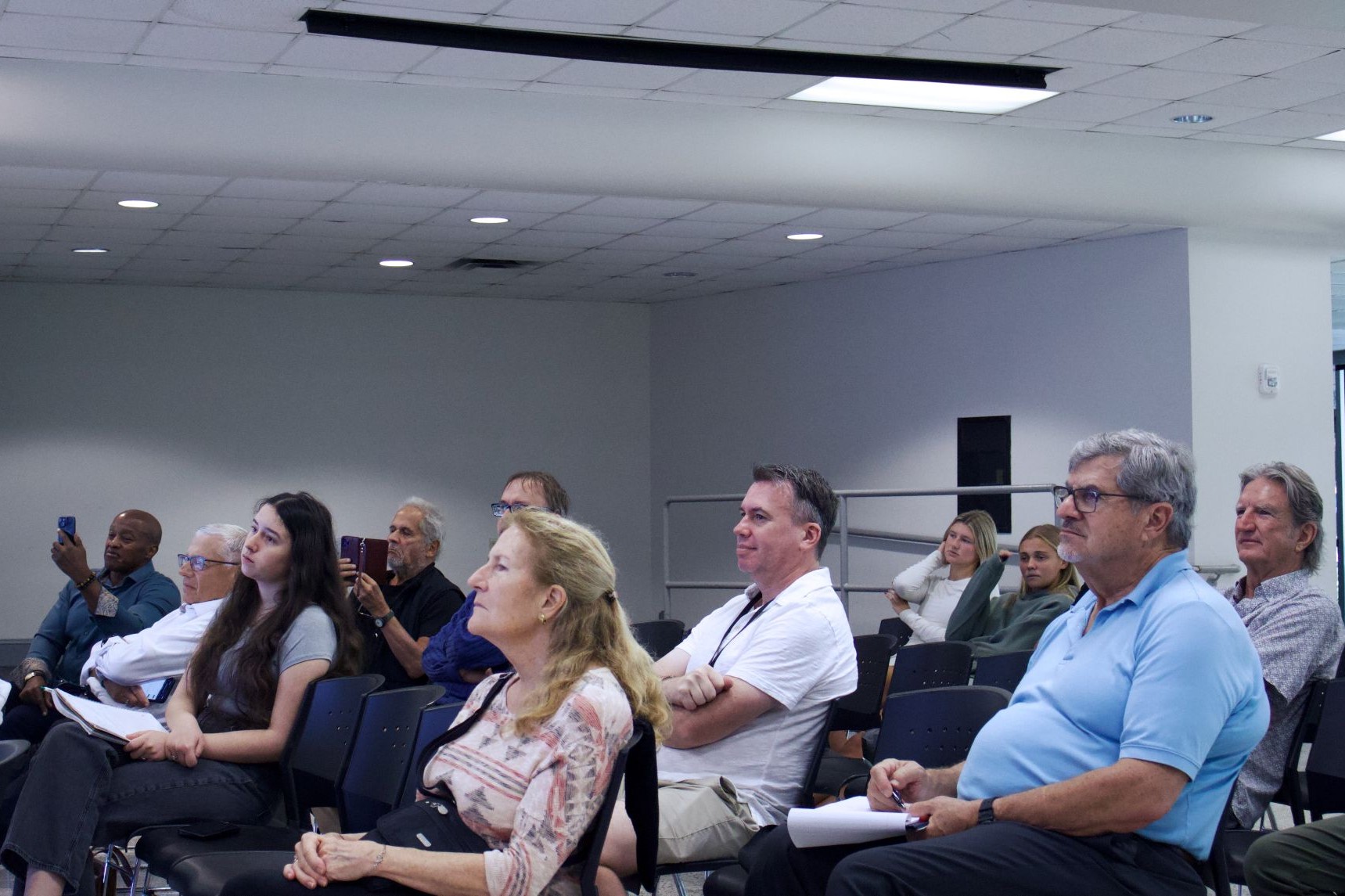
Balani stressed the need for the general public to be aware and vigilant about how money laundering may be impacting their lives.
“$4.4 trillion of illicit financial activity was measured in 2025,” Balani stressed.
An unfathomable amount of money is procured from activities Balani listed, like drug trafficking, human trafficking, bribery, fraud and counterfeiting. These activities are often connected to criminal schemes that allow for money laundering to occur.
Many professionals, agencies, and countries try to investigate and stop money laundering, but it is extremely difficult.
Among the obstacles authorities face are specific patterns that professionals look for have to constantly adapt to criminals’ new or creative methods in which money is laundered. The need for open collaboration can also lead to complications between agencies and countries looking to stop money laundering.
“It is like pushing a boulder on a mountain here, you take two steps forward, three steps back,” Balani described. “It varies depending on the administrations that we work with, it varies depending on the countries we work with.”
Balani cited how complacency is another difficulty of preventing and ending money laundering, as an example he explained complacent banks.
“The more money is being moved around the more money banks make, so there’s this pressure between the compliance group in the bank,” Balani illustrated “Go sit in your corner!— a lot of that happens.”
Even large, prominent banks have been implicated in money laundering through negligence or willful lapses in financial oversight.
Balani also noted that many banks are susceptible to complacency. He cited during Oct. 2026 both Bank of America and American Express have been fined for lapses in money laundering prevention, but despite being fined the banks can continue to operate.
Despite how overwhelmingly complex money laundering is, Balani concluded with different ways to minimize the impact of money laundering which attendees and students at Eckerd could do.
“Number one, be aware of what’s going on, recognize when these things come out in the news. This is all public information. Number two, ask yourself, what does it mean to you personally? Does it make any significance to you personally? If it does, do something about it. If you are a Bank of America customer, write an angry letter. Close the account. Number three, make others aware of what’s actually going on.”
At the end the attendees at the lecture had proposed their insight to the presentation and the current issue of money laundering.
“A lot of us in society should question how and where people get this money and how it results in bribery and corruption,” considered alumnus and board member on the SPWAC Maurice Kurtz ’75.
Sophomore biology student Rondine Elor from Fort Lauderdale, Florida, reflected “so in a way I wasn’t shocked, but it was very educational and interesting to me.”
“Eckerd students, they’re going to be the ones working in banks eventually. Maybe they can make changes to make sure business are better verified,” Assistant Director of Career Education Taylor Snipes gathered, “knowing what’s going on doesn’t mean it has to happen forever.”