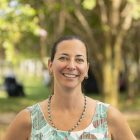

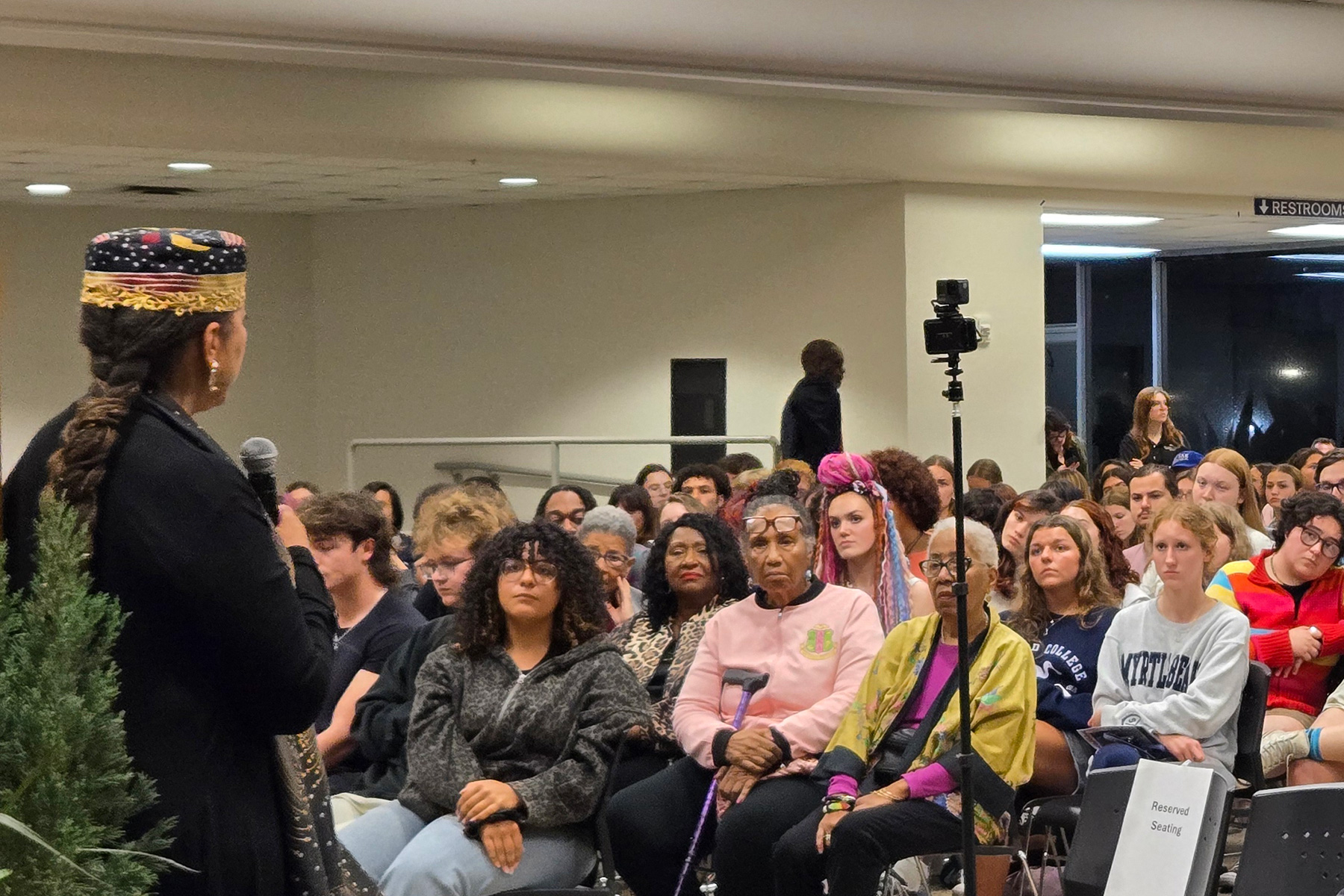
Ambassador Attallah Shabazz spoke at Eckerd College on Feb. 27 as a kickoff to EC Classic Weekend—a community event designed to draw St. Petersburg to support the College’s basketball programs. Photos by Robbyn Hopewell
The Feb. 27 speech at Eckerd College revolved around a simple exercise: the audience was asked to raise their hand if they like themselves. Most hands sprung up.
Then, if they love themselves. Fewer hands rose. Lastly, they were asked to raise their hands if they knew themselves. Even fewer hands emerged from the crowd.
This, Ambassador Attallah Shabazz said, is what deserves our attention. Shabazz noted that, in order to effectively advocate for the rights of others, people must first understand themselves. It was evident from the exercise that there was some work to be done. That said, who one is and what they support will change or “evolve,” as Shabazz put it.
Shabazz is a diplomat, actress, and advocate for human rights. Born in Brooklyn, New York to Civil Rights leaders Malcolm X and Betty Shabazz, she says she is a part of a lineage of advocates for human rights.
Shabazz attended the United Nations International School, followed by Briarcliff College where she studied international law. In 2002, she was appointed the Ambassador-at-Large representing the country of Belize internationally and in perpetuity.

Shabazz encouraged the students to be listeners when they encounter people with differing viewpoints and values.
After Malcolm X was assassinated in 1965, Shabazz wanted to preserve her father’s legacy. One way of achieving this has been to travel across the country to do speaking engagements.
Eckerd students, faculty, staff and community were invited to attend the kickoff event sponsored by the Unity Center, and coordinated by Director of Equal Access and Campus Community Ann Sherman-White ’06. The room was packed with people, eager to receive the ambassador’s guidance.
The evening consisted of an interactive speech by Shabazz followed by a Q&A.
“I’m not an activist, I’m an advocate,” she said. Advocates are not bound by one particular issue and are not married to any one position, she said. They are open to change and are curious about opposing views.
She credits her approach to her father’s willingness to adjust his perspective when presented with new information. It is simply how the Shabazz family interacts with the world.
In following her father’s methodology, Shabazz does not “resist but exist[s].” She emphasized this mantra to her audience. The most influential advocates are those who focus on the people around them. She calls this “the circumference.” By engaging with others, one becomes acquainted with themselves.
Neon Liebson, a sophomore anthropology and East Asian Studies student from St. Louis, Missouri, attended the event. They read Alex Haley’s “The Autobiography of Malcolm X” and was eager to hear his daughter speak.
“I wanted to learn a little bit more from someone who actually knew [Malcolm X] and experienced how it was growing up with leaders from the Civil Rights Movement,” they explained. Ambassador Shabazz was 6 when her father was assassinated, but grew up close to many other leaders in the civil rights struggle.
Neon sees the value in learning through speaking events like this.
“There are things you can learn from a textbook, but it’s much more impactful when you learn it in person and learn it from engaging in dialogue,” they observed.
For Shabazz, this is what makes life rich. She said that true wealth is not monetary but driven by one’s experiences – particularly with others. “Wealth has to be consistently there,” she said.
It is this practice of connection that leads to positive change and less hatred, she said, This is her purpose, and she encouraged her audience to find theirs.