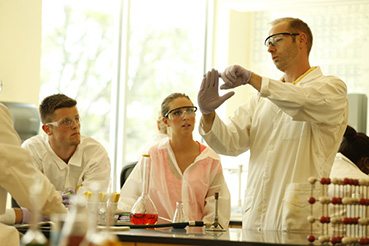

Assistant Professor of Marine Science Philip Gravinese, Ph.D., allows students to formulate their own research questions as a part of his lab focused on stone crabs. Photo file
They weren’t about to let a couple of major hurricanes stand in their way.
In the fall of 2024, then Eckerd College senior Taran McNelly and first-year student Lilly Branton began work on a research paper that would be titled The physiological responses of the Florida stone crab to changes in salinity. Their research describes how Florida’s $30 million per year stone crab fishery may respond to both high and low salinity extremes.
Taran, who graduated from Eckerd in 2025 with a degree in marine science and a minor in chemistry, and Lilly, now a sophomore marine science student, recently learned that despite interruptions from hurricanes Helene and Milton, their paper had been accepted into the prestigious Journal of Experimental Marine Biology and Ecology. Taran was the lead author and was doing the research as an independent study, and Lilly was part of Eckerd’s first year research program.And there was a third author. A person who acted as a mentor and chief moral booster. Philip Gravinese, Ph.D., assistant professor of marine science at Eckerd and adjunct scientist at Mote Marine Laboratory and Aquarium. It was in his Ecophysiology lab, inside the Galbraith Marine Science Laboratory on Eckerd’s campus that the research took place.
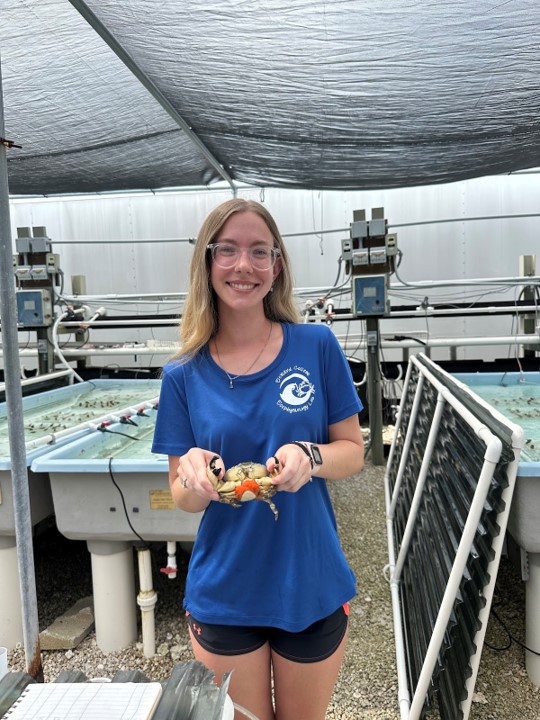
Lilly Branton ’28
“Taran started work in the Ecophysiology lab during the spring semester of his senior year which ended up being a portion of the research related to this paper,” Gravinese explains. “And Lilly’s initial project was interrupted by the evacuation for the hurricanes that fall, so she had no data.

Stone crabs are an important part of the Florida economy and seafood industry.
“In the spring semester of 2025 we needed to develop a research plan that had achievable goals in a short time frame. Lilly was resilient and open to collaborating with Taran.”
Each student took ownership of part of the project. Independently the data would not have been publishable but by working as a team they were able to expand the study to achieve a robust data set. I guess this is something positive that arose from the hurricane year.”
The stone crabs used for research were collected by the Florida Fish and Wildlife Conservation Commission and kept in Gravinese’s Ecophysiology lab.
“During their time working on this project I was able to observe that both students worked well in a team, were dedicated, showed up on the weekends to collect their data, and were able to work independently,” Gravineese adds. “These are skills and traits that our students will need if they plan to go to graduate school or jump into the work force immediately after graduation.
“Their dedication during this project is what led me to hire both Lilly and Taran as paid summer interns on one of my grants. They both relocated with me and a team of Eckerd undergraduates to Mote Marine Laboratory in Summerland Key, Florida for 70 days during the 2025 summer to work on a much larger stone crab project that was unrelated to their paper.”
“Taran took full advantage of this opportunity and interviewed for and was hired by Mote to be their Ocean Acidification Technician. Lilly also took advantage of this immersive experience. She is currently analyzing a large data set that characterizes how reduced seawater pH and elevated temperatures modify the ability of larval stone crabs to respond to different light intensities that simulate moving up or down in the water column. She will present this data set at the annual Eckerd College Research Symposium Symposium this spring.
“Lilly’s ability to dive into a research project during her first year has opened many doors for her professional development. She has been able to participate in multiple research projects that are diversifying expertise, skills she will need for after graduation. Further, she has been able to develop her own novel research questions. By starting early, Lilly now has 2-3 years to collect a robust data set for her undergraduate thesis work which most likely will lead to a 2nd peer-reviewed publication.”
Taran says that even now, he’s still shocked by what’s happened since the hurricanes. “We got the paper published despite them,” he says, “and then I switched over to Mote and the work I’m doing now has been unreal.
“The hurricanes pushed Lilly and myself to finish the work. Looking to see how closely stone crabs follow changing salinity is very important. If the salinity gets too high, it becomes dangerous to the crabs. They’re already having to adapt to higher salinity conditions. Hopefully this will inspire others to act to find solutions.”
Lilly grew up in Jersey Shore, Pennsylvania, a small town about 250 miles from the Atlantic Ocean. “When the hurricanes hit everything was put on pause,” she says. “I eventually went home until we could come back on campus. So I needed something I could do quickly, before the end of the year. But it had to be a good, robust project. I got paired with Taran and he showed me how to do everything.
“It was difficult, but we had to keep going. Not a ton of previous research had been done on this. How stone crabs are able to survive in higher salinity could be representative of how other marine life can survive in the future.”
Before she arrived at Eckerd, Lilly says she didn’t know if she liked research. “Or exactly what a lab is. But now I have a passion for research and crustaceans, and I’d like to continue on to graduate school. If these crabs can’t survive, that $30-million number would plummet and you’ll have a ripple effect on the economy. It might affect us in ways we haven’t thought of.
“But it’s been a great experience. I’ve learned so much about research and teamwork skills and the thought process that goes into research. And I had so much fun doing it.”
Eckerd College was closed for five weeks, from late September to late October 2024, due to hurricane damage. But students learned remotely, and research work continued.
“Publishing a paper is a noteworthy milestone in anyone’s undergraduate career and is extremely hard to accomplish,” Gravinese says. “It demonstrates that the research Taran and Lilly did met the rigor and professional standards required by anonymous experts that reviewed their work. Being a published author as an undergraduate can also be a key differentiator when they go to apply for graduate school or marine science jobs.
“During this process, Lilly and Taran were able gain incredible experience throughout the entire scientific process: developing research questions, executing an experiment, troubleshooting when things don’t go as planned, collaborating in a team, collecting and analyzing data, composing a manuscript, being open to criticism during the review process, and providing sound arguments in response to expert criticism during peer-review.
“Most of all they did it all while having fun. These opportunities are exactly why Eckerd’s Marine Science Program stands out above other programs. Eckerd professors need dedicated students to help with our research and being an entirely undergraduate institution means that our students do not have to compete with graduate students like at other institutions.
“As their academic and research mentor I am extremely proud of what Lilly and Taran have accomplished.They set the bar high. I am also proud that Taran is employed at Mote where he is developing new skills and I am excited to continue to advise Lilly as she pursues her thesis over the next couple of years.”