
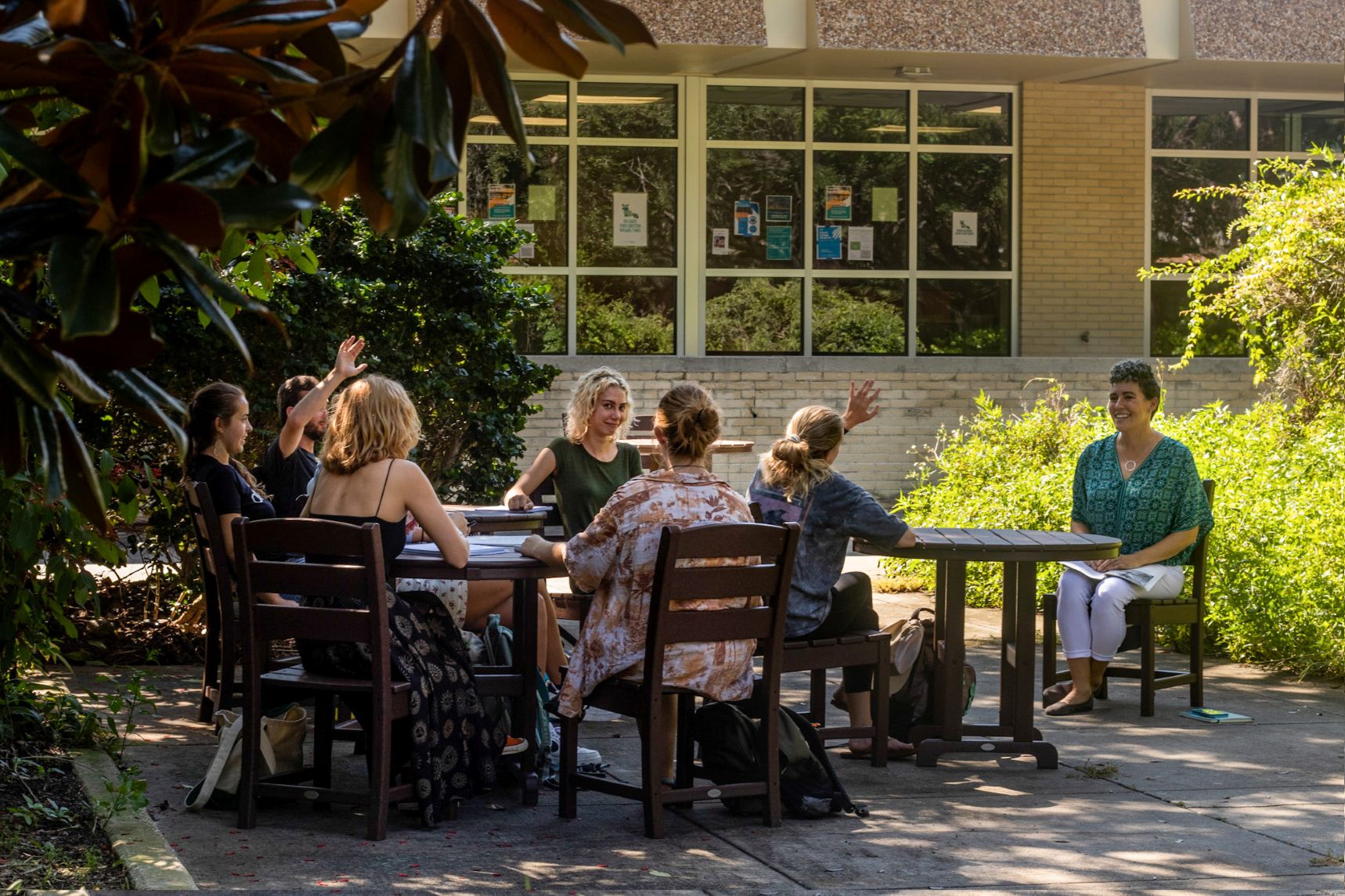
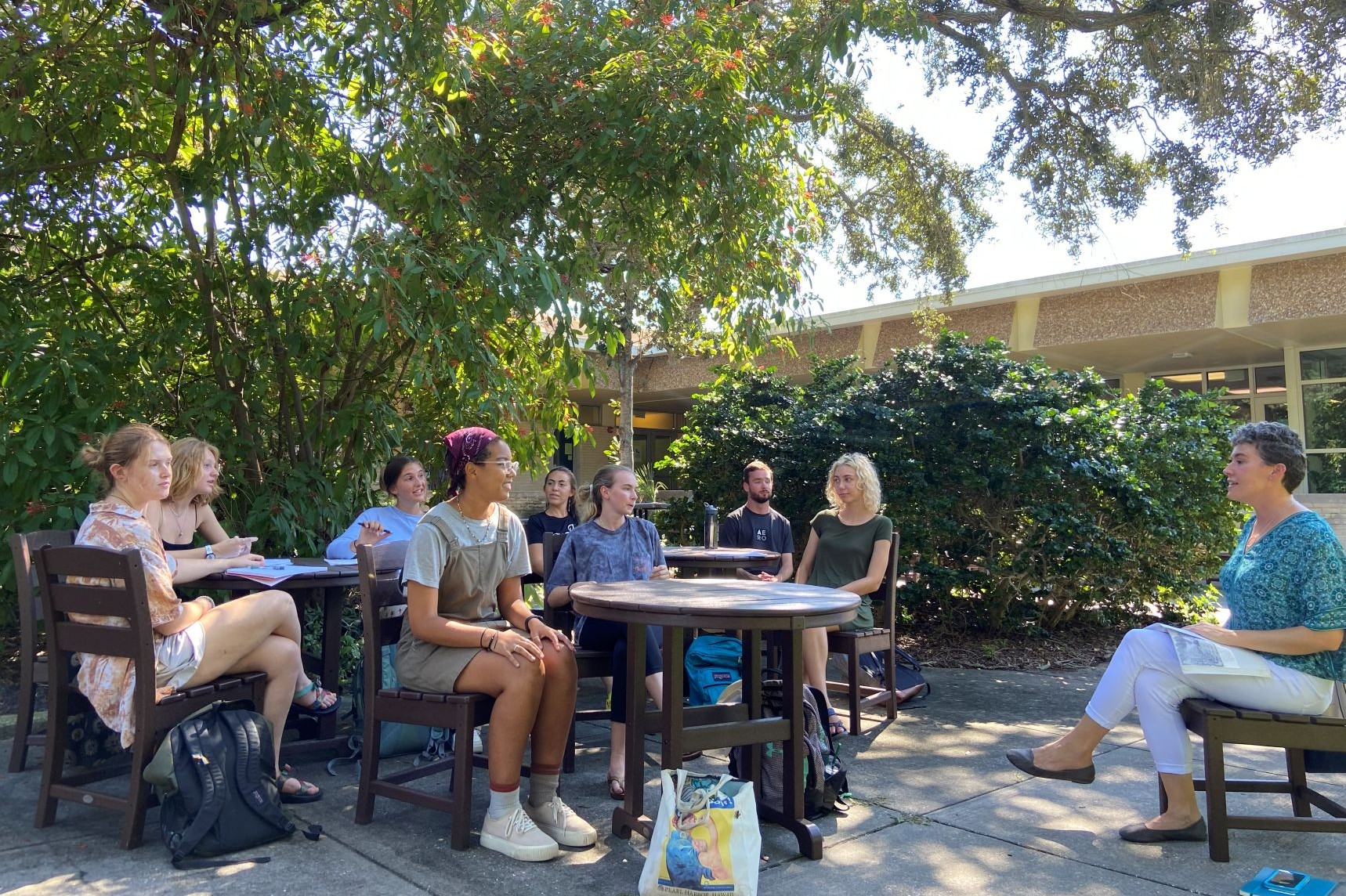
Joanna Huxster (furthest right) leads an outdoor class discussion near the Sheen Complex. Photos by Angelique Herring ’19
Eckerd College Associate Professor of Environmental Studies Jo Huxster, Ph.D., has taken her climate communication skills beyond the classroom and published a book.
“Climate Converts: People Who Changed Their Minds on the Greatest Threat of Our Time” follows eight people who have come to view climate change as a serious, human-caused problem that requires action. The book is available for preorder and will be published by Columbia University Press in March of 2027. The book is intended for a general audience that wants to better understand where people’s viewpoint on climate change comes from.
“We spend so much time studying climate deniers and trying to change their minds,” Huxster says. “But I hadn’t seen anything out there where they talked to people who had already changed their minds, and said ‘What did it for you?’”
As an undergraduate, Huxster had her own brush with climate denial. She took a class taught by a paleoclimatologist and climate denier; he told his students that what was occurring was natural, there was no problem and there was no need to worry, Huxster says. She remembers calling her mom and saying they didn’t need to worry about climate change.
After Huxster researched further, she realized the professor was a well-known climate denier and sharing false information. Huxster became interested in how some people, particularly those with advanced degrees in scientific fields, can deny climate change.
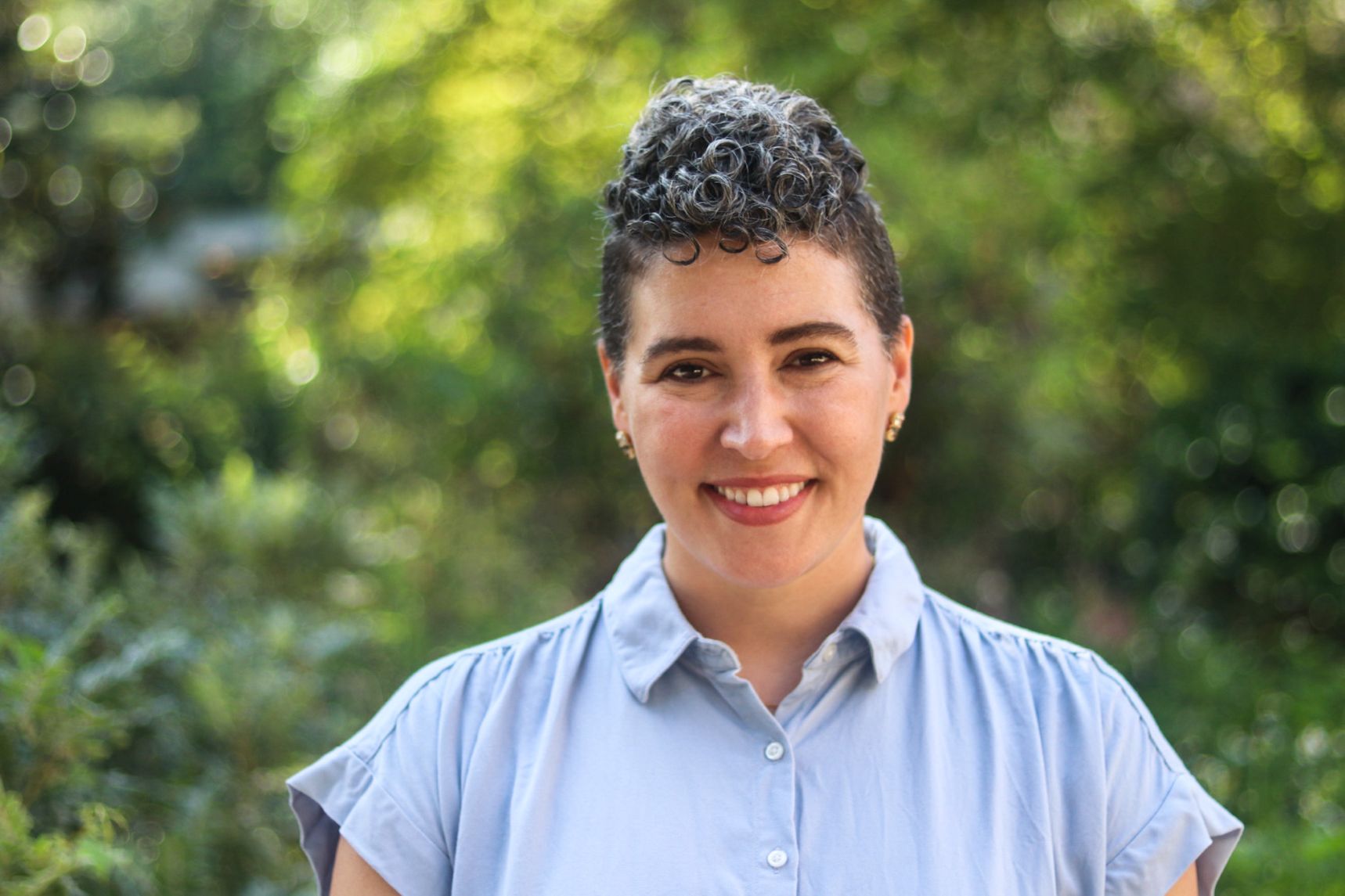
Dr. Huxster’s new book follows eight individuals whose views on climate change have drastically shifted.
“We need to be having more open conversations where we are listening, not just spouting facts at people,” Huxster says.
In 2023, Huxster began to work on the book. She found interviewees through social media and republicEn, a nonprofit organization for Republicans who want to solve climate change. She interviewed four men and four women from across the country in search of what changed their minds. Each conversation was significant, but one that stands out to Huxster was with someone she attended graduate school with.
Her graduate school classmate was raised in a fundamentalist Baptist community and went to a school that claimed evolution wasn’t real and that the Earth was created in seven days, Huxster says. She went on to study oceanography and engineering.
“She had a huge shift in not just her ideology on climate change, but in her whole identity,” Huxster says.
A catalyst for the change of mind for many of those interviewed was their feelings over facts. Several of them desired a community where others believed the same things as them. Across the board, conversations were key. It wasn’t so much the content of the conversations, but who they were having conversations with, Huxster says.
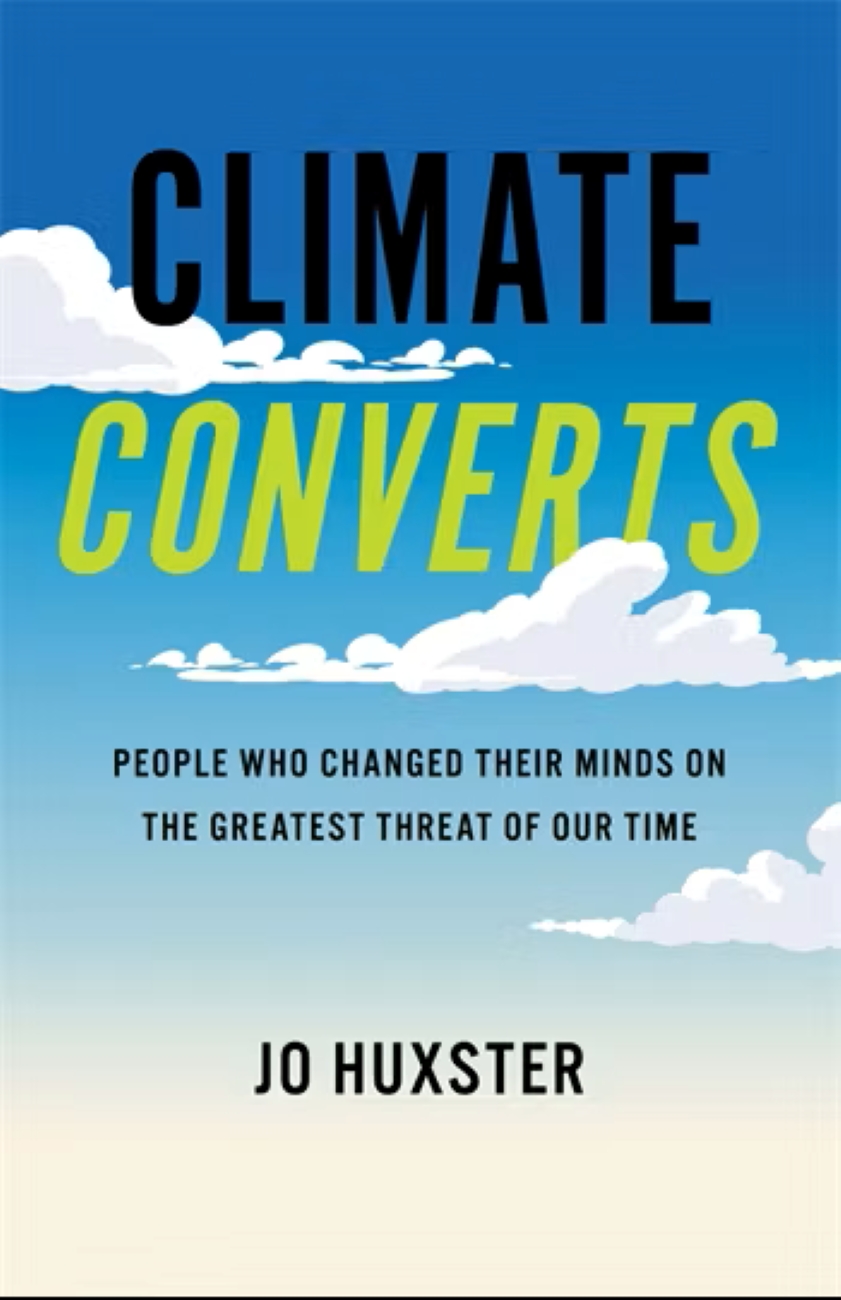
The book will be available in March 2027.
“Climate Converts” is written to be accessible to general audiences seeking a better understanding of different viewpoints on climate change.
“Finding trusted messengers or someone whose beliefs aligned with theirs in other ways was really important,” she says.
For students or anyone passionate about an issue but unsure of how to communicate with others, Huxster advises being open-minded. We have a tendency to latch onto a belief and reject anything that might challenge it. We can become better at defending our beliefs if we have a better understanding of what others believe too, Huxster adds.
“We need to be having more conversations where people feel like they’re being heard and listened to, not just lectured,” she says.
The experience that inspired the book, and the process of writing it, has convinced Huxster it’s unlikely someone’s mind will be changed just by confrontation with scientific facts.
“If that were true, then we would have already done something about climate change,” Huxster says.