


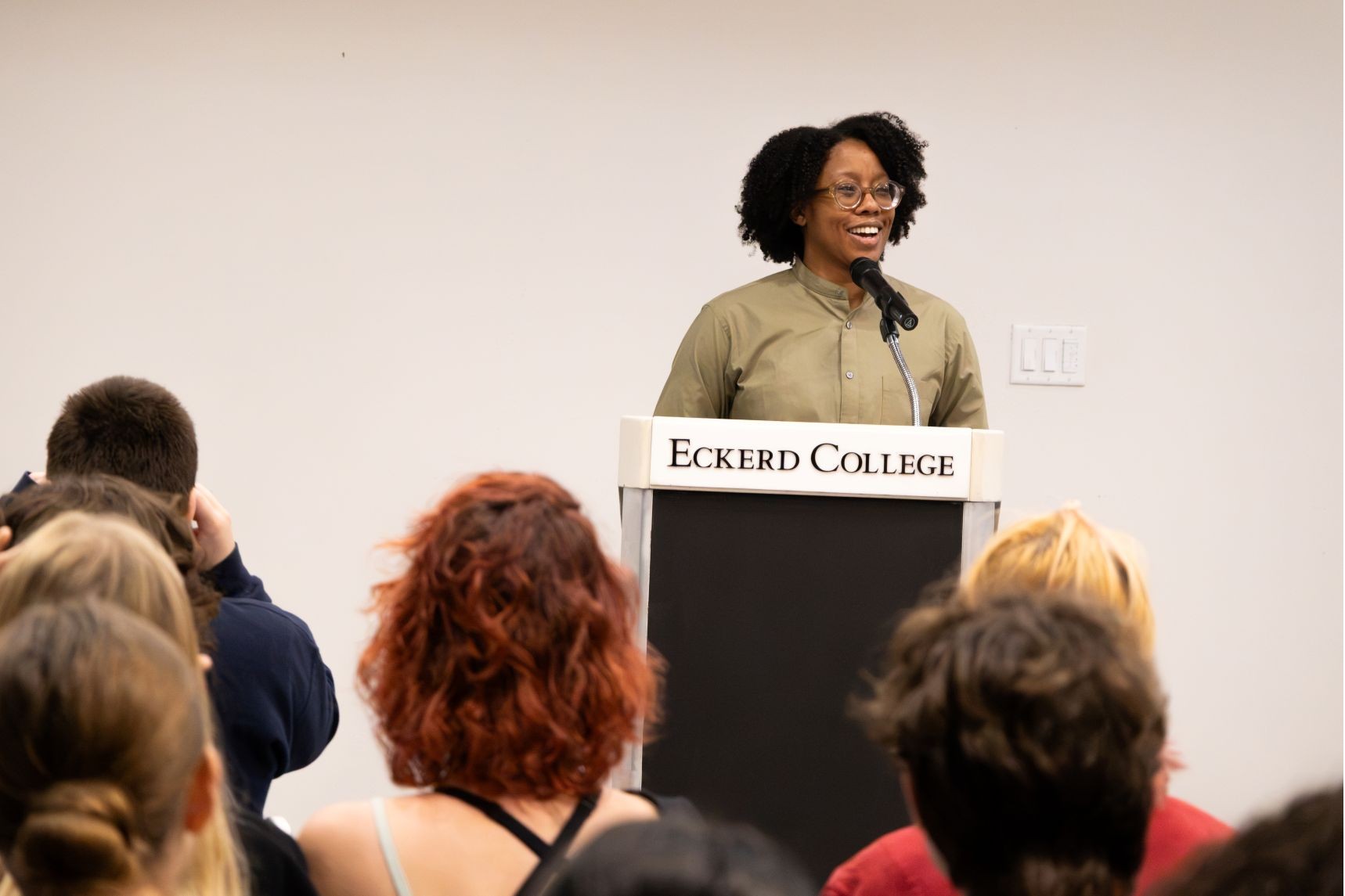
Donika Kelly read some of her notable work and discussed her writing career during her visit to Eckerd College. Photos by Madison DeVore ’25
Award-winning poet Donika Kelly visited Eckerd’s campus for the first time for a poetry reading and discussion with students. On Nov. 12, the Triton Room was packed for the event.
Kelly teaches creative writing at the University of Iowa and authored “The Natural Order of Things,” “The Renunciations” and “Bestiary.” Her work has been featured in The New Yorker and The Paris Review, among other publications. When a student in the audience asked Kelly if she always knew she wanted to write poetry books, the answer wasn’t simply yes or no.
“I was writing poetry in college, but I didn’t know being a poet was a thing, because all the poets I read were dead,” Kelly said with a laugh.
Now, a large part of her life is organized around writing poetry. Because of that, Kelly is already successful beyond her wildest dreams, she said.
Professor of Literature and Comparative Literature Jared Stark, Ph.D., introduced Kelly before she read her poetry and answered questions from the audience. The event follows several Zoom visits with Kelly in Stark’s “Voice of the Animal” course.
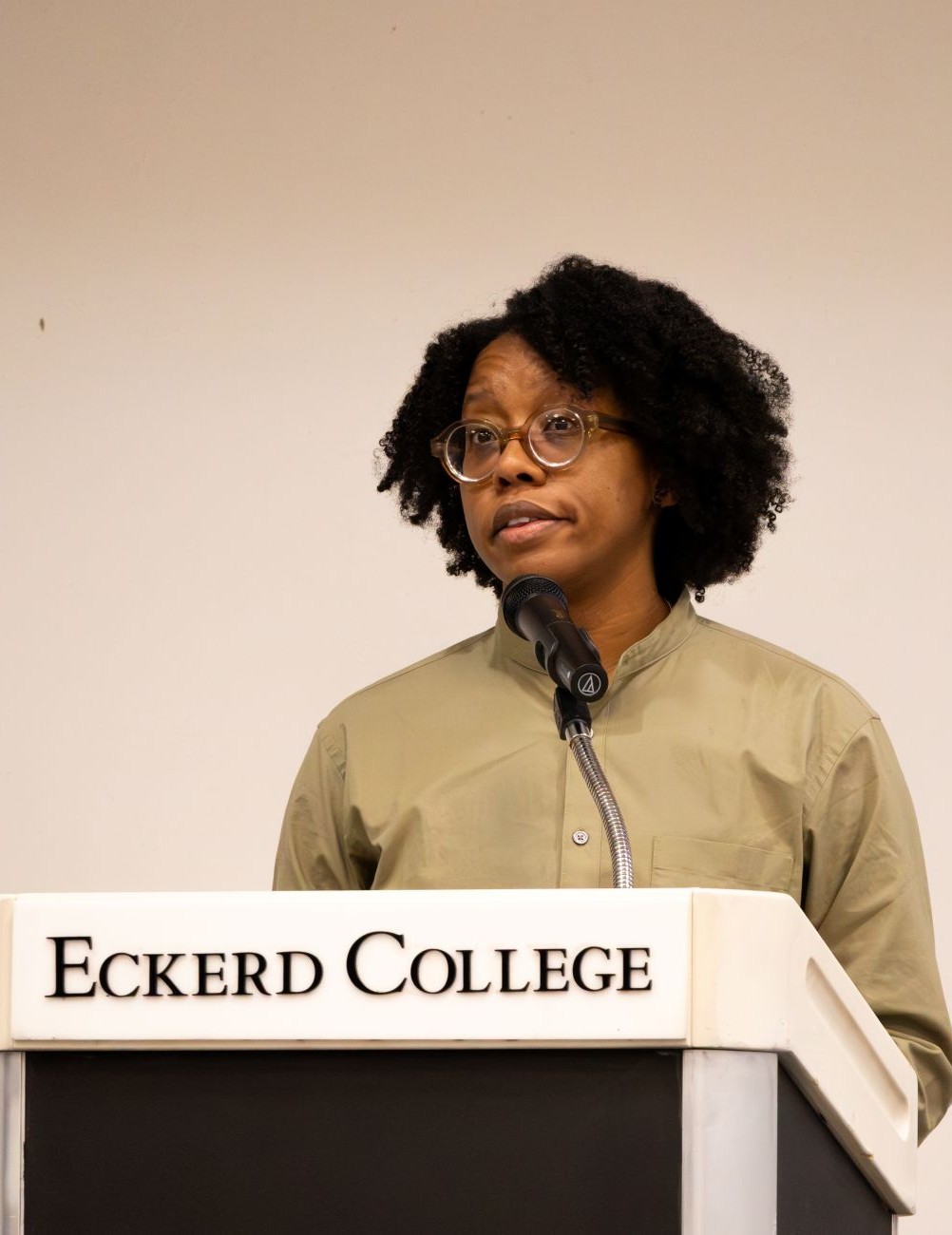
Kelly is an associate professor at the University of Iowa, where she teaches creative writing.
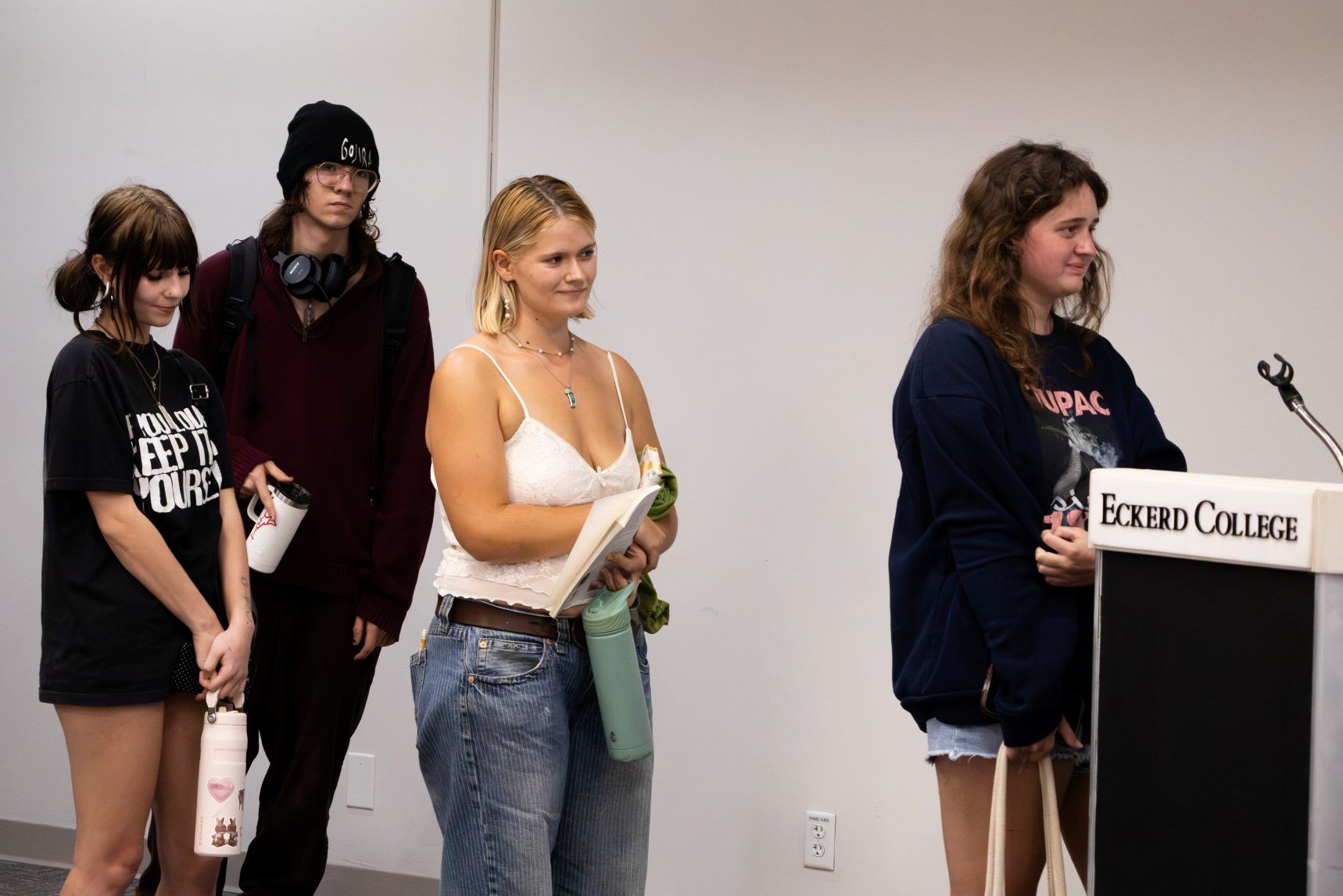
Students wait in line to have their books signed by Donika Kelly.
“What brought Donika Kelly’s poetry to my attention was how it discovers and articulates the experience of being alongside other animals rather than in dominion over them, as she put it when speaking to my students,” Stark says.
Kelly read a selection of her poems, which feature everything from a whale-watching adventure to mythological creatures. She asked her wife, Melissa Febos, who is also a writer, what she thinks about the love poems Kelly writes for her.
“‘Those love poems aren’t about me. They’re about you,’” Febos said to Kelly. “And she was right!” Kelly added.
That led Kelly to write a love poem that holds that truth within it, which she worked on leading up to her wife’s birthday. It’s titled “What is the Measure.”
During the event, Kelly answered questions about what inspires her, her favorite words, and what threat artificial intelligence may pose to her field. For inspiration, she considers what she thinks and feels and where those ideas come from. She likes the word “grotto.” And AI poses no threat to her art, Kelly said. The threat is labeling it “artificial intelligence,” because everything in it is human-generated, she said.
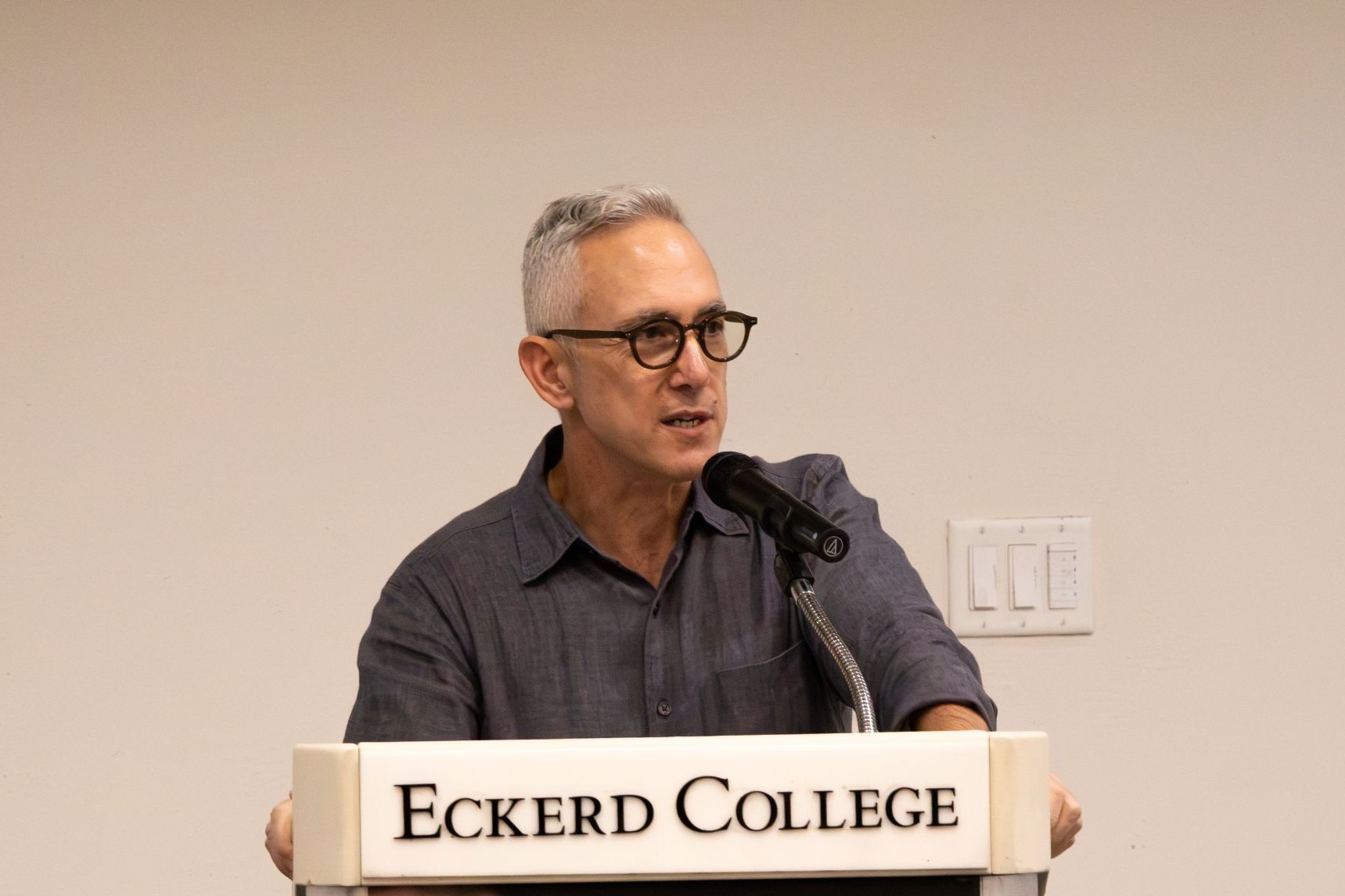
Jared Stark, Ph.D., introduced Donika Kelly to start the event.
Kelly combatted the notion that writing is a solitary act, noting that she meets with a group of friends several times a month to write together. She offered a piece of advice to students who are artists: be friends with other artists.
“There is something about being with other writers, being with other poets, just being in a community that values the facility of the human mind, that is so enriching. It just makes me feel better in the world and about the world,” Kelly said.
Kai Michel, a sophomore creative writing major from St. Augustine, Florida, called the event a “golden opportunity,” as a writer focused on poetry. She couldn’t pass it up.
“I think Donika is really phenomenal, and she’s such a great writer. As somebody who wants to be in her shoes one day, this is something that I just feel like I have to do to see how it’s done,” Kai said.
Kelly says seeing the evidence of her own thinking and feeling in her published work is a remarkable thing. But it’s not all about the outcome.
Valuing the practice of writing itself—even if it doesn’t lead to payment or publication—is significant, Kelly said.