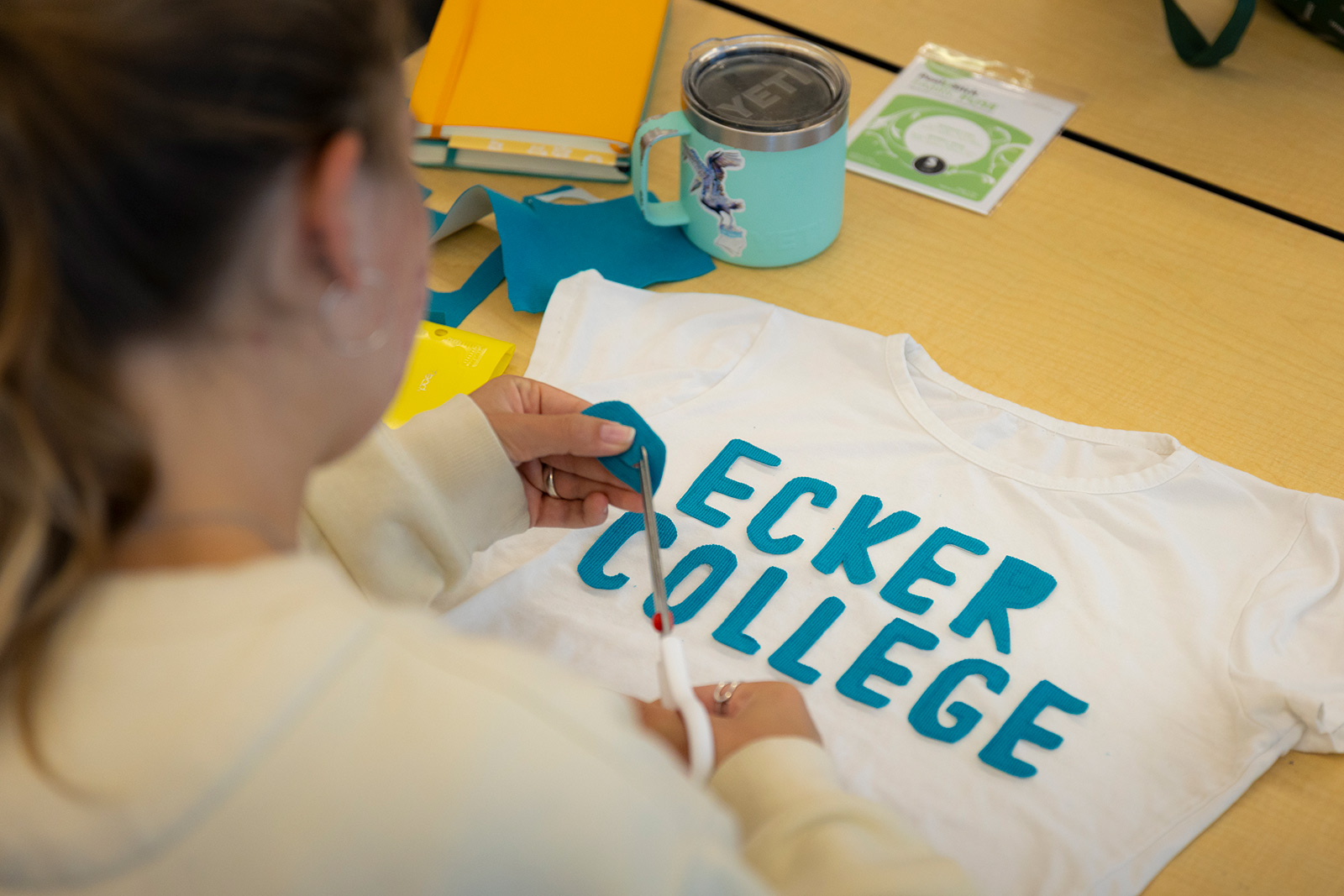
Senior Amelie Brazelton works on her customized Eckerd College branded t-shirt for her Designing Icons Winter Term Course. Photos by Penh Alicandro ’22
The New York Yankees and pinstripes. The University of Michigan and wolverine helmets. The Seattle Storm and the Space Needle jerseys. All iconic sports uniforms and logos.
And all part of Designing Icon: Sport and Fashion, an Eckerd College Winter Term course taught in January by Assistant Professor of Visual Arts Rachel de Cuba. The course was far more than simply admiring uniform designs.
“Students studied the historic connections and brand development that have created the iconic names we wear today,” de Cuba explains. “The focus is on textiles, fashion and branding, and also hands-on design. We talk about how we create connections to those designs and logos within sports apparel.
“They also focused on our customization, and how fashion, design and sports intersect through readings, film, and case studies of iconic campaigns. The students learned the design theory as well as customization techniques through hands-on activities culminating in the creation of their own custom sportswear.”
An interdisciplinary artist who grew up in Sebastian, on Florida’s east coast, de Cuba received her bachelor of fine arts degree in studio art at Flagler College in 2013 and her master of fine arts in digital art at Indiana University Bloomington in 2019. She later served as an instructor of art at IU. Most recently, she was an assistant professor of art at Clemson University.
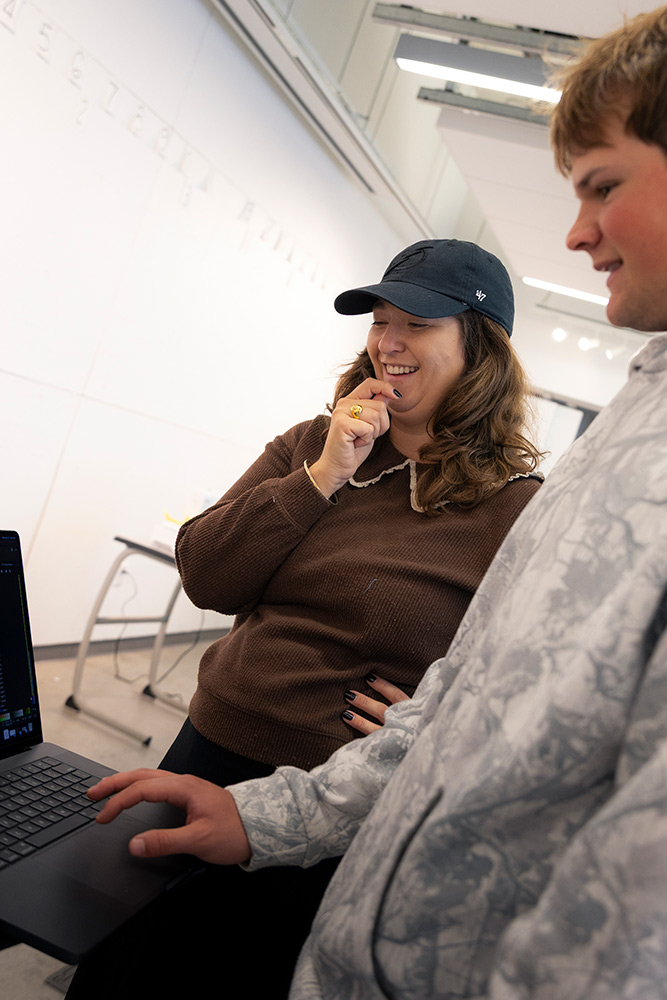
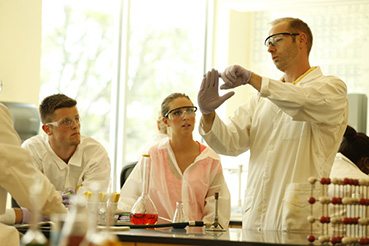
Assistant Professor of Visual Arts Rachel de Cuba (left) reviews student work.
In 2019, she was invited to create new media artworks for the New Orleans Film Festival with support from the Andy Warhol Foundation. Her work has been shown nationwide.
The Detroit Red Wings, de Cuba points out, have used the same wheel-and-wings logo since 1949. But this year, to celebrate their 100th year in the National Hockey League, the team introduced special logos and uniforms featuring a reimagined winged wheel with a “1” in front of the wheel and a “0” behind it.
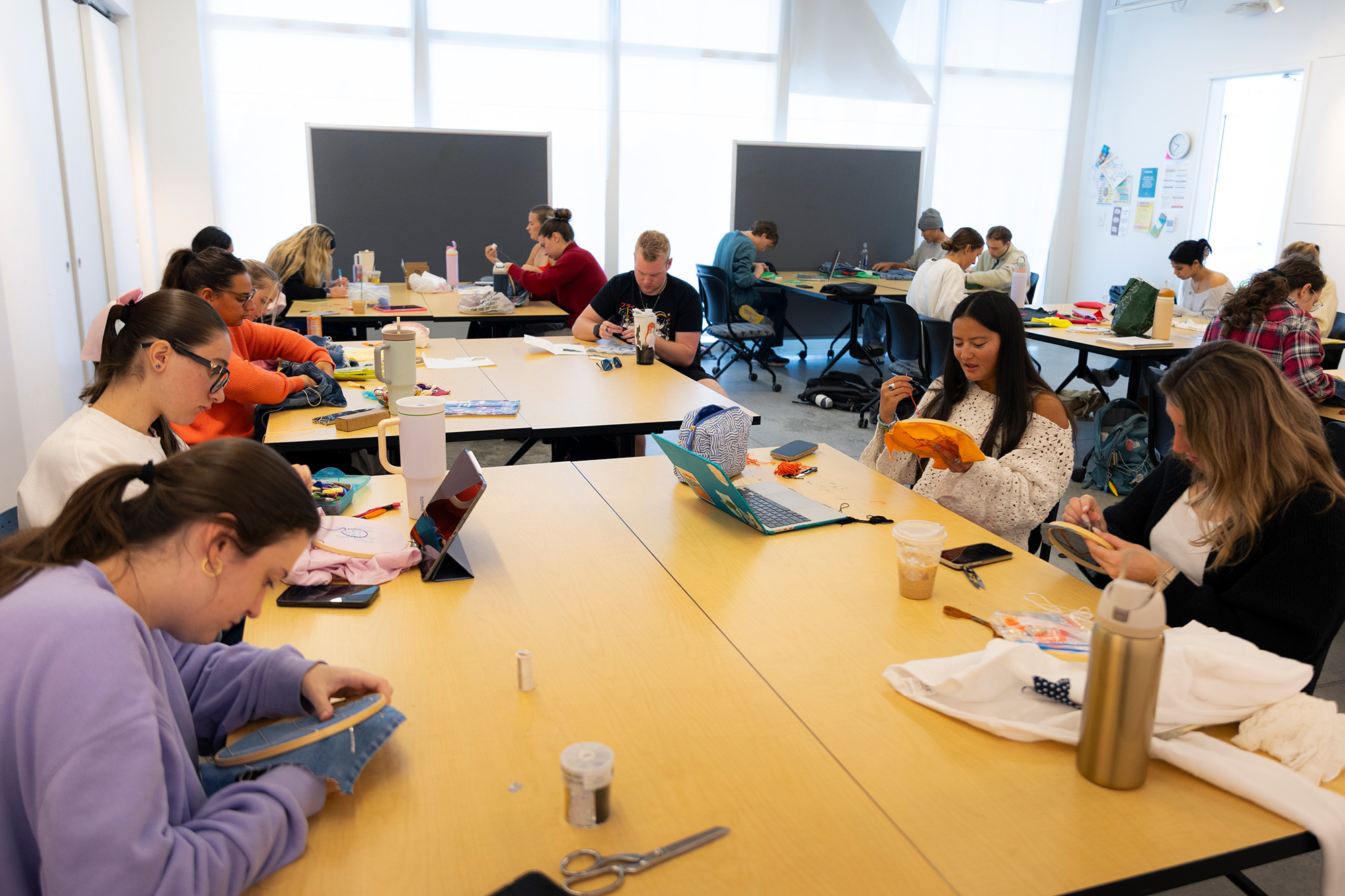
The course encouraged students to examine what works visually for a brand’s identity and try and create some of that magic on their own.
“They’re fantastic at branded identity,” de Cuba says. “And it carries it over to their centennial year. I’m not a Red Wings fan, but I am a fan of their graphic design. They’ve done really well.”
And then there are the Tampa Bay Buccaneers. “We consider the context and meaning when we see that retro creamsicle color,” she says. “It’s nostalgic, a harkening back to times of glory. You’ve got to know that as a designer. A fan will know if it’s not the right orange color on a hat. Those details matter to a fan. Knowing that the details of the design can make or break audiences seeing themselves in the merchandise is a really good skill for a designer.”
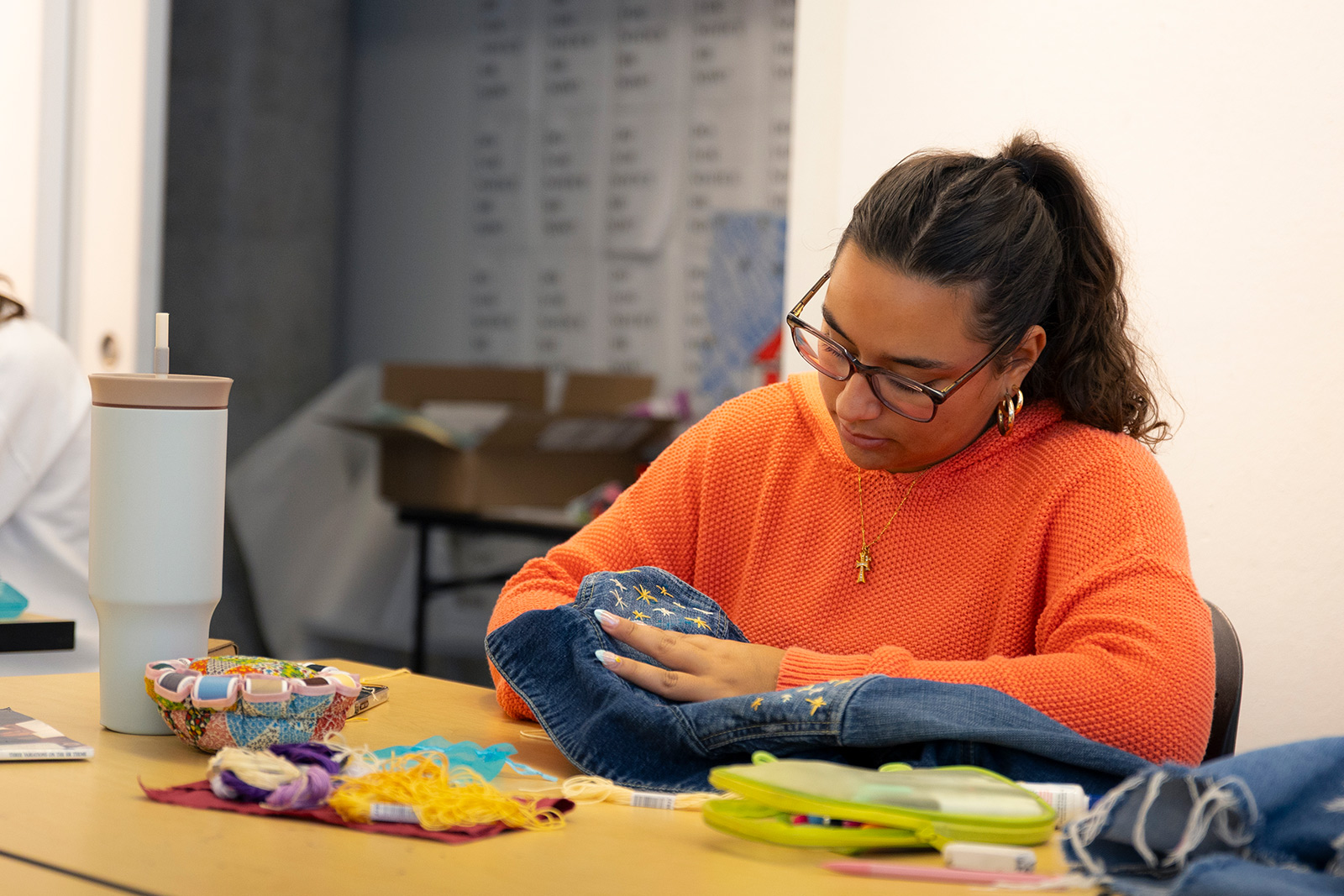
The skills practiced in the class ranged from graphic design to hand embroidery.
This marks the third time Amelie Brazelton, a senior environmental journalism student from Minneapolis, Minnesota has taken a course taught by de Cuba. “I love crafting and sports, so this course was perfect,” Amelie says. “We focused on the influence of customization in sportswear. How the adidas and Nike brands developed and how different logos work. Teams want a logo and color that’s distinctive and something people can connect with and get excited about it.” She cites the Hartford Whalers, a former NHL team that incorporated an H, a W and the tail of a whale into an unforgettable logo.
The course also offered Amelie something more personal. “Sewing was something that was passed down and isn’t done that much anymore,” she says. “Like mending something. I want to make sure my clothes last longer. But it’s also customization.” Her final project? “It’s a t-shirt with Eckerd College in teal appliqué on the front and an orange chain stitch border,” she explains. “I thrifted the material to make the teal cut-outs and the t-shirt.”
Marco Patzia is a sophomore film studies and visual arts student from North Redington Beach, Florida. His final final project was a crest of embroidered roses and tulips he embroidered onto a pair of jeans. “They represent places I’ve lived,” he explained. “The roses represent Pasadena, California, and the tulips represent where I was born—Pella, Iowa, which is famous for its Dutch heritage and Tulip Time festival.
“I always wanted to own a print shop or a custom design shop that makes banners and t-shirts, and I definitely learned how much time it takes to produce these things. The last time I embroidered something was in middle school. This was definitely fun. I can express my creative voice and show my life experience through the designs on the clothes.”
When Sam Shin was a child, he got to see the NBA’s Philadelphia 76ers play a home game. Now a junior biology student from North Wales, Pennsylvania, the Designing Icon class brought back memories of the 76ers uniforms. “The class made me think more about brand identity and what it means. It made me more aware of the conscious choices teams and the fans make. I also wanted to take a class that was outside of my normal interests.”
Sam’s final project was to embroider a red flower onto a pair of jean shorts. It was his first attempt at embroidery. “I was pretty proud of how it came out,” he says. “I could see myself doing it again.”