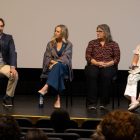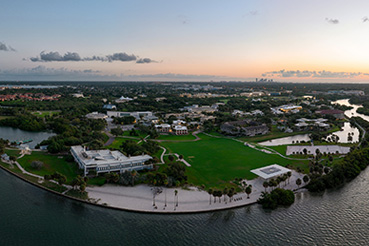

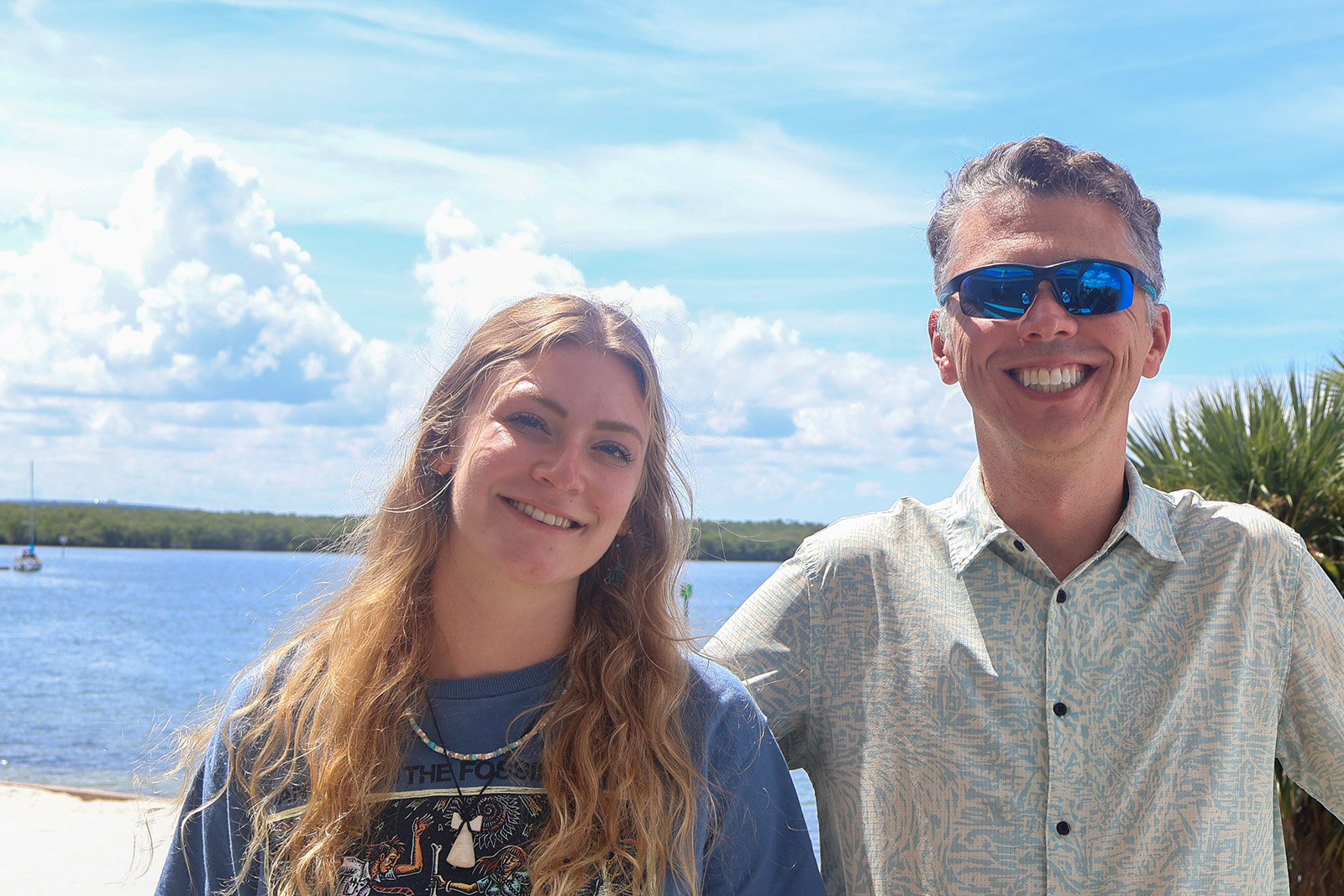
Thea Rind ’26 and her career mentor, Mark Mueller ’03, stand on the patio of Galbraith Marine Science Laboratory at Eckerd College. Photos by Madison DeVore ’25
Every year, Eckerd students write a statement about which career mentor they’d like to be paired with and why.
Thea Rind ’26 got her first choice.
Eckerd’s Career Mentor Program pairs students who opt in with professionals for a year-long one-on-one mentorship. Students are encouraged to consider career interests, industries, occupations, graduate school experience, shared identities, Eckerd experiences and common interests.
Rind, who was a marine science student, was paired with Mark Mueller ’03 at the beginning of her senior year. Mueller, who studied environmental studies at Eckerd, has experience in environmental management and expertise in benthic ecology–Rind’s primary interest.
“I thought that he would have a really good perspective on both my specific interests in research, but then also on more of the environmental management side,” Rind says.
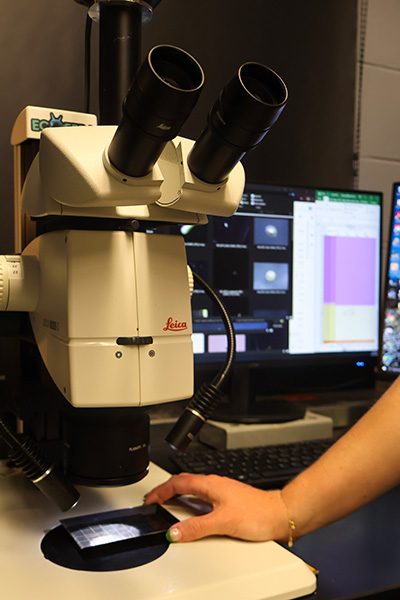
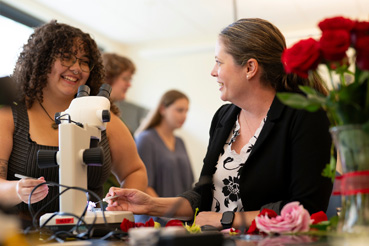
Thea Rind ’26 places a sample under the microscope.
The application asks students what their motivation for being in the mentoring program is, what they hope their monthly mentor meetings will look like and their hobbies outside of academics. This is then read by Assistant Director of Industry Development Maddy Nelson ’21, who manages the mentor program.
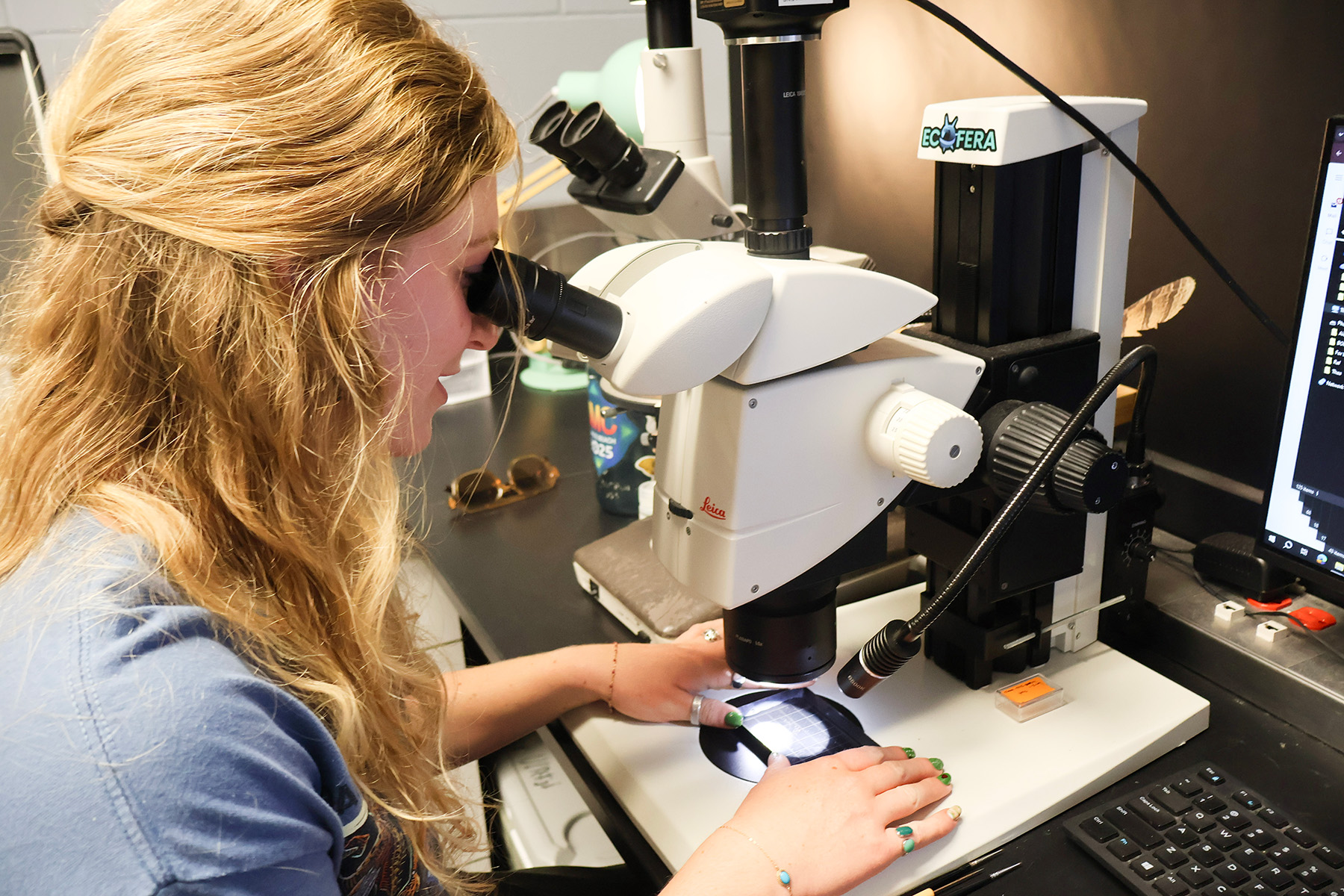
Thea Rind ’26 examines samples from the abyssal deep sea.
“As I read that [student application], it gives me a lot of context so I can get at the core of what they actually want,” says Nelson.
In Rind’s responses, she described her ideal life after Eckerd. She hopes to stay in the Saint Petersburg area, so Nelson wanted Rind to have a local mentor. Mueller checked this box too.
During their year-long mentorship, Rind and Mueller met monthly, always in person. Nearly every time, they met at Habana Cafe, a local Cuban restaurant. They discussed everything from resume writing and graduate school programs to job opportunities Mueller suggested.
Now, Rind is a research technician at Eckerd. Working out of Galbraith Marine Science Laboratory, Rind works to establish environmental baselines in the abyssal deep sea using benthic foraminifera as bioindicators of health. About half of her job is evaluating samples, while the other half is studying deep-sea species that haven’t yet been studied. Some of these species do not yet have the classic scientific name, so a major goal in the lab is creating an atlas for these deep sea species.
When considering the question of why he has revisited the Eckerd community to volunteer as a mentor, Mueller said: “I never really left the Eckerd bubble.”
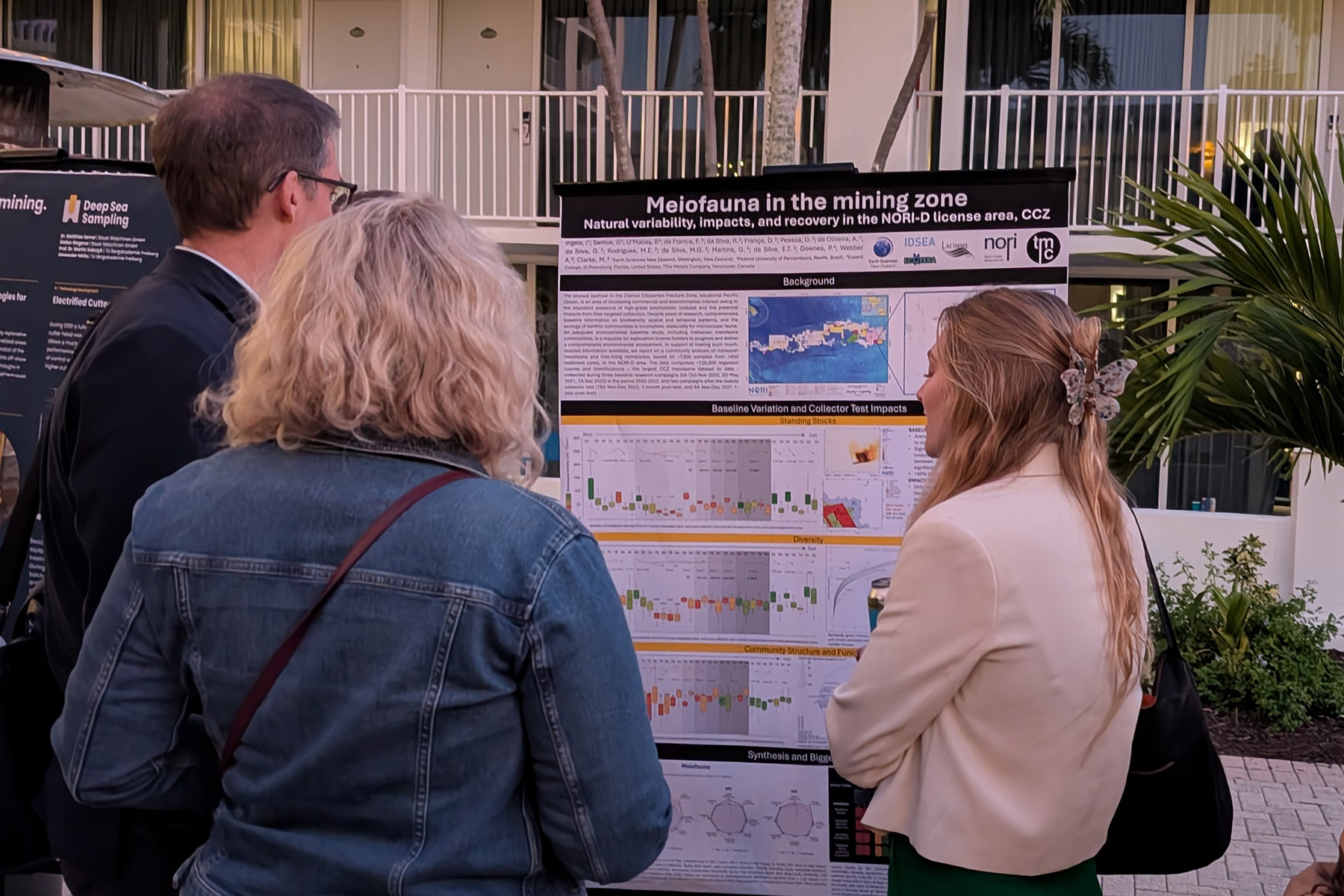
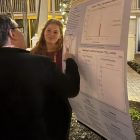
Thea Rind ’26 presented a research poster at last year’s Underwater Minerals Conference. Photo provided by Mark Mueller ’03
He stayed in the area after graduating from Eckerd to earn his master’s degree from the University of South Florida. Now, Mueller is the Chief Scientist at the Florida Institute of Oceanography and Founder of Sea to Sea Advisors, an ocean resource management consulting business.
When Mueller relocated back to Tampa Bay, he attended events at the College and learned about the mentor program.
“I’ve sort of been doing unofficial career mentoring whenever I can, just to try to help students and early career people understand how to help themselves and set themselves up for success later,” he says.
The most memorable piece of advice he gave, Rind says, is selling yourself. It’s been a challenge for her to be assertive and confident, but Mueller’s guidance has been a game-changer.
When Mueller was an Eckerd student, this program didn’t exist. If he had a time machine, he says, there are life lessons he’d share with his younger self. Without a time machine, mentoring other students will have to do.
“I see it as a way of helping Eckerd and giving back to the college that really set me up for success and my own career,” Mueller says.