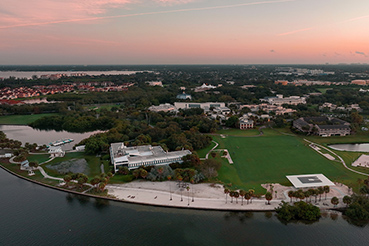

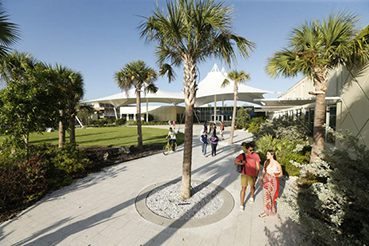


Students in the Autumn Term course Music Videos and Identities listen to Ryan Lambe, Ph.D., give a lecture under one of Eckerd College’s chickee huts. Photos by Penh Alicandro ’22
“Hearing how people make sense of music is amusing,” says Eckerd College Assistant Professor of Music Ryan Lambe, Ph.D.
Music shows up in vastly different ways, whether as a social pressure valve, for aesthetic enjoyment or in cultural rituals, Lambe explains. In his Autumn Term course, Music Videos and Identities, students examine music videos on technical and societal levels.
Lambe saw that music videos offer a bite-sized piece of media, palatable to undergraduates in their first college course. Music videos are flexible teaching tools because you can pay attention to sound, image or cultural studies, he says.
“Pretty much everyone has immediate responses to music videos, So there’s a buy-in there already,” Lambe says.
During the first half of the course, assignments focus on developing language to describe sound and image. Students discussed the melody and bass layers in music. Other times, they analyzed how our attention is impacted by instruments entering and leaving a song.
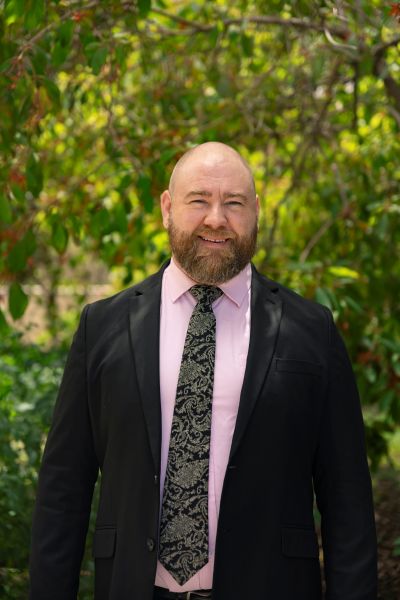
Ryan Lambe, Ph.D.
After building this base knowledge, the class explored broader cultural conversations, from gender and sexuality to race and political questions. Lambe raised the example of the band 100 Gecs.
A member of the band is transgender, which could potentially pose a challenge, as on video the voice doesn’t match the perception of the singer’s gender. Using vocal manipulations like autotune, the band alters the viewer’s senses of the performer’s gender by frequently changing voice modulation, Lambe says.
The class also explored how musicians have responded to racism, gun violence and police brutality over the decades, including works like Childish Gambino’s “This is America.”
AJ Mondala, a first-year from Elk Grove Village, Illinois is planning to study marine science and Spanish. When he was first placed in a music course—he felt uncertain. Now, he couldn’t be happier.
It’s exciting, Lambe says, to see students placed in his class become surprised at how much they enjoy it.
AJ happens to be a musician, playing the drums, guitar, bass and piano. Music videos are something AJ hadn’t thought much about before. “Basket Case” by Green Day stood out to AJ when discussed in class, because its technical aspects give it vivid coloration.
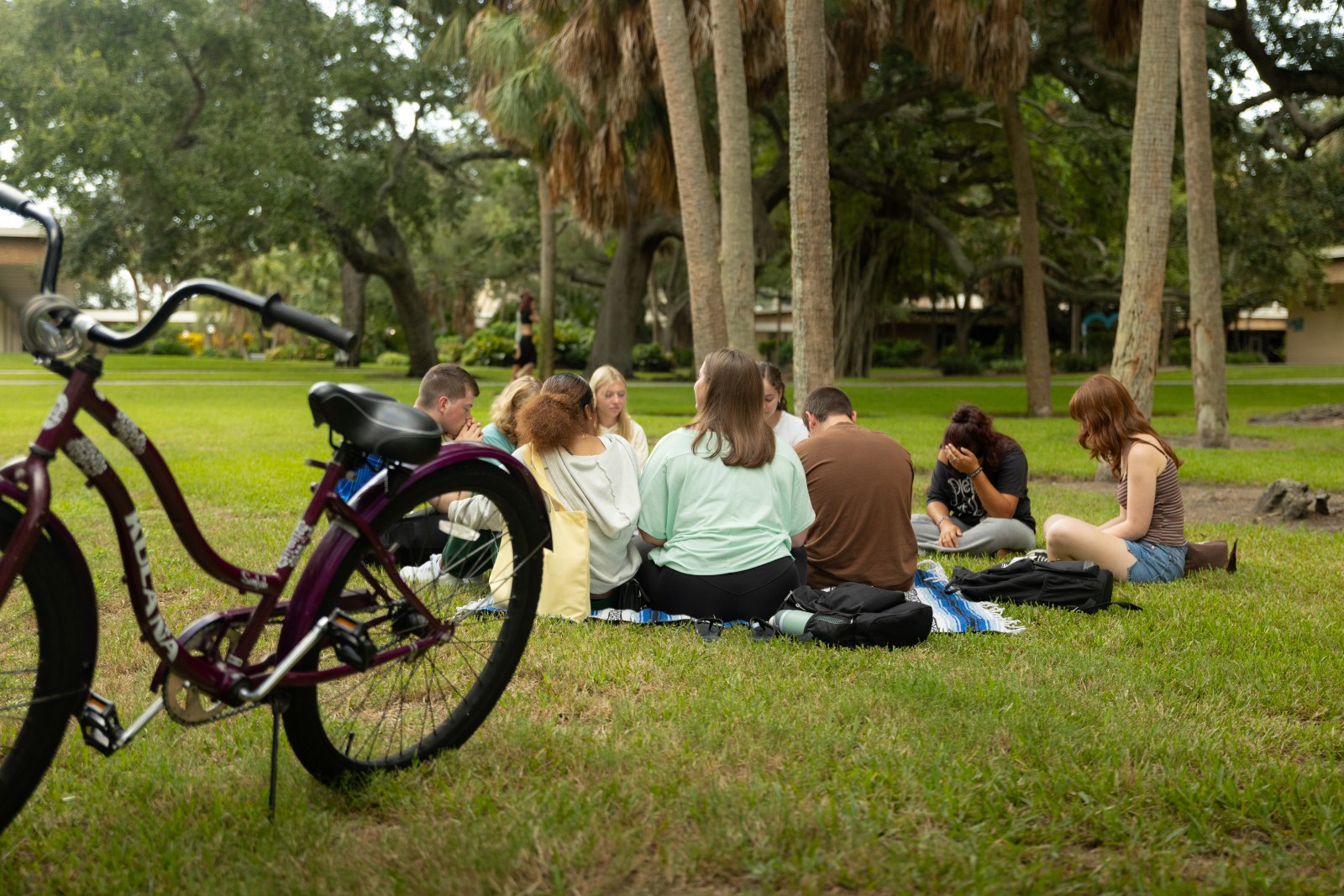
Classes taking place outdoors is a common site at Eckerd, especially in Autumn Term courses designed specifically for first-year students.
“They shot the video in black and white and then used this thing called a ‘digital medium’ to basically add in fake colors, which is why the video looks the way it does,” he says.
When considering how he might think about music differently after this class, AJ says, “It’s funny, I’ve kind of already started doing that.”
Now he watches music videos frequently, seeing the message one can convey differently than a song alone. He asks, “What are they trying to convey and why might they be trying to convey that?”
Lambe emphasizes the importance of branching out in a liberal arts education, and the value a course like this can have regardless of major.
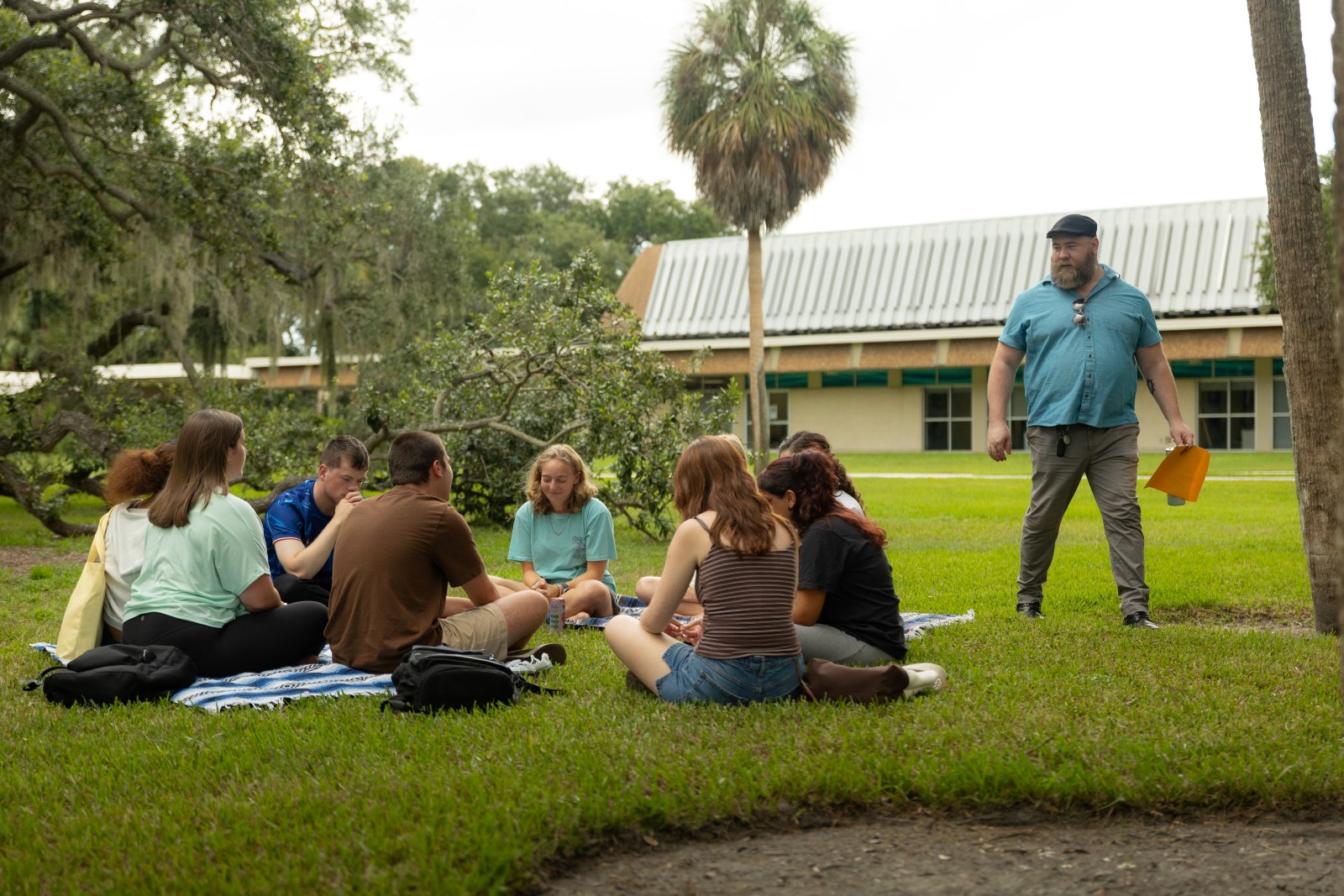
Ryan Lambe, Ph.D. addresses the Music Videos and Identities students during an outdoor class session.
All of the different subjects inevitably connect, Lambe says, because the world is connected. Trying new things is powerful, especially in a world hyper-focused on jobs and productivity, he says. Students have come to Lambe, feeling as though they cannot study music in college. He tells them they can. All the way to the doctorate level.
Lambe holds degrees in music education and cross-cultural musicology, through the doctorate level himself. However, he says succeeding in classes isn’t the only thing to focus on. The experience of learning and finding joy is vital.
“I love the arts because it takes joy and pleasure seriously,” Lambe says.