
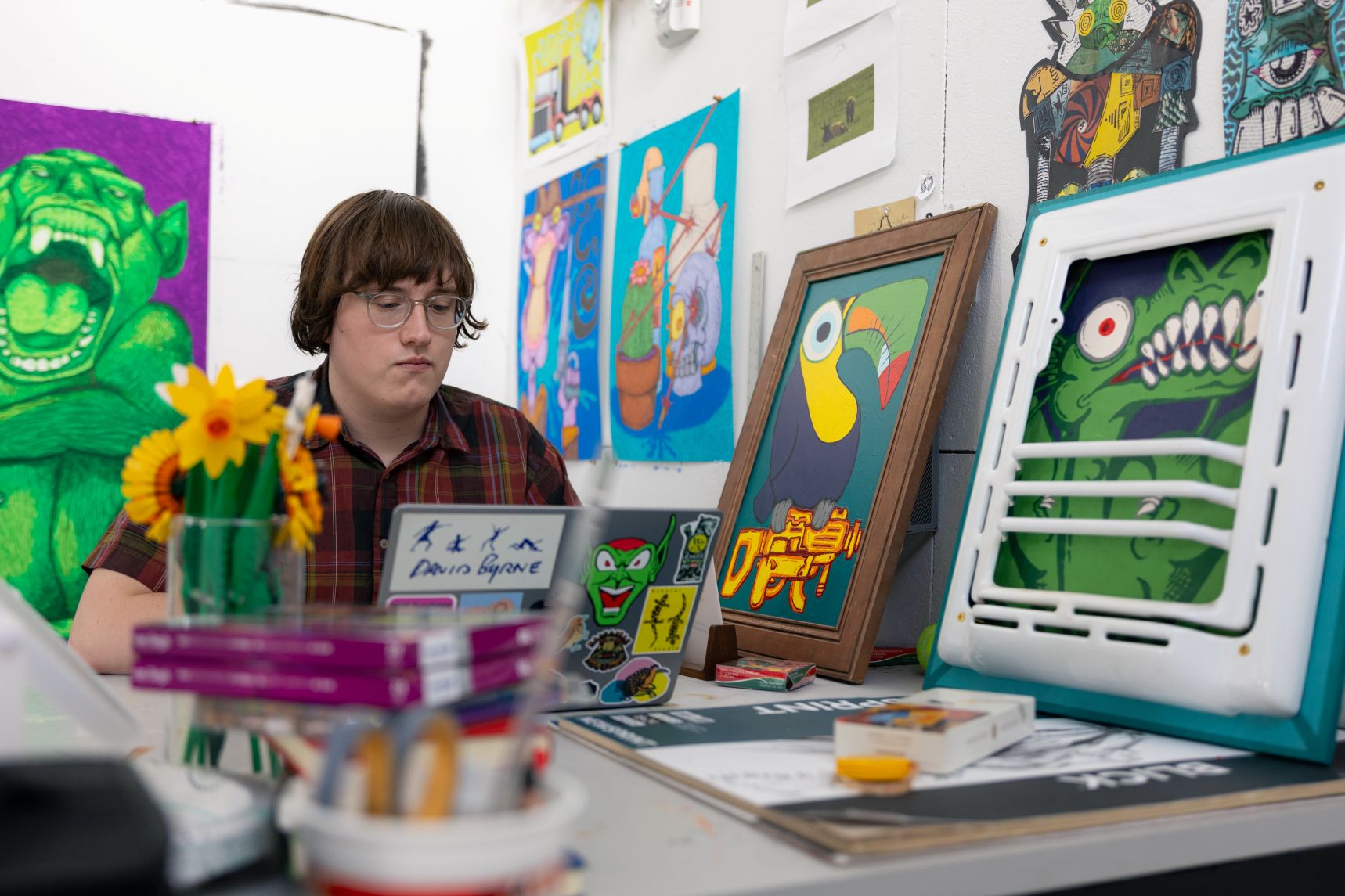
August Lambrecht, a senior visual arts and film studies major, works in his art studio. Photo by Penh Alicandro ’22
At Eckerd College, art students have dedicated studios to work on their projects 24 hours a day.
Ezio Severens, a senior visual arts and French major from Takoma Park, Maryland, recalls their first night in their art studio. Ezio has insomnia, so he prefers to work late at night. Their parents, being in a different time zone, could talk on the phone while Ezio created their art.
“It’s really pretty unheard of for undergraduates to have studios,” says Assistant Professor of Visual Arts and Discipline Coordinator Rachel de Cuba.
As an undergraduate, de Cuba and her partner—also an artist—had to split the floor space in their apartment to work on art projects. She didn’t have a campus space with 24-hour access to work on her art.
For Ezio, the studio allows him to maintain a creative flow by working at the time of day that aligns with his energy, whether it be a break between classes or at three in the morning.
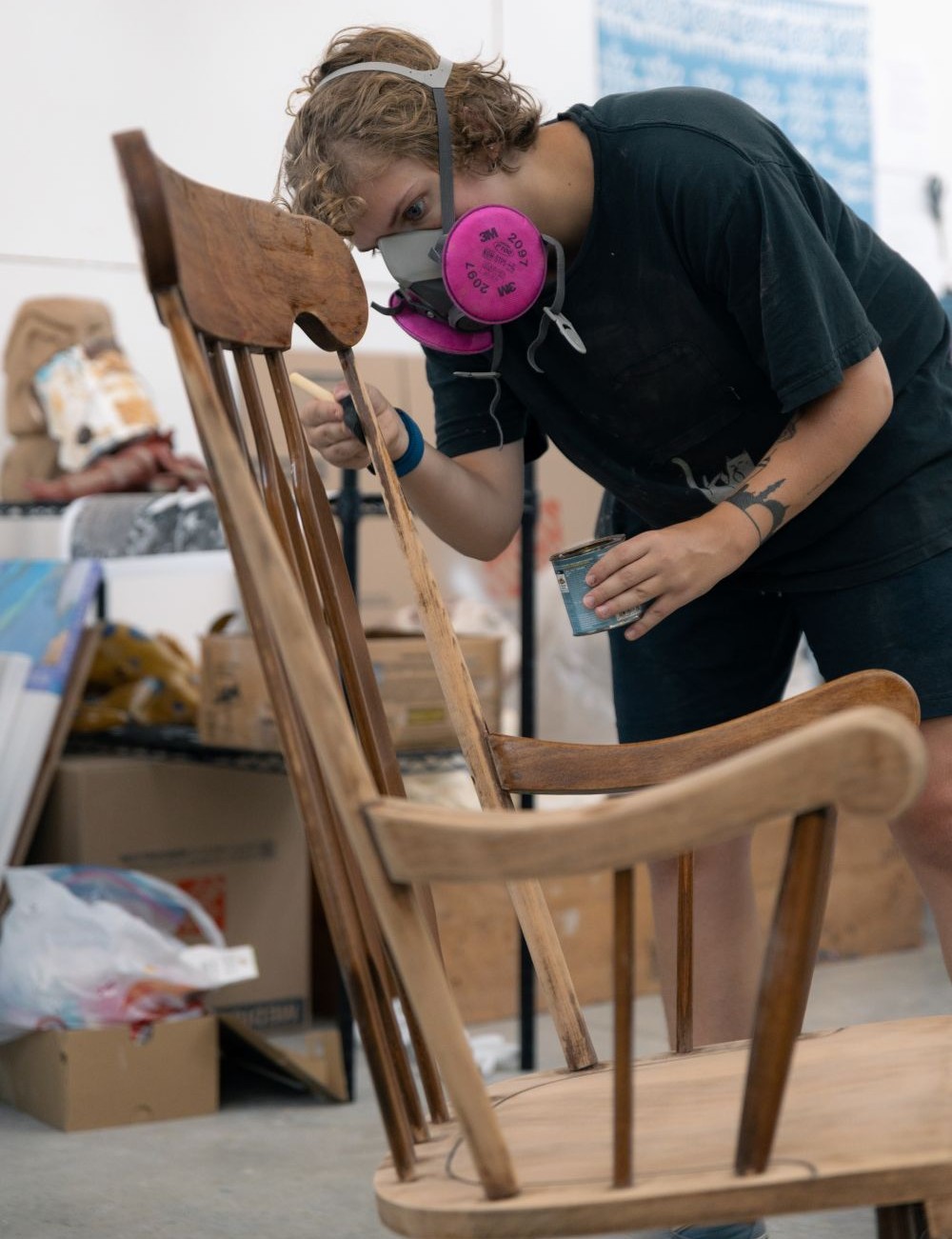
Ezio Severens often works in their art studio late at night. Photo by Penh Alicandro ’22
The seven art studios at Eckerd are designed for visual arts majors and accommodate four students each. Junior and senior students get priority, though sophomores can occasionally get a studio space. Seniors are expected to develop a coherent body of work and be able to present it professionally in the form of a solo or two-person gallery exhibition.
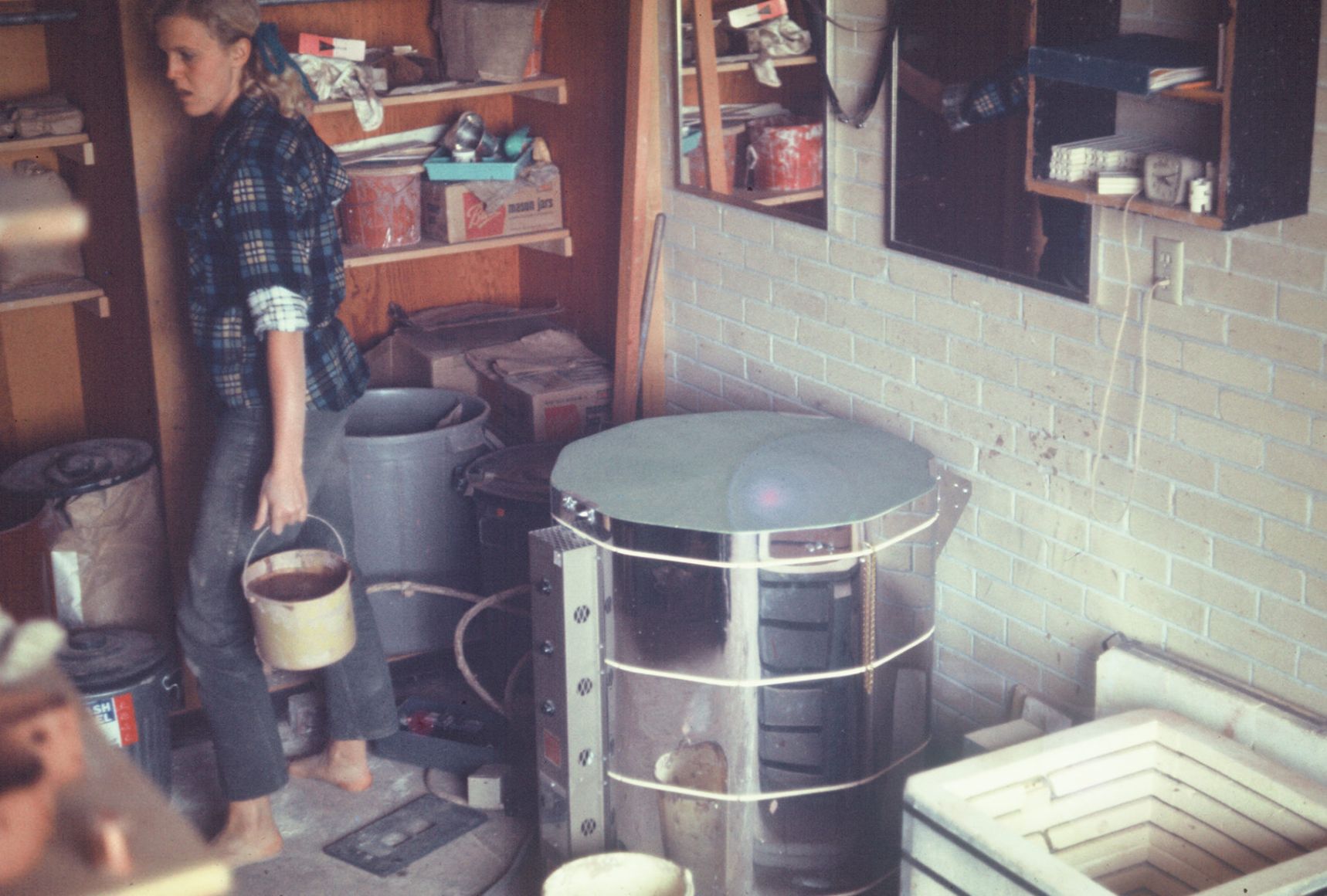
The art classrooms at Florida Presbyterian College (now Eckerd) were housed in an empty dormitory from 1964-1970, as seen by the presence of a kiln in this dorm room. Photo courtesy of Arthur Skinner ’72
“You have to be a major in order to qualify for a studio,” de Cuba says. “You get the privilege, because we have the expectation of and rigor of a program that you need the studio—you need the space and time.”
Eckerd’s history of art studios had humble beginnings
Though Eckerd’s art studios are a longstanding feature of campus, they weren’t always what they are today. In 1964, as the art department was growing, the only available space for additional art classrooms was an empty residence hall. Rather than try to teach in residence hall rooms, students used them as studio space.
“Welding happened in the downstairs dorm lounge area. The upstairs bath served as a darkroom. The downstairs bath once served for fabric dyeing,” says Professor Emeritus of Visual Arts and Gallery Director Arthur Skinner ’72.
“Ceramics happened in a dorm room. Glazes were stored in the closet,” he says.
Classes for critique were held either in the upstairs dorm lounge or the complex lounge, and occasionally outside, Skinner says.
A state-of-the-art home for artists
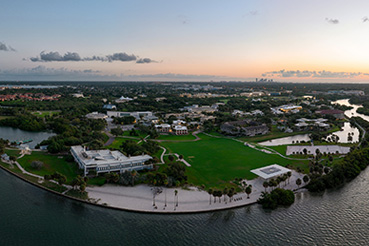
The art studios are now housed in the 33,000-square-foot Nielsen Center for Visual Arts. In addition to the students’ studios, the Nielsen Center houses a film photography darkroom, classrooms, and a ceramics and sculpture yard.
The cutting-edge facility opened in 2018, and its $15 million construction costs were largely made possible thanks to the generosity of more than 350 Arts Fellows, including the building’s namesakes, Helmar E. Nielsen and his daughter Enole. Helmar E. Nielsen, a former Eckerd trustee, made a gift of $7 million to the visual arts discipline, including endowing a professorship in film studies.
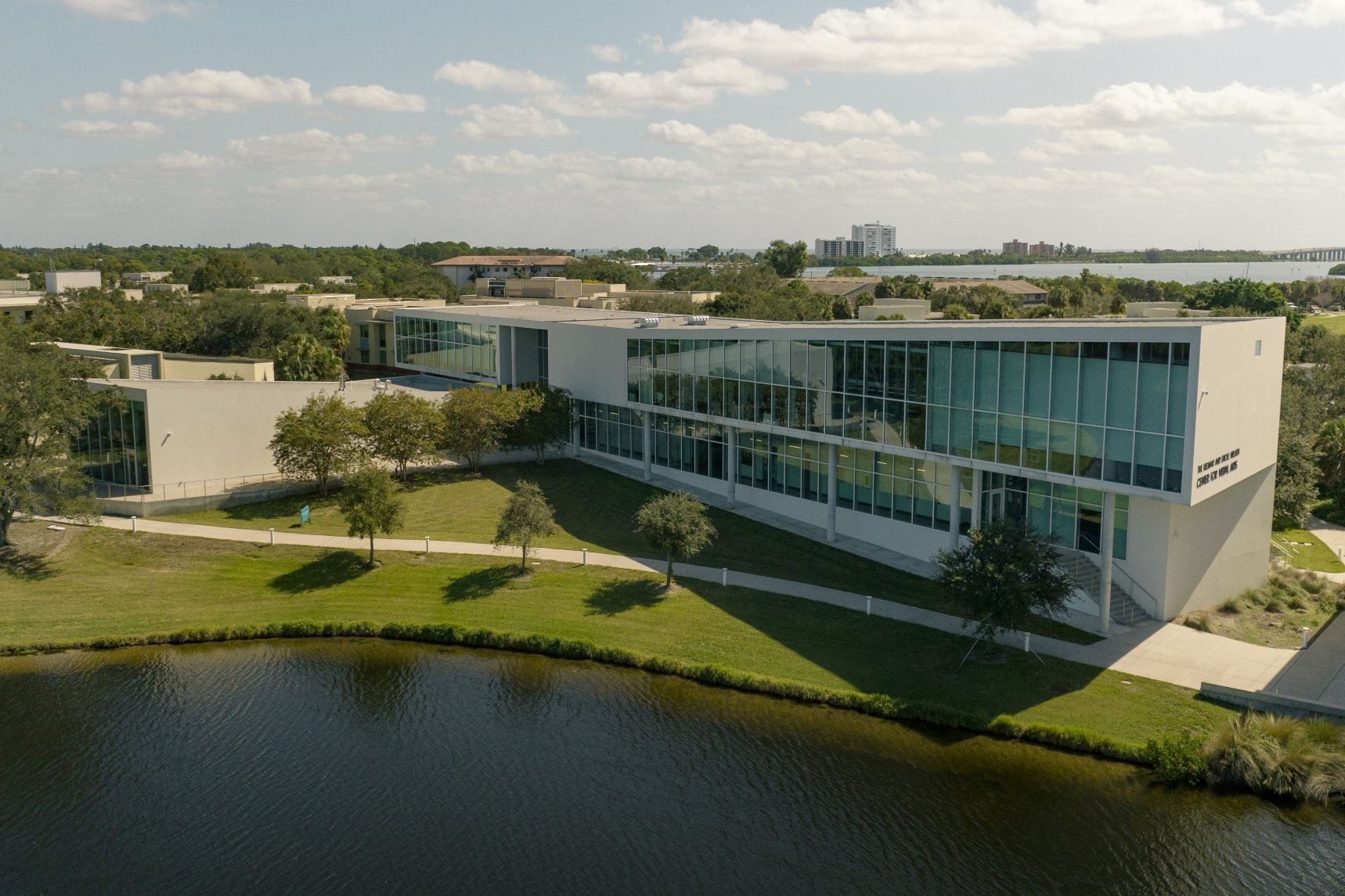
The 33,000-square-foot Nielsen Center for Visual Arts. Photo by Penh Alicandro ’22
Students work across mediums in their studios, and Ezio primarily works with pen drawing and pyrography, or embellishing wood using controlled burn marks from a heated metal tool.
August Lambrecht, a senior visual arts and film studies major from San Antonio, Texas, often works with graphic design, painting and filmmaking.
August appreciates the small class sizes at Eckerd and the tight-knit community he’s found. In his studio, while working alongside other students, he feels that he receives constructive feedback that some people may not feel comfortable enough to share in a class setting.
“It’s good to be in a space where I get the input of other artists, instead of just creating in a vacuum,” August says.