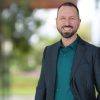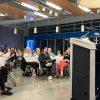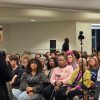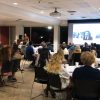

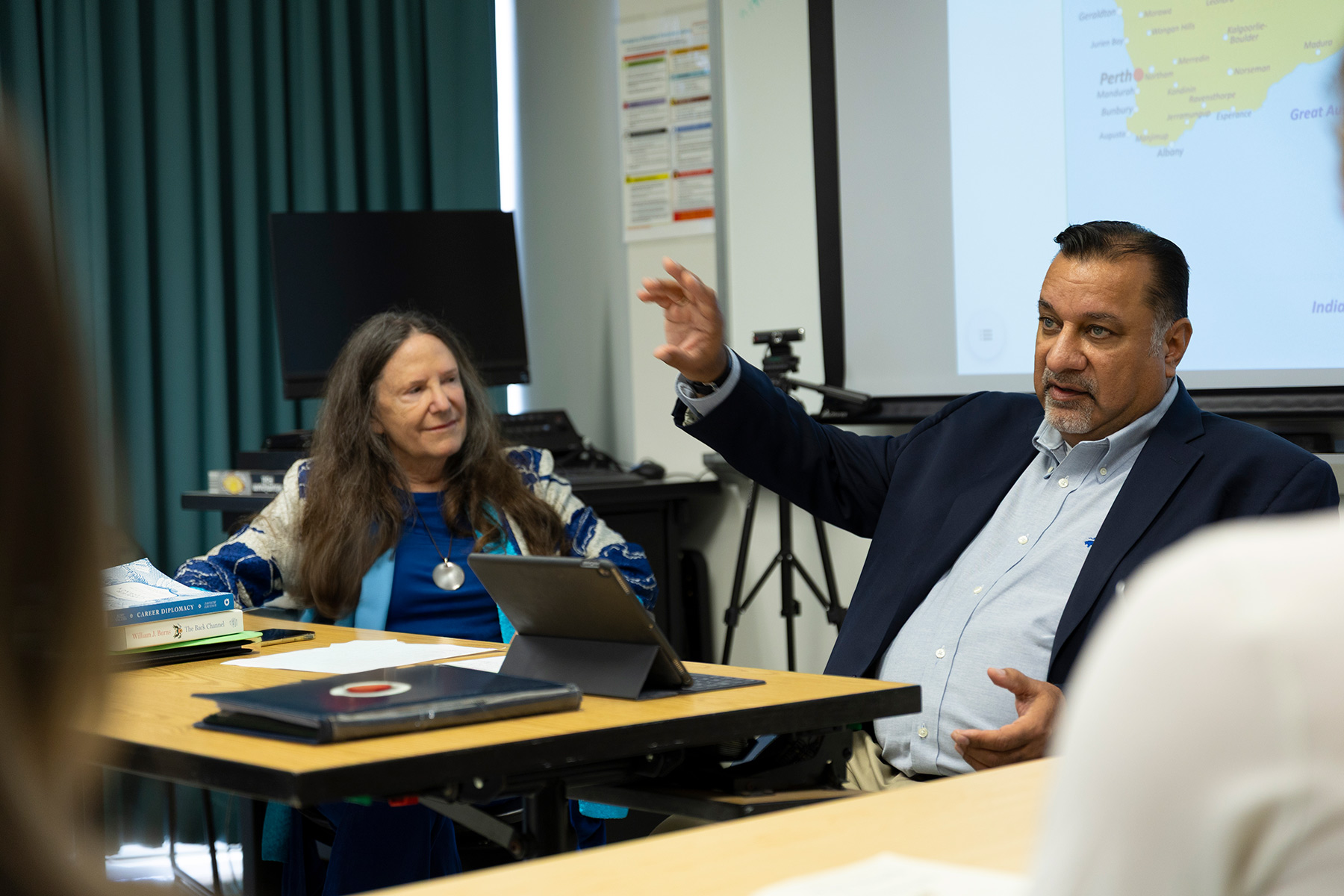
Professor of History and American Studies Carolyn Johnston, Ph.D., (left), mentored Nasir Abbasi ’89 (right) before he became a career member of the U.S. Foreign Service and diplomat. Photos by Penh Alicandro ’22
After 37 years, Nasir Abbasi ’89 and Carolyn Johnston, Ph.D. are working together again, this time co-teaching an Eckerd College Winter Term course titled The History and Practice of Diplomacy that combines their unique experiences and insights. Johnston was Abbasi’s mentor when he was a student at Eckerd.
A January tradition at Eckerd since 1961, the three-week Winter Term offers students a chance to study abroad or on campus. “I wanted to take a Winter Term class that would give me a more well-rounded perspective of the world, “ says Miranda Arias, a junior international relations and global affairs student from Norwalk, Connecticut, “and The History and Practice of Diplomacy is perfect. Professor Johnston has a real passion for U. S. History, and Professor Abbasi has stories about whom he dealt with and what he did in Australia, Saudi Arabia, and other countries. The first day, when I learned who he is, I called my mom immediately.”
Johnston is a professor of history and American studies and the Elie Wiesel Professor of Humane Letters. She earned her bachelor’s degree in History from Samford University and her master’s and Ph. D., in History from the University of California at Berkeley. She has written six books, and was a recipient of a Woodrow Wilson Fellowship and a Danforth Fellowship. At Eckerd, Johnston taught 24 Winter Term courses with Dr. Elie Wiesel, the world-renowned author, human rights activist and Holocaust survivor. She also helped develop new Eckerd programs such as the Environmental Studies major and the Women’s and Gender Studies major. Last year she was honored with the renaming of the Johnston-Ford Scholars Program. She has taught in the program since its inception.
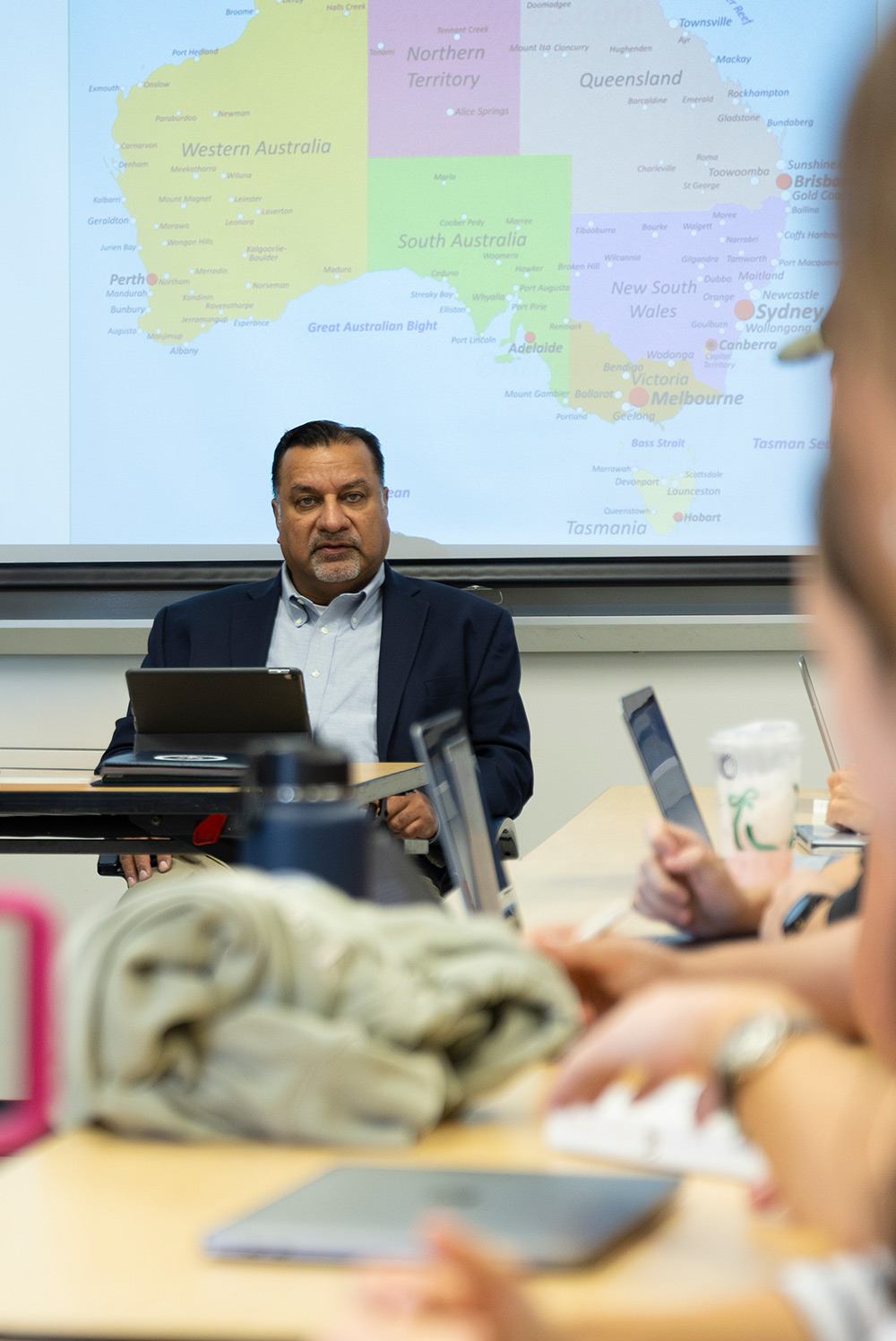
Abbasi was excited to teach post-retirement and reached out to Eckerd College to find an avenue to share his knowledge.
Abbasi served as a senior member of the U.S. Foreign Service with Presidents Clinton, Bush, Obama, and Trump, and is now an adjunct at Eckerd College. He was in Eckerd’s first class of Ford Scholars, he graduated with a bachelor’s degree in management and then earned an MBA in international business from the American Graduate School of International Management. He served as a U.S. diplomat for more than 30 years, working at diplomatic missions in Saudi Arabia, Malaysia, the United Arab Emirates and Australia.
While working as a diplomat was rewarding, Abbasi says it could also be a challenge.
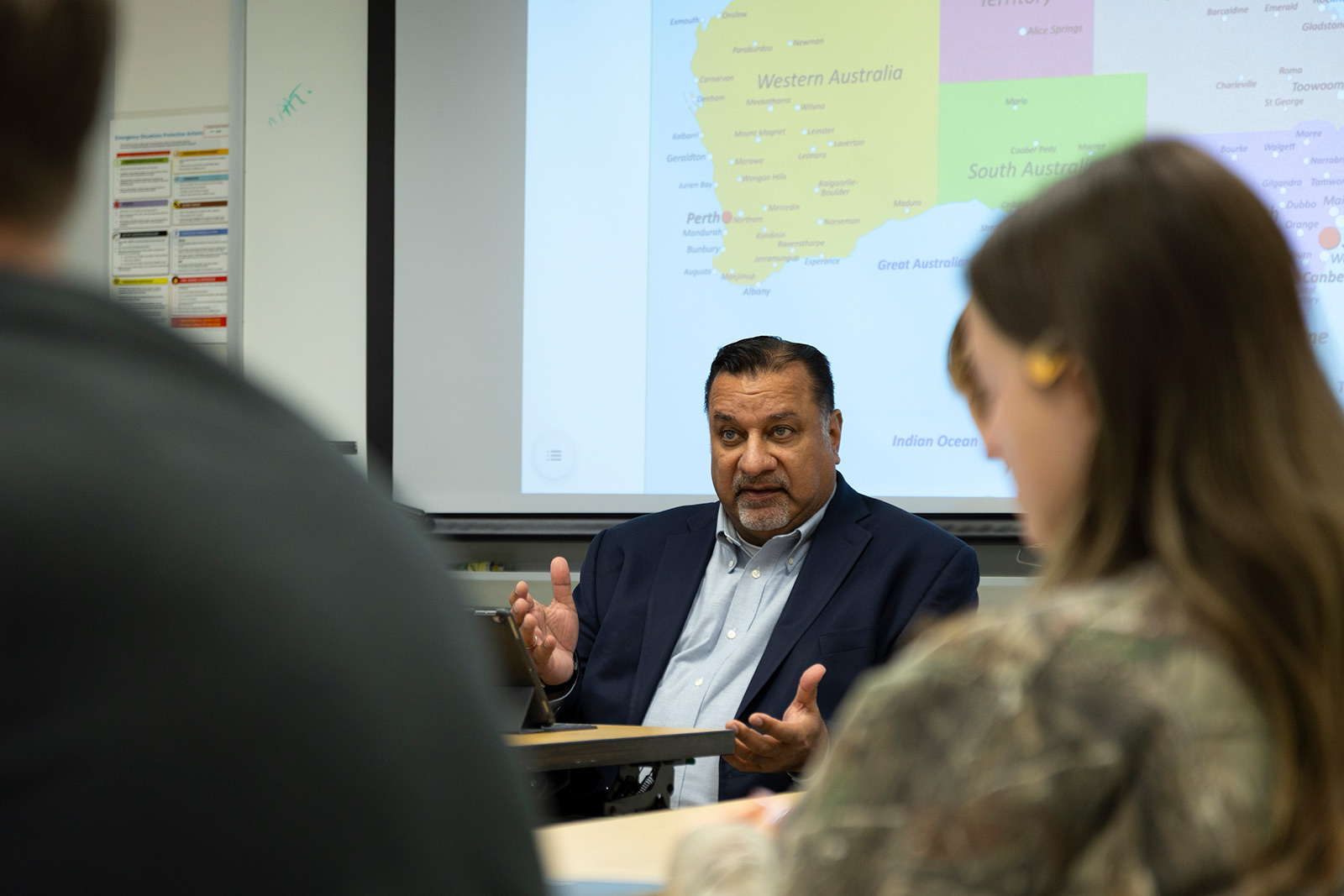
Students got to hear background stories and lesson learned from Abbasi that helped shaped his rise to a senior U.S. Foreign Service official for four administrations.
“When you get to an embassy, they don’t teach you any of this stuff,” he says. “You learn as you go. You learn from the ambassador, your colleagues and local staff at the embassy. You must learn to navigate in a different cultural setting and with a foreign language.”
Throughout his career, Abbasi organized high level visits to Saudi Arabia (such as Presidents Bush, Obama, and Trump), negotiated a free trade agreement between the U.S. and Australia, advocated for U.S. businesses with the King of Saudi Arabia, and landed high dollar-value contracts in Malaysia that created jobs in the United States, and successfully convinced the Malaysian government to sign the nuclear non-proliferation treaty.
“When I retired from the Foreign Service, everyone was telling me to share my information, to teach, write a book or memoir,” Abbasi explains. “I visited Professor Johnston and suggested to her that I would like to share with the students my experiences as a diplomat, because Eckerd is where I got my start. The College gave me the discipline to go into the career track I did. She suggested we teach a Winter Term together, giving me an opportunity to give back and share what I had learned. For the next three months we planned the course.”
Abbasi adds that he wants students to gain an understanding of how diplomats serve overseas representing the U.S. government, and the complex interactions with different cultures, religions and languages. “Your job as a diplomat is to carry out the work of your government in that particular country,” he says. “But first you must build a relationship of trust with your counterpart. And you have to be able to convey your point without having a conflict about it. Did they really understand the meaning of what you’re trying to convey because of the language difference? Sometimes they may not agree with your position.”
Johnston doesn’t hide her admiration for her former student. “Nasir was brilliant then and he is now,” she says. “He has negotiated high-stakes commercial agreements, advised senior U.S. officials on international trade policy, and overseen embassy operations across the Middle East and Asia. His expertise spans economic diplomacy, commercial development, and international relations. With a distinguished career in the U.S. Foreign Service, he offers Eckerd students a rare opportunity to engage with the real-world practice of international diplomacy, commercial strategy, and foreign policy execution.”
Jackson Davis, a student in Johnston’s and Abbasi’s Winter Term class, is a sophomore business administration student from Marietta, Georgia, and a member of the Eckerd baseball team. He also doesn’t hide his admiration. When Abbasi asked Jackson what he wanted to be, Jackson answered, “I want to be like you.”