
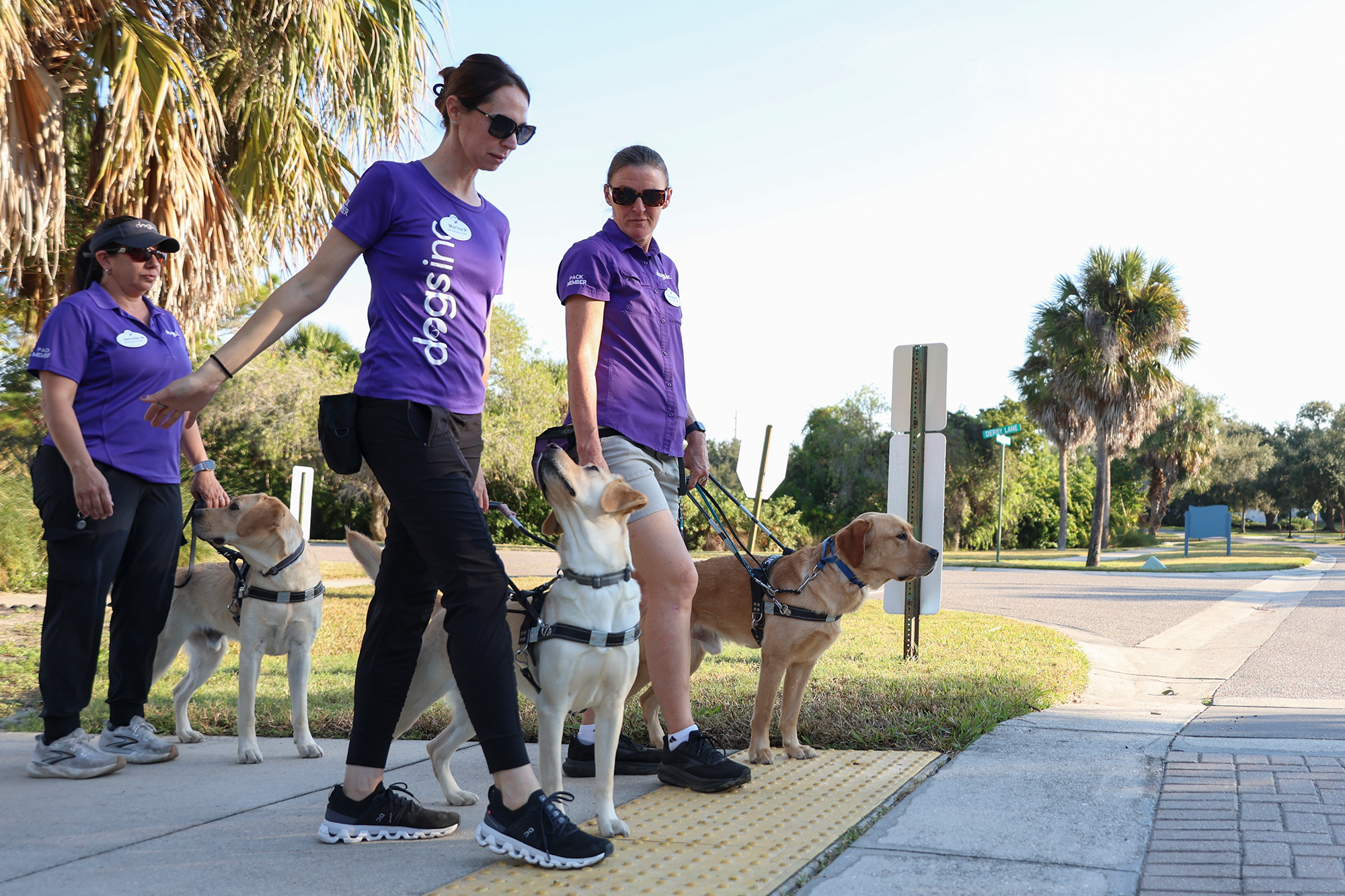
Dogs Inc trainers use the different campus terrains to train the service dogs on how to be helpful companions. Photos by Penh Alicandro ’22
Recently, in front of the James Center for Molecular and Life Sciences on the Eckerd College campus, Jennifer Johnson ’99 and a yellow labrador retriever named Russet arrived at the top of the downward steps when Russet slowed to a stop.
It was an easy six steps to the bottom, but Russet has been trained to halt when he comes to stairs, curbs or obstructions. The person holding Russet’s handle could be blind, visually impaired or have a disability that would make navigating sidewalks or even familiar places dangerous. Russet is a canine early-warning system.
“So when Russet stops,” Johnson explains, “the person knows to probe what’s ahead.” She looks down at her companion sitting patiently by her feet. “Good boy.”
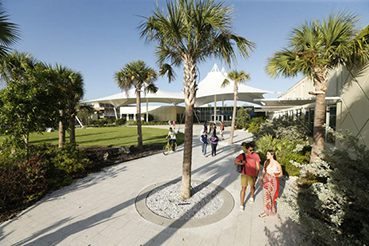
People strolling through Eckerd’s campus will be seeing more of Russet and many of his closest friends in the future. The College recently agreed to partner with Dogs Inc, a Palmetto nonprofit (formerly known as Southeastern Guide Dogs) that will start using the Eckerd campus for guide dog and service dog training several times a month.

Jennifer Johnson ’99 walks Russet through a stairs exercise.
Johnson, who serves as director of guide dogs for Dogs Inc, says she will bring a group that usually includes 15–20 animals and several Dogs Inc trainers. Each trainer will lead and train four or five dogs during the course of a day. They will operate usually from 8:30 a.m. to 1:30 p.m., and while they will be visible on campus, the dogs and trainers will be trying to stay to themselves, because these will be working sessions.
Dogs Inc, founded in 1982 as Southeastern Guide Dogs, has a mission of training young canines to become guide dogs, service dogs and skilled companion dogs and then pairing them—at no cost—with people who have vision loss, veterans with disabilities, children facing significant challenges, and others who can benefit from these partnerships.
Dogs Inc pups are born on the organization’s Palmetto campus and then placed with volunteers at about 10 weeks old. The pups return to campus about a year later to start their advanced instruction. That’s when the trainee chooses its “career path”—guide dog, service dog, therapy dog or skilled companion dog.
About half a dozen Eckerd alumni currently work at Dogs Inc, including Johnson, who graduated from Eckerd with a Bachelor of Arts degree in environmental studies and a minor in biology. After working in a veterinarian’s office and volunteering for SPCA, she started working for Southeastern Guide Dogs in 2006.

Animals are provided to people in need, free of charge.
“The benefit we have working at Eckerd,” she explains, “is that the dogs are being trained in a real-world situation—crowded sidewalks with bicycles and skateboards, walking through Starbucks … and it’s all at one venue.
“And I believe in the human-animal bond,” she adds. “That’s an incredible motivator. The dog’s job is to help people get from point A to point B safely. If the dog sees a hazard, it will stop. Then it’s the job of the handler to figure out why the dog stopped. The person can search with their foot or hand to figure out what the hazard is. It’s a partnership.”
Johnson hopes the Eckerd College–Dogs Inc partnership will continue for the foreseeable future. “I think the Eckerd campus will always be a valuable venue for us to train the dogs,” she says. “It’s not far for us to travel, and there are so many elements of our training process we can work on while we’re on campus. When we walk around during our visits, I see a lot of smiles. But everybody is very respectful of the work we’re doing.”
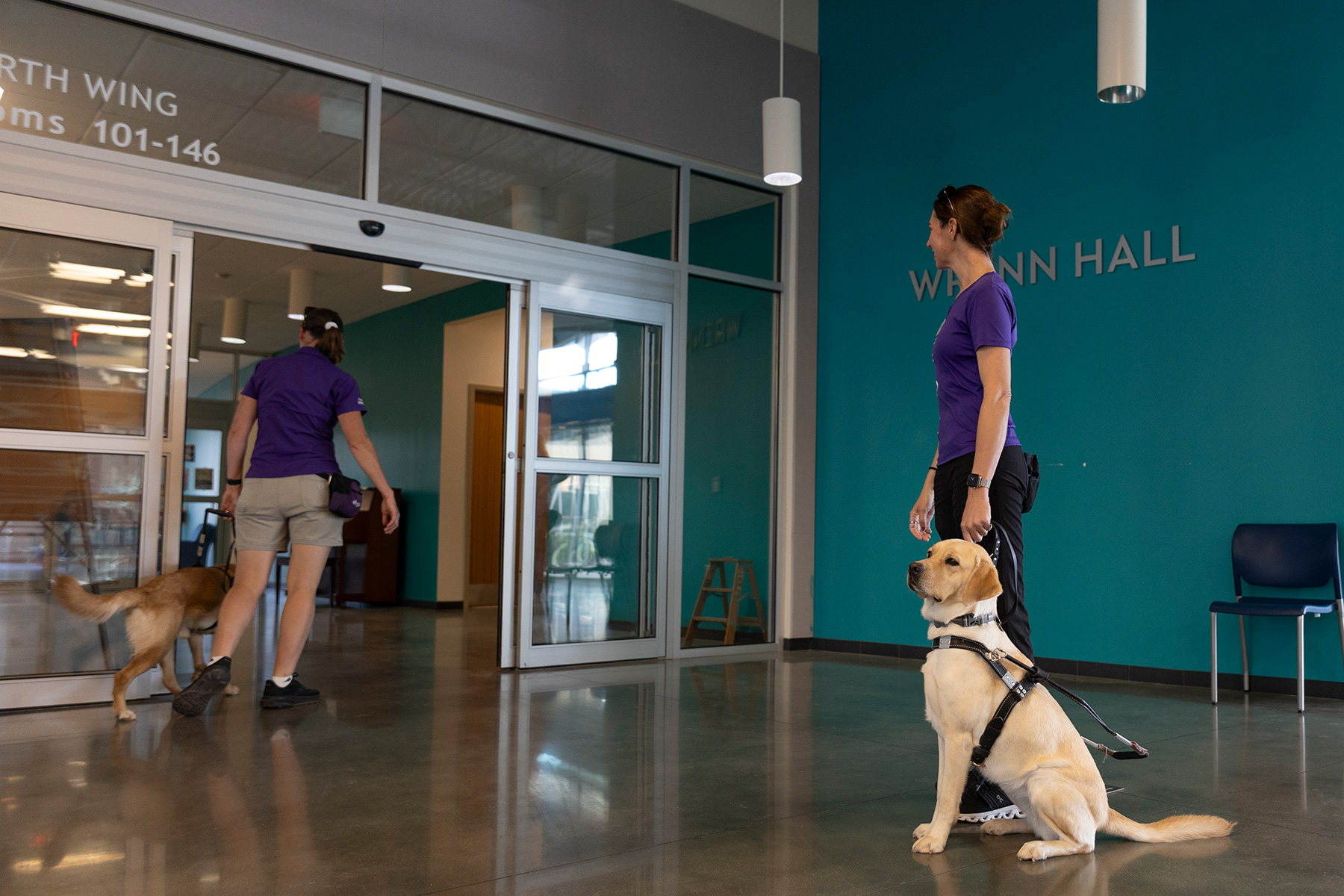
Hazards like automatic doors are a vital part of the training program for guide dogs.
Few people at Eckerd College have a better understanding of what it takes to successfully train a dog than Lauren Highfill, Ph.D., professor of psychology and animal studies. She founded the Eckerd College Dog Training Program and, using a grant, led a group of students that taught a therapy dog named Orlo to play rudimentary video games to improve his learning ability and mental health.
“I had Jennifer Johnson visit my Dog Behavior and Cognition class last spring, and it was a highlight for the students,” Highfill says. “They learned a tremendous amount about the raising and training of guide dogs, and, of course, they absolutely loved meeting a dog-in-training. I’m planning to have Jennifer come to a different course this spring, and I’m excited to broaden the connection for more students.
“Dogs Inc is an ideal practicum site for our animal studies majors who are required to complete hands-on fieldwork as part of the curriculum,” Highfill adds. “Having such a strong partner right across the bridge is a huge asset. There are so many ways for our students to volunteer, intern, and gain real-world animal-care and behavior experience with Dogs Inc.
“Animal studies faculty are also looking forward to expanding the collaboration in additional directions over time. I would love to explore future opportunities, including the possibility of student-driven research projects with Dogs Inc. There’s enormous potential for mutually beneficial work as our partnership develops.”