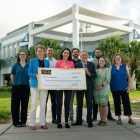

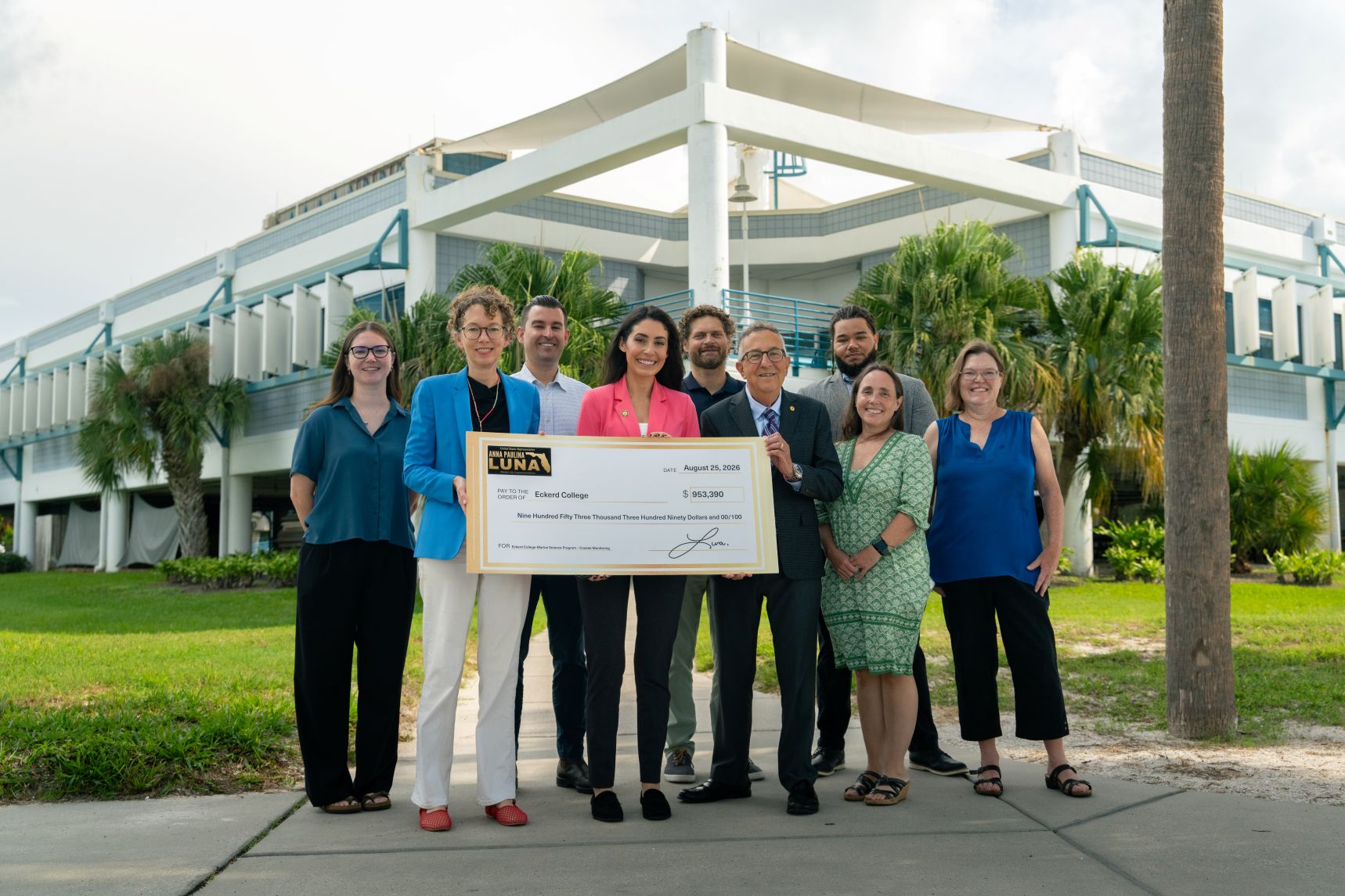
Congresswoman Anna Paulina Luna (center, pink shirt) presents a check for $953,390 in federal funding for marine science research at Eckerd College. Photo by Penh Alicandro ’22
Eckerd College’s marine science faculty research some of the most critical issues facing Florida’s coastal waters, creating opportunities for students to engage in this important work as well.
That research received a significant boost on Tuesday with the announcement of a $953,390 infusion of federal funding earmarked for the College from the National Oceanic and Atmospheric Administration.
The funding, to be administered by NOAA’s National Ocean Service, will support four specific projects. All four address key concerns about Tampa Bay’s waters and may enable the replication of similar monitoring programs in other coastal waters and estuaries across the nation.
“Monitoring really is critical, but difficult for typical college/university settings to fund through traditional pathways,” says Associate Professor of Marine Science Amy Siuda, Ph.D.
This funding will allow students to engage in hands-on research without competition from graduate students.
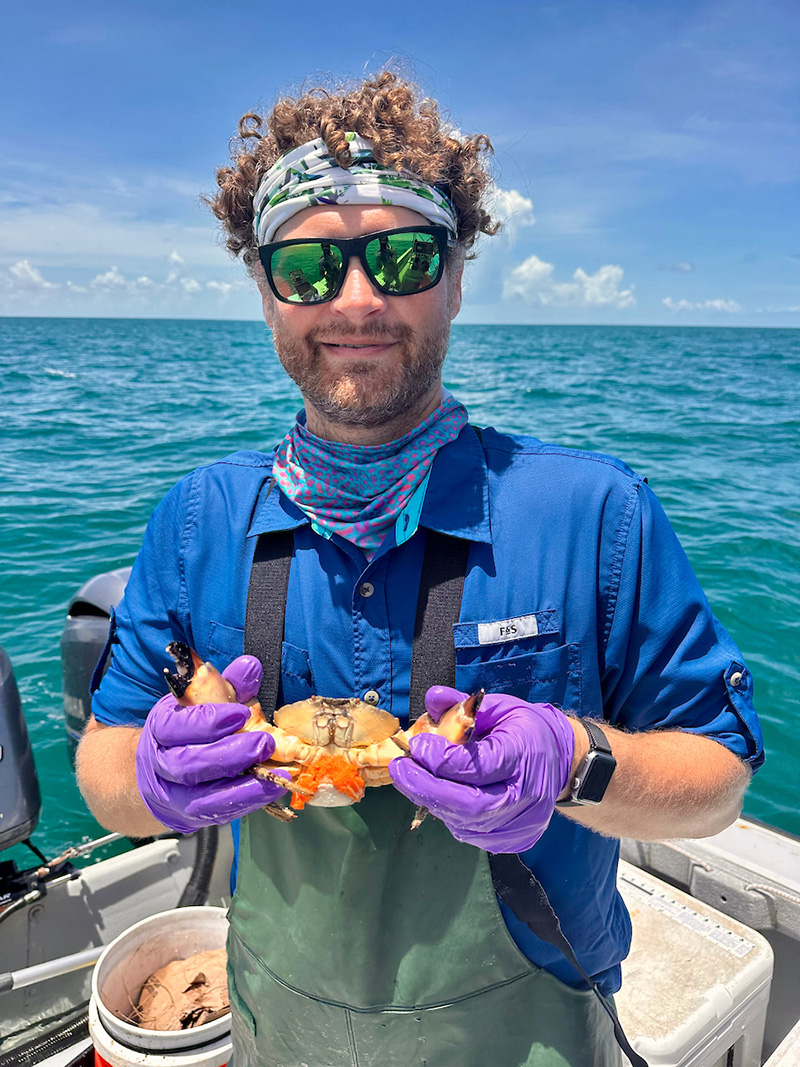
Part of the federal funding will support Philip Gravinese’s work monitoring stone crab populations in Tampa Bay. Photo by Vianne Kossman
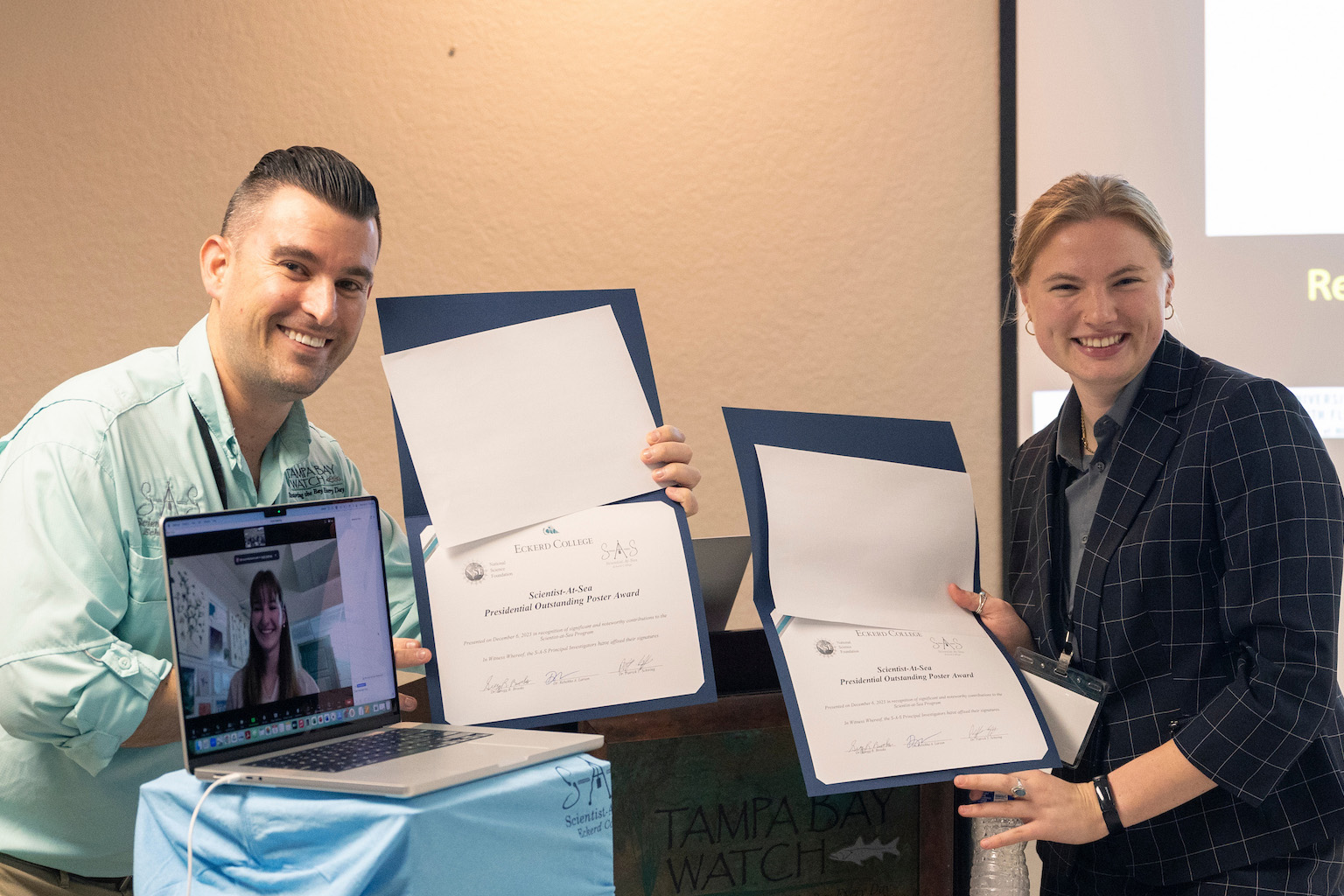
Assistant Professor of Marine Science Patrick Schwing ’06 (left) joins Rosalie Cruikshank ’25 (laptop screen) and Rachel Flickinger ’25 in celebrating their President’s Awards at the Eckerd College Scientist at Sea Research Symposium in 2023. Photo by Penh Alicandro ’22
“It helps support students in gaining experience, building their scientific skills and professional development,” Siuda says.
Professor of Biology and Marine Science Shannon Gowans, Ph.D., and Siuda guided a team of student researchers in 2017 to establish a baseline for microplastic pollution. Sustained monitoring is needed to track the prevalence of this emerging contaminant and the ecological implications when marine life consumes the plastic. The additional research this year could help form a sustained monitoring model that could be replicated in estuaries nationwide.
Associate Professor Patrick Schwing ’06, Ph.D., will use the funding in support of a collaboration with the Florida Fish and Wildlife Conservation Commission’s Fish and Wildlife Research Institute to try to forecast harmful algal blooms. Red Tide has had devastating effects on the region’s marine life and takes a toll on the economy through reduced tourism during large blooms. Through improved monitoring of the benthic zone of the West Florida Shelf, the research team hopes to understand better the conditions that cause Red Tide blooms to form.
“There have been blooms in Tampa Bay and Safety Harbor, pretty much annually, for decades. After the hurricanes, two years ago, there haven’t been any blooms. And so the question is: why?” asks Schwing.
Students at Eckerd can get involved with research during their first year. Schwing actually prefers it.
Through the first-year student research associateship program and introductory courses, Schwing aims to identify interested first-year students, train them over a semester, and then work with them for several years.
A new laboratory group led by Assistant Professor Emily Lancaster, Ph.D., is using environmental DNA to detect invasive species in portions of Tampa Bay, particularly in murky harbors, where visually identifying them is challenging. Early detection of invasive species creates the potential to eradicate them before their populations swell to levels that harm native species.
The fourth project will explore how oxygen levels, seawater temperature, and acidity impact the settlement patterns of juvenile stone crabs. Assistant Professor Philip Gravinese, Ph.D., and his ecophysiology students are exploring the reproductive biology, larval development, and eventual settlement patterns of stone crabs. The region’s stone crab fishery represents an industry of approximately $30 million annually; however, annual harvest landings have declined by nearly 30% over the last three decades.
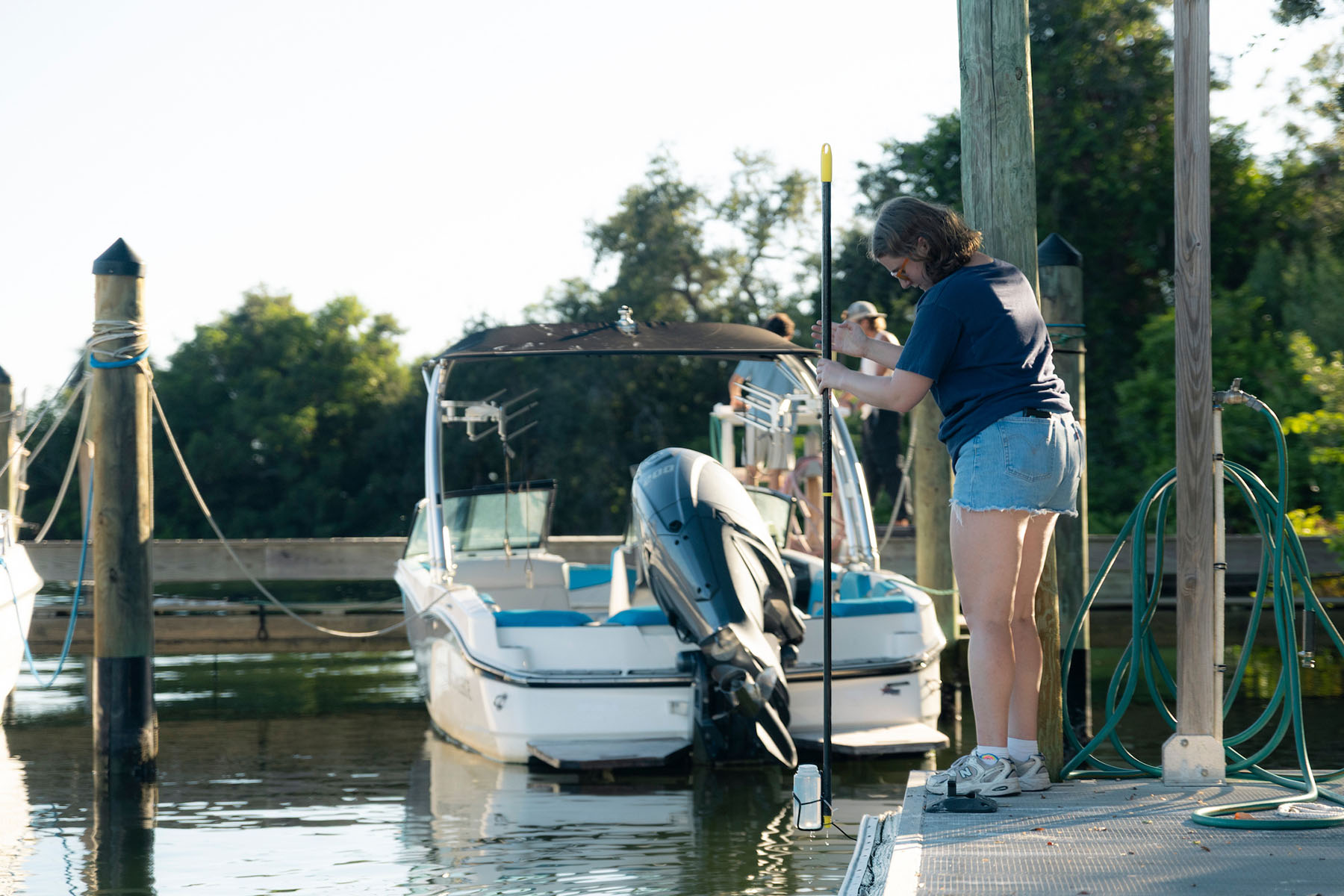
Gaby Hoenig ’26 takes a water sample from the waterfront to conduct environmental DNA tests in Emily Lancaster’s lab. Photo by Penh Alicandro ’22
A recent report from the Tampa Bay Estuary Program indicated one in every 10 jobs in the Tampa Bay region depends on the health of local waters. Developing robust water monitoring initiatives is of monumental importance for both the ecological and economic health of the region.
Congresswoman Anna Paulina Luna played an instrumental role in securing the research funds for Eckerd. She visited the campus recently to formally present the funding.
“We are deeply grateful to Congresswoman Luna for her support of the College’s work in furthering the protection of the coastal resources of our Tampa Bay region,” says Eckerd President James J. Annarelli, Ph.D.
“Florida’s way of life depends on healthy waters,” said Rep. Luna. “This funding gives Eckerd scientists and students the tools to better understand Tampa Bay and preserve it for generations to come.”
The research initiatives will create high-level undergraduate research opportunities Eckerd is renowned for. Students will be involved in every phase, from sample collection and laboratory testing to the examination of results and the reporting of findings. Eckerd will share the data with numerous local, regional and national stakeholders, like FWC, the Gulf Estuarine Research Society and NOAA.
“Having the funding to support these monitoring projects allows us to understand the baselines of what’s going on in Tampa Bay, which is really important,” Siuda says, “for when there’s perturbations or to understand if work being done is improving or declining the health of the system.”